Introduction
Choosing an IBM Sterling OMS implementation partner is one of those decisions where the evaluation process is genuinely harder than the decision. Everyone in the room will have Sterling experience. Everyone will have retail logos. Everyone will say they’ve done complex integrations before. For a comprehensive understanding of what an IBM Sterling OMS Implementation Partner is, read our blog titled, IBM Sterling OMS Implementation Partner Services: What They Cover and How to Choose.
The difficulty is that the things that actually determine whether your programme succeeds — bench depth, environment discipline, cutover judgement, whether the delivery team survives past go-live — are exactly the things a capability deck is designed not to reveal. And the cost of getting it wrong compounds. Gartner’s 2026 study of 645 business buyers found that 45% used generative AI during a recent purchase, mostly to gather information on providers and products — which means shortlists are now forming faster than diligence can keep up.
So here are fourteen questions, grouped into five areas, that we’ve found genuinely separate a capable partner from a convincing one. They’re deliberately awkward. That’s the point.
How Do You Verify an IBM Sterling Partner's Real Credentials?
Start with what can be checked rather than what can be claimed.
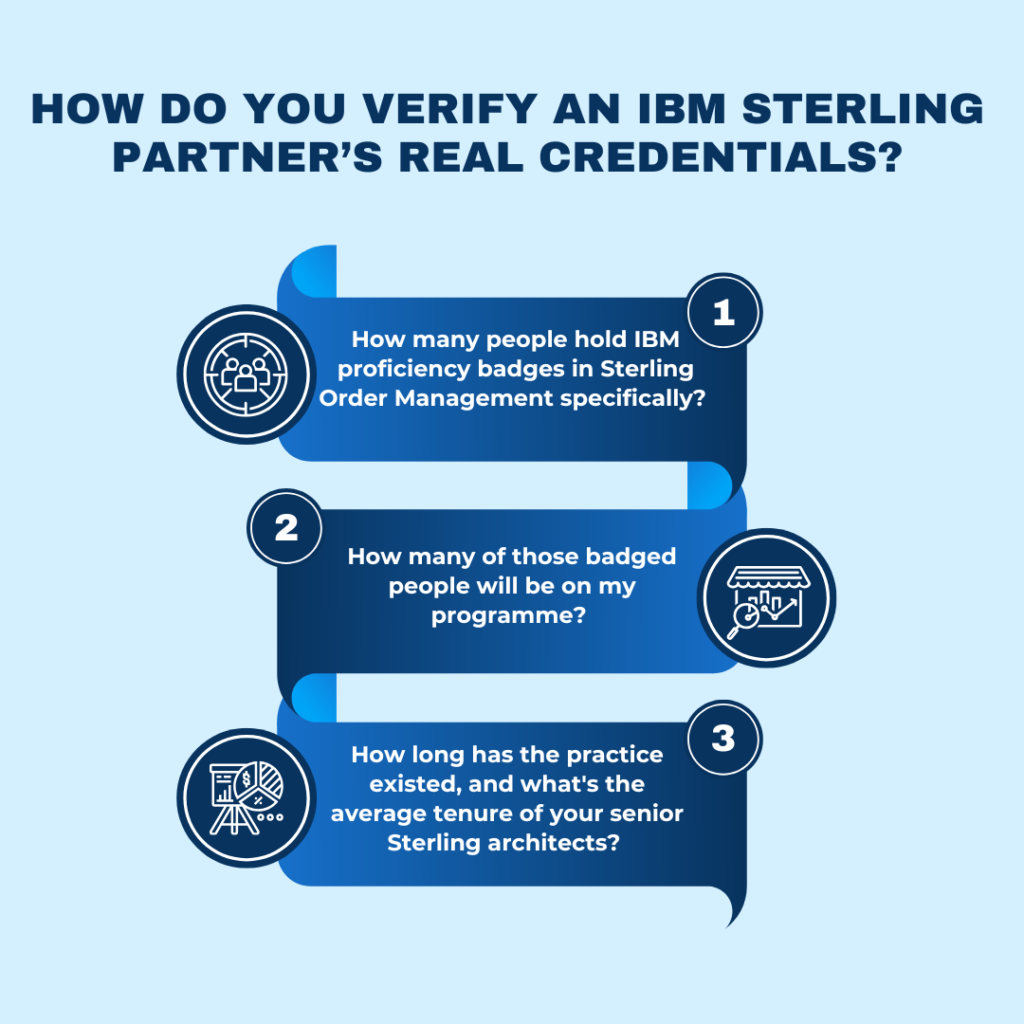
- How many people hold IBM proficiency badges in Sterling Order Management specifically? IBM’s Partner Plus programme progresses partners through Silver, Gold, and Platinum tiers, with badging as the standardised measure of skill and validated solutions as the measure of expertise. Tier tells you about the firm. Badge counts by product area tell you about the bench.
- How many of those badged people will be on my programme? This is the question that changes the tone of the room. A large badge count across a firm means nothing if the Sterling practice is committed elsewhere for the next two quarters.
- How long has the practice existed, and what’s the average tenure of your senior Sterling architects? Continuity of people is continuity of context. A practice built in the last eighteen months has not yet been through a peak season with a client, which is where Sterling judgement is actually formed.
What Should You Ask About Delivery Experience?
Move past whether they’ve done it and into how it went.
- Show me an outcome with a number attached. Not “improved fulfilment.” Something like: order fulfilment accuracy up 23%, cancellations down 68%, inventory turnover up 14%, and fulfilment cost per order down 9% — the results one major omni-channel retailer saw over a ten-week phased rollout of a dynamic inventory allocation engine. If a partner can’t produce numbers in that form, ask why not. Sometimes the honest answer is that the client won’t allow disclosure, which is fair. Sometimes there aren’t any.
- Tell me about a programme that went badly and what you changed afterwards. The answer matters less than whether they have one ready. A partner who claims an unbroken record either hasn’t done enough work or isn’t telling you about it.
- What’s your experience with my deployment model — on-premises,OMoC, or hybrid? These are meaningfully different engineering problems. A partner whose Sterling depth is entirely on-premises will be learning cloud environment management on your programme.
- Which of my integrations have you built before? Ask them to go through your actual system landscape, connection by connection. The ones they haven’t touched are your risk register.
How Do You Assess Technical and Architectural Judgement?
This is where the strongest differentiation shows up, and where most evaluations spend the least time.
- What’s your position on customising Sterling versus configuring it? There’s no single correct answer, but there should be a considered one. Heavy customisation buys immediate fit and pays for it at every upgrade. A partner should be able to describe where they draw the line and why.
- How do you handle environment management and release cadence? Ask for target numbers on deployment time and downtime. As a reference point, one large Indian fashion retailer running 3,000+ stores and 40 warehouses moved from 40-minute deployments to 10, and from 30 minutes of downtime to 5, on a containerised auto-scalable architecture holding 99.99% uptime.
- When does quality engineering start? If the answer is “before UAT,” keep asking. On a system carrying live revenue, performance and test automation should run alongside the build, not queue behind it.
- How would you approach agentic AI on my order profile? IBM made the Sterling OMS Agentic Toolkit Add-On generally available on 6 March 2026, covering agents for order information, cancellations, coupon enforcement, and inventory segmentation. A good partner will tell you which of those are worth activating for you and which aren’t — and won’t recommend all of them.
What Should You Ask About Commercials and Continuity?
- Which engagement model are you proposing, and why that one for this programme? Time-and-materials, fixed-scope, and outcome-linked models allocate risk very differently, and the right choicedepends on how well-defined your requirements are.
- What happens on day one after go-live? Ask specifically: same team, different team, or handover to us? All three can work. Only one of them is usually what the client assumed. If application managed services are part of the answer, ask when the transition planning starts — the good answer is “during the build.”
- Can I speak to a client who is two years past go-live? Recent references tell you about mobilisation. Older references tell you about durability, which is the thing you’re actually buying.
What Are the Red Flags in an IBM Sterling Partner Evaluation?
Three that reliably predict difficulty.
No environment strategy. If a partner can’t describe how many environments you’ll need, how they’ll be provisioned, and how long it takes to refresh one, they haven’t run a Sterling programme at your scale.
No cutover position. Ask when they’d schedule go-live relative to your peak season. A partner who leaves that to you hasn’t internalised that the calendar is a design constraint, not an admin detail.
A pitch team that won’t be on the programme. Named individuals in the proposal, with named individuals in the pitch, or you’re evaluating one team and buying another.
The honest framing: these aren’t mutually exclusive. Plenty of successful Sterling programmes blend all three, IBM for a defined product assessment, a partner for delivery and integration, and your team owning process design and adoption. What matters is that ownership of each layer is explicit before the first sprint, not negotiated during the first escalation.
Getting the Choice of IBM Sterling OMS Implementation Partner Right
Choosing an IBM Sterling OMS implementation partner comes down to three things you can genuinely test in a room: verified skill you can count, outcomes with numbers attached, and clarity about who stays after go-live. Everything else is presentation.
Acuver Consulting is a supply chain consulting firm, specializing in Order Management, Warehouse Management and Software Engineering solutions. Acuver has been an IBM Business Partner since 2013, and we’d rather you ask us all fourteen of these questions than none of them.
Connect with our team of experts to get the right guidance.