Introduction
Nobody budgets an IBM Sterling OMS implementation accurately on the first attempt. Not because finance teams are careless, but because the biggest cost drivers sit in places the initial estimate rarely looks, the eleventh integration nobody documented, the item master with twelve years of accumulated inconsistency, the extra environment you need once parallel workstreams start.
The numbers on this are stark. McKinsey’s research with the University of Oxford across more than 5,400 IT projects found large IT projects run 45% over budget on average, with one in six becoming a “black swan” — an overrun of more than 200%. These aren’t projects that were badly intentioned. They’re projects where the cost model didn’t match the shape of the work.
This blog covers what actually drives IBM Sterling OMS implementation cost, how the three engagement models allocate risk between you and your partner, and where the money quietly leaks. It doesn’t quote a headline price, because any figure honest enough to be useful would have to be a range wide enough to be useless.
What Actually Drives IBM Sterling OMS Implementation Cost?
Six variables explain most of the difference between two programmes that look identical on paper.
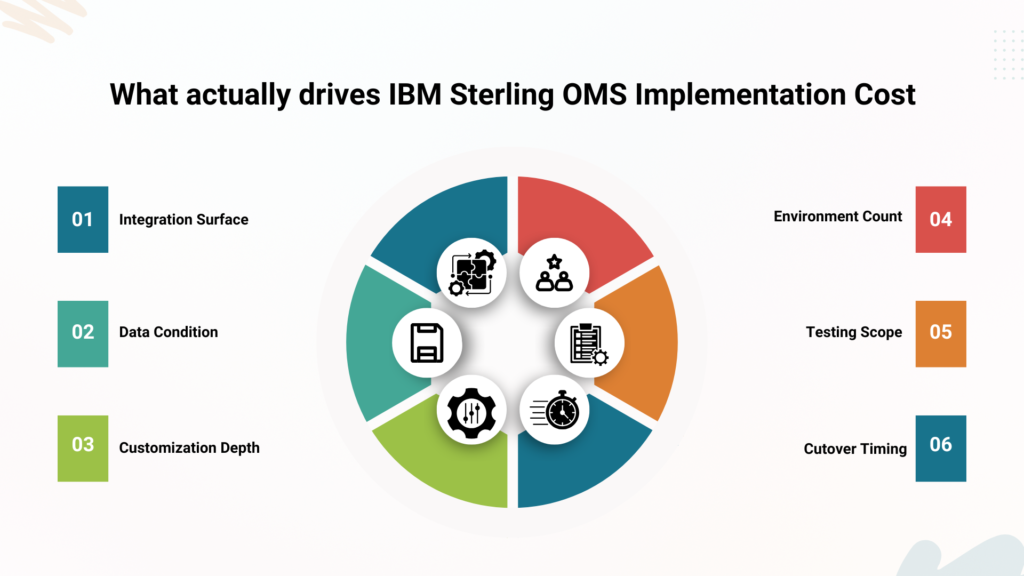
- Integration Surface
Every connected system is a contract to be designed, built, tested, and maintained — commerce platform, ERP, WMS, marketplaces, payments, tax, carriers, returns. Cost scales with the number of integrations and, more sharply, with how many of them are bespoke rather than standard. This is consistently the largest line item and the most under-scoped.
- Data Condition
Item master, inventory, customer, and historical order data all have to move, and they have to arrive clean enough to trust. A well-governed data estate is a manageable workstream. A neglected one becomes its own project. Nobody discovers this during estimation; everybody discovers it during migration.
- CustomizationDepth
Configuring Sterling is cheap relative to extending it. Custom pipelines, custom user exits, and custom UI carry a cost twice — once to build, and again at every upgrade. A modular approach to order management that isolates what genuinely needs to be bespoke from what can be configured tends to keep the second cost down.
- Environment Count
Development, test, performance, UAT, staging, production. Each one has provisioning, refresh, and management cost. Teams routinely budget for four and end up needing six once parallel workstreams start colliding.
- Testing Scope
Functional testing is assumed. Performance and peak-load testing frequently aren’t, and then get added under time pressure at the worst possible rate. On revenue-carrying systems, quality engineering belongs in the original budget.
- Cutover Timing
A go-live scheduled near your peak trading period costs more, because it requires deeper rollback planning, more rehearsal, and heavier hyper-care cover. Timing is a budget decision disguised as a calendar decision.
Which Engagement Model Should You Choose?
Three models dominate Sterling programmes, and the choice is fundamentally about who carries the risk of the unknown.
| Time-and-Materials | Fixed-Scope | Outcome-Linked | |
|---|---|---|---|
|
Risk sits with |
You |
Your partner |
Shared |
|
Best when |
Requirements are still forming; discovery-heavy work |
Scope is genuinely well-defined and stable |
A measurable business metric is the real goal |
|
Cost predictability |
Low, but transparent |
High, with a risk premium priced in |
Moderate |
|
Change handling |
Absorbed naturally |
Change requests, which create friction |
Negotiated against the outcome |
|
Common failure mode |
Scope creeps quietly, nobody stops it |
Partner protects margin; you get the letter of the scope |
Metric is ambiguous and becomes disputed |
|
Watch for |
No burn-rate reporting cadence |
Discovery skipped to fix the price early |
Attribution — can the metric be isolated? |
The pattern we see work most often is a blend. Discovery and design run on time-and-materials, because pricing a phase whose entire purpose is to reduce uncertainty is self-defeating. Build and integration move to fixed-scope once the design is signed. Managed services run on a separate, longer commercial footing.
A word on fixed-price: it feels like the safe option and often isn’t. A fixed price agreed before discovery is a guess wearing a suit. Either your partner has padded it, in which case you’ve paid the premium, or they haven’t, in which case you’ll spend the programme negotiating change requests instead of building software.
Why Do IBM Sterling OMS Implementations Go Over Budget?
Three causes, in rough order of frequency.
Requirements never reached consensus. McKinsey’s work on supply chain IT modernization found 45% of executives named lack of agreement on technical and process requirements as the single biggest barrier to launching a project. Unresolved disagreement doesn’t disappear at kickoff — it reappears as rework in build.
The programme ran too long. The same McKinsey research found that every additional year on a project increases cost overruns by 15%. Long programmes aren’t just late; they’re structurally more expensive. Phasing isn’t a delivery preference; it’s a cost control.
Integrations were counted, not scoped. A list of twelve integrations tells you nothing about effort until each one has a data contract, an error-handling design, and a test approach. Counting is not scoping.
How Should You Build the Business Case?
Put the return in the same document as the cost, or the cost will be evaluated alone and will always look large.
The market context supports the investment case. Fortune Business Insights projects the multichannel order management market to reach $11.34 billion by 2034, growing at 12.2% CAGR from $4.52 billion in 2026, with cloud holding roughly 72% of the market in 2026 — this is a category enterprises are investing into, not out of.
Planning for IBM Sterling OMS Implementation Cost With Confidence
Three things carry forward. IBM Sterling OMS implementation cost is driven by integration surface and data condition far more than by licensing. Duration is itself a cost, at roughly 15% additional overrun per extra year, which makes phasing a financial decision. And the engagement model should follow how well-defined your requirements really are, not which one feels safest in a procurement meeting.
Acuver Consulting is a supply chain firm, specializing in Order Management, Warehouse Management and Software Engineering solutions. Acuver has delivered enterprise implementation services as an IBM Business Partner since 2013. If you’re still at the selection stage, our guide to choosing an IBM Sterling OMS implementation partner covers what to ask. if you’ve chosen and want to understand the delivery sequence, the phase-by-phase roadmap is the next stop.
Connect with our team of experts to get an in-depth understanding of the cost and expenses involved during implementation.