The first edition of the blog outlined how unregulated AI creates ethical, legal, and reputational risks for organizations and how strong AI governance provides the structure needed to build safe, accountable, and trustworthy systems. With the growing adoption of AI, many companies still lack proper safeguards—putting their business at risk. The first edition also covered some of the ways to fix these risks and ensure governance. This edition of the blog touches upon the essential components of effective AI governance, from fairness and transparency to privacy protection and clear accountability.
Balancing Transparency with Data Privacy
The pursuit of transparent AI creates inherent tensions with both data privacy and intellectual property concerns. Excessive transparency might expose sensitive personal data or proprietary algorithms to potential misuse. Yet insufficient transparency undermines trust and accountability.
Primarily, organizations must determine what information to disclose and to whom. Higher-stakes AI applications (like mortgage evaluations) generally require more comprehensive disclosure than lower-stakes uses (like audio classification). This risk-based approach aligns with emerging regulations like the EU AI Act, which imposes specific transparency requirements based on an AI system’s risk classification.
Effective AI governance frameworks must therefore establish appropriate transparency thresholds that satisfy stakeholder needs while safeguarding sensitive information. This nuanced approach creates AI systems that remain both accountable and secure.
Accountability Structures for AI Failures
Effective accountability mechanisms form the foundation of trustworthy AI systems, especially as these technologies grow increasingly complex. When AI systems fail or cause harm, clear lines of responsibility become essential for both rectification and prevention of future incidents.
Defining Ownership Across the AI Lifecycle
Accountability in AI systems requires a comprehensive understanding of the shared responsibility model. According to Microsoft, AI accountability spans three distinct layers: the AI platform layer, the AI application layer, and the AI usage layer. Each layer involves different actors with specific responsibilities:
- Developers create the underlying models and systems, bearing responsibility for design choices, training data quality, and fundamental safety systems
- Deployers determine how AI systems are implemented, assuming accountability for proper usage, monitoring, and alignment with business objectives
- Integrators serve as intermediaries who customize or fine-tune existing models, taking on proportional responsibility based on their specific contributions
This distribution of accountability must remain dynamic throughout the AI lifecycle. As IBM notes, organizations should establish a governance strategy encompassing frameworks, policies, and processes that guide responsible AI development and usage. Additionally, appointing specialized roles like AI Risk Officers helps centralize accountability functions—though some organizations integrate these responsibilities into existing roles like Data Privacy Officers.
Incident Response Protocols for AI Misuse
Formalized incident response frameworks specifically designed for AI systems have become increasingly vital. The Coalition for Secure AI has developed comprehensive playbooks addressing unique AI threats, including training data poisoning, prompt injection attacks, and cloud credential abuse through AI vulnerabilities.
Effective AI incident response protocols fundamentally differ from traditional cybersecurity approaches in several ways:
- They must address novel attack vectors specific to AI systems, such as prompt injection and memory poisoning
- They require specialized monitoring of AI-specific telemetry, including prompt logs, model inference activity, and memory state changes
- They need unique containment strategies like rolling back to previous model versions or purging poisoned memory
NIST’s AI Risk Management Framework offers structured guidance for establishing incident response capabilities, organizing them around four essential functions: govern, map, measure, and manage. Georgetown University researchers advocate for a standardized approach to AI incident reporting that captures incident type, harm severity, technical data, and affected entities.
Ultimately, accountability structures should foster what the Government Accountability Office calls “trustworthy AI”—systems that align with principles of transparency, fairness, security, and explainability while remaining accountable for outcomes.
Privacy and Security Safeguards in AI Systems
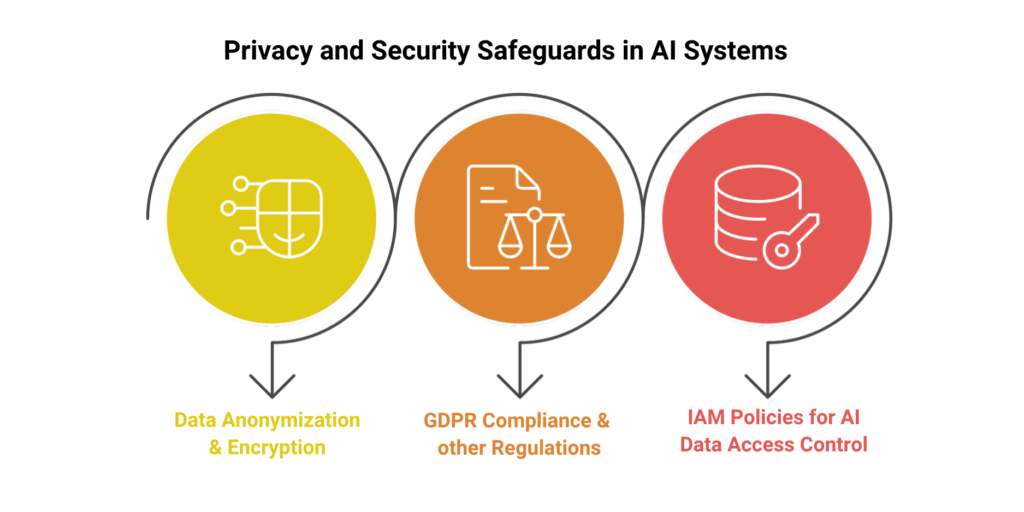
Privacy safeguards represent essential components of any robust AI governance framework. As artificial intelligence systems increasingly process vast quantities of personal data, implementing technical protections becomes vital for maintaining both security and regulatory compliance.
Data Anonymization and Encryption Standards
Strong data protection begins with proper anonymization techniques. For AI systems, several critical approaches include k-anonymity (making individuals indistinguishable from at least k-1 others), l-diversity (ensuring sensitive attributes have diverse values within anonymized groups), and t-closeness (requiring attribute distributions to match overall dataset distribution). Even with these methods, studies have shown that neural networks can still identify up to 14.7% of users from anonymized data within just one week.
Compliance with GDPR and Other Regulations
Under GDPR, AI applications must adhere to core principles, including purpose limitation and data minimization. Purpose limitation allows data reuse only when compatible with original collection purposes, whereas statistical processing is generally permitted given appropriate safeguards.
Subsequently, newer regulations like the EU AI Act establish stricter governance requirements. The Act explicitly prohibits certain AI applications that could threaten citizens’ fundamental rights, including systems exploiting vulnerabilities or performing social scoring.
IAM Policies for AI Data Access Control
Identity and Access Management (IAM) policies establish critical control mechanisms for AI systems. Effective policies implement zero trust principles through resource-based policies, permissions boundaries, and service control policies.
Given that proper authorization requires both identity-based and resource-based controls, organizations should leverage frameworks like role-based access control alongside technical measures such as Private Services Connect and VPC Service Controls. These technologies establish secure perimeters around AI resources while preventing unauthorized network access.
Governance Mechanisms for Ethical AI Deployment
Implementing practical governance mechanisms serves as the capstone of an effective AI ethics strategy. Organizations increasingly recognize that structured oversight bodies are essential for translating ethical principles into actionable policies.
Establishing AI Ethics Boards or Councils
Initially, companies must determine the optimal structure for their ethics board—whether internal (composed of employees) or external (separate legal entities with contractual relationships). External boards typically offer greater independence plus the ability to legally bind the company through contractual arrangements. Alternatively, internal boards provide better understanding of company culture alongside easier access to information. The formation process typically begins with either direct appointment by the company’s board of directors or through a dedicated formation committee.
Continuous Monitoring and Policy Updates
Real-time monitoring represents a fundamental practice for maintaining AI system integrity. Unlike one-time evaluations, continuous monitoring tracks model drift, detects anomalies as they emerge, and enables immediate corrective action. This approach addresses fluctuating AI behavior through automated detection systems that evaluate inputs, outputs, and performance metrics. Presently, organizations implement continuous monitoring across multiple dimensions, including model performance, resource usage, data validation, API operations, and cost metrics.
Assigning Roles for Oversight and Enforcement
In addition to establishing monitoring systems, organizations must clearly define accountability across technical leadership, legal experts, and operational teams. Effective governance requires both specialized AI ethics expertise alongside diverse perspectives representing various stakeholder groups. The governance structure should incorporate decision-making authorities with clearly defined voting procedures, meeting frequencies, and documentation practices.
Conclusion
AI governance frameworks stand as essential safeguards for organizations deploying artificial intelligence across their operations. Throughout this article, we explored multiple dimensions of responsible AI implementation, from fairness criteria to accountability structures. Effective governance not only mitigates ethical risks but also delivers tangible business value through enhanced trust, reduced liability, and improved stakeholder confidence.
The distinction between ethical AI principles and responsible AI implementation emerges as particularly significant. While ethical AI provides aspirational guidelines, responsible AI transforms these ideals into actionable frameworks with concrete safeguards. This practical approach allows enterprises to balance innovation with appropriate risk management.
Fairness assessment must examine protected attributes and evaluate performance across different demographic groups, as demonstrated by the COMPAS case study. Similarly, transparency mechanisms enable stakeholders to understand AI decision pathways without compromising intellectual property or data privacy. Accountability structures further strengthen governance by clearly defining ownership throughout the AI lifecycle and establishing incident response protocols for when systems fail.
Privacy safeguards, compliance mechanisms, and proper access controls serve as technical foundations for trustworthy AI. These elements work together with formal oversight bodies, continuous monitoring systems, and clearly assigned governance roles to create comprehensive protection frameworks.
AI governance represents not merely a defensive measure but a strategic asset that supports sustainable innovation and responsible growth. Acuver helps organizations establish robust AI governance that positions them advantageously for the future. This structured approach enables them to navigate complex ethical considerations while maintaining regulatory compliance and preserving stakeholder trust.
Get in touch with our team of experts for any queries.