Supply chains run on data, and data moves between systems through APIs.
Your Order Management System talks to your Warehouse Management System via APIs. Your WMS talks to your Transportation Management System via APIs. Your suppliers, carriers, payment gateways, and customer-facing channels are all connected through APIs.
When those APIs work, your supply chain hums. When they don’t, orders get lost, inventory goes out of sync, shipments miss their windows, and customers notice.
API testing is the discipline that keeps this from happening. However, in supply chain architecture specifically, it’s one of the most underinvested areas in the entire quality engineering stack.
This blog explains what API testing means for supply chain systems, why it’s critical, and how to do it well.
What Is API Testing?
An API (Application Programming Interface) is the mechanism by which two software systems exchange data. When your OMS sends an order to your WMS, it’s making an API call. The WMS receives the data, processes it, and sends a response back.
API testing validates that this exchange works correctly, every time, under any condition.
Unlike UI testing, which simulates user interactions on a screen, API testing operates at the system-to-system level. It verifies:
- Functional correctness — Does the API return the right data for a given input?
- Data integrity — Is the data structure accurate, complete, and properly formatted?
- Error handling — Does the API respond correctly when it receives invalid input or encounters an error?
- Performance — Does the API respond within acceptable time limits under normal and peak load?
- Security — Is the API protected against unauthorized access and malicious inputs?
In supply chain architecture, these aren’t abstract concerns. They map directly to real operational outcomes.
Why API Testing Is Especially Critical in Supply Chain
Supply chain systems are uniquely complex from a testing perspective. Here’s why:
High transaction volumes
Enterprise supply chains process thousands, sometimes millions of API calls per day. An API that works under low load may fail under production conditions. Performance testing is not optional.
Multi-system dependencies
Supply chain systems do not operate alone. An OMS depends on inventory data from the WMS. The WMS depends on order data from the OMS. The TMS depends on both. When any API in this chain behaves unexpectedly, the downstream effects can be severe.
Real-world consequences of failure
A failed API call in a supply chain context doesn’t just generate an error log. It can mean:
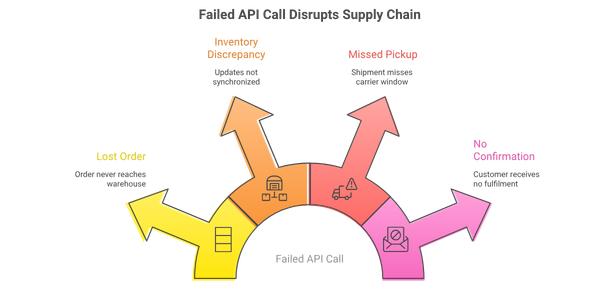
- An order that never reaches the warehouse
- Inventory that’s updated in one system but not another
- A shipment that misses its carrier pickup window
- A customer who receives no fulfilment confirmation
These are not technical failures in isolation. They are customer experience failures with direct revenue impact.
Regulatory and compliance requirements
In pharmaceuticals, automotive, and food supply chains, data accuracy is a regulatory requirement, not just a quality goal. API testing that validates data integrity is a compliance necessity.
Key Types of API Tests for Supply Chain Systems
A robust API testing framework for supply chain architecture includes several layers of testing.
Functional Testing
The baseline. Does the API do what it’s supposed to do?
- Send a valid order payload → Does the WMS accept it and return a confirmation?
- Request inventory for a SKU → Does the OMS receive accurate stock levels?
- Submit a shipment request → Does the TMS respond with a valid tracking reference?
Every API endpoint, for every system in your architecture, needs functional test coverage.
Data Validation Testing
Supply chain APIs carry structured data, product codes, quantities, addresses, dates, weights, prices. Any discrepancy in this data can cause downstream failures.
Data validation testing checks:
- Field Completeness — Are all required fields present in the payload?
- Data types — Is a quantity field returning a number, not a string?
- Value ranges — Is a weight value realistic, or has something gone wrong upstream?
- Format consistency — Are dates in the expected format? Are SKU codes in the right structure?
This type of testing catches data quality issues before they reach operational systems.
Integration Testing
Integration testing validates that two systems work together correctly — not just that each system works in isolation.
In supply chain contexts, this means testing end-to-end flows:
- Order placed in e-commerce platform → OMS → WMS → pick confirmation → TMS → tracking update
- Supplier sends ASN (Advance Shipping Notice) → WMS receives it → inventory updated → OMS reflects new availability
These flows involve multiple API calls across multiple systems. Integration testing validates the full journey, not just individual hops.
Performance and Load Testing
Under normal conditions, an API might respond in 200 milliseconds. Under peak load, a promotional event, a holiday season, a flash sale, and response times can degrade significantly.
Performance testing validates:
- Response time under load – Does the API stay within SLA thresholds at peak volume?
- Throughput – How many API calls per second can each system handle?
- Degradation behaviour – Does performance degrade gracefully, or does the system fall over suddenly?
For supply chain systems where, peak periods are predictable (Black Friday, end-of-quarter fulfilment pushes), load testing before those events is non-negotiable.
Error Handling and Edge Case Testing
What happens when an API receives unexpected input? Does it fail gracefully, or does it behave unpredictably?
Edge case testing includes:
- Sending malformed payloads – Does the API return a clear error, or does it crash?
- Testing null and empty fields – How does the system handle missing data?
- Testing boundary values – What happens when a quantity is zero, or negative, or exceeds the maximum?
- Simulating system downtime – If a downstream system is unavailable, does the API queue the request or lose it?
Edge cases in supply chain systems are not rare. They happen every day at scale.
Security Testing
Supply chain APIs carry sensitive data, customer information, pricing, supplier details, inventory positions. Security testing validates that this data is properly protected.
Key checks include:
- Authentication – Are API endpoints properly secured? Can unauthorised callers access them?
- Authorization – Can a caller access data they shouldn’t be able to?
- Input sanitization – Is the API vulnerable to injection attacks or data manipulation?
- Encryption – Is data in transit properly encrypted?
Security vulnerabilities in supply chain APIs can expose customer data, reveal competitive intelligence, or enable fraud.
Building a Supply Chain API Testing Framework
A mature API testing framework for supply chain architecture has several components.
Test environment management. You need environments that mirror production with realistic data, representative system configurations, and proper integration setups. Testing against a staging environment that doesn’t reflect production conditions produces unreliable results.
Test data management. Supply chain APIs depend on data that changes, inventory levels, order statuses, and carrier availability. Good test data management ensures that test scenarios use consistent, controlled data, so results are reproducible.
Automated test execution. Manual API testing doesn’t scale. Automated test suites that run on every code deployment catch regressions before they reach production. CI/CD pipeline integration is the standard for mature supply chain engineering teams.
Monitoring and observability. Testing before go-live is necessary but not sufficient. Production API monitoring catches issues that only emerge under real-world conditions, performance degradation, unexpected error rates, and data anomalies.
Test coverage reporting. Knowing which APIs are tested and which are not essential. Coverage reporting identifies gaps and helps teams prioritize testing investment.
Common API Testing Mistakes in Supply Chain
Even experienced teams make these mistakes:
- Testing only the happy path. If your tests only validate what happens when everything goes right, you’ll be surprised when things go wrong in production.
- Ignoring performance until go-live. Performance issues discovered in production are far more expensive to fix than those caught in testing.
- Insufficient integration of test coverage. System-level tests without end-to-end integration tests leave large gaps in quality assurance.
- Poor test data hygiene. Tests that depend on specific data states that aren’t consistently maintained produce unreliable results.
- Not testing error responses. If an upstream system sends a bad request, your API’s error response is as important as its success response.
How Acuver's Quality Engineering Practice Supports API Testing
Acuver Consulting’s Quality Engineering practice is purpose-built for the complexity of supply chain systems. It’s not a generic testing service; it’s a team that understands the architecture, the integrations, and the operational stakes involved.
Here’s what Acuver brings to API testing in supply chain environments:
- End-to-end API test design – Acuver’s QE team designs comprehensive test suites that cover functional, integration, performance, data validation, and security testing across the full supply chain architecture
- Automated testing frameworks – Acuver builds automated test suites that run on demand and integrate into deployment pipelines, enabling continuous quality assurance without slowing down delivery
- Peak load simulation – Acuver conducts realistic load tests calibrated to expected peak volumes, ensuring that APIs and integrations hold up when it matters most
- Integration testing across systems – With deep expertise in OMS, WMS, TMS, and ERP integrations, Acuver designs and executes integration tests that validate real-world data flows across the entire supply chain technology stack
API quality is not something you can bolt on at the end of a supply chain implementation. It has to be engineered from the start.
If you’re building, upgrading, or scaling a supply chain technology architecture, Acuver’s Quality Engineering team can help you get it right. Get in touch with our team to learn more.