The e-commerce landscape presents formidable challenges for businesses seeking customer loyalty. Over 1.07 million retail establishments compete alongside 13.98 million ecommerce sites in the United States alone. Amazon controls 37.6% of the market while customers demand delivery within 24 hours. These conditions create intense pressure on fulfillment operations.
Distributed Order Management systems address these challenges by optimizing fulfillment for both speed and cost. DOM technology enables businesses to meet demanding customer expectations while maintaining operational efficiency across multiple locations and channels.
What is distributed order management? This blog examines how retail distributed order management systems operate, the essential features that make these systems effective, and the selection criteria for successful implementation. Read on to discover how DOM systems can optimize your e-commerce fulfillment operations within today’s competitive environment.
Understanding Retail Distributed Order Management Systems
Distributed Order Management software orchestrates order fulfillment across multiple channels, inventory locations, and fulfillment methods through rule-based logic and automation. The system applies mixed integer programming (MIP) and predictive analysis models to perform optimizations at both batch and individual order levels. DOM ensures products reach customers in correct quantities, from optimal sources, at the right times while maximizing profits and minimizing costs.
This technology differs fundamentally from traditional order management systems built for single-warehouse operations. Legacy systems operate in silos, connecting single channels to single inventory sources. DOM provides real-time visibility across warehouses, retail stores, dropshippers, and third-party logistics providers. This network-wide perspective allows the system to balance conflicting fulfillment needs using defined rules as constraints.
How does DOM optimization work? Businesses can define multiple profiles for running different optimization strategies depending on business type or consumer segment. When orders arrive, the system evaluates several factors: distance between fulfillment sources and shipping destinations, cost factors defined as optimization objectives, and rules such as inventory availability at fulfillment nodes.
DOM automatically determines the best fulfillment path through this evaluation process. The system might split orders across locations, merge shipments, or route through the nearest distribution center to meet service-level requirements while controlling costs. This automated decision-making replaces manual routing processes that often fail to account for dynamic inventory and capacity changes across the fulfillment network.
Essential Features and Capabilities of DOM Systems
Core capabilities separate effective distributed order management systems from basic order processing software. The key capabilities are as follows:
Intelligent order routing: It forms the foundation, using sophisticated algorithms to evaluate proximity to customers, current inventory availability across locations, shipping costs, labor capacity at fulfillment sites, and special handling requirements. The system calculates optimal shipping paths in real-time rather than relying on manual selection.
Real-time inventory visibility: This provides SKU-level accuracy across warehouses, stores, and distribution centers with live synchronization. This prevents overselling and enables accurate available-to-promise (ATP) calculations that factor in on-hand inventory, confirmed sales orders, and expected goods receipts. Sales teams know which quantities they can allocate and within what timeframes without breaching existing commitments.
Omnichannel fulfillment support: This accommodates buy-online-pickup-in-store (BOPIS), ship-from-store, curbside pickup, and dropshipping arrangements. The platform processes orders from multiple channels while coordinating fulfillment methods based on customer preferences and business rules.
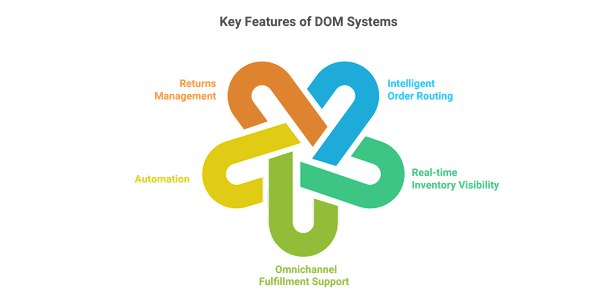
Automation: helps streamline order splitting, allocation, and shipping while reducing manual intervention.
Returns management: This optimizes reverse logistics by routing returns to appropriate locations based on proximity, inventory needs, and processing capacity. Worldwide returns reached USD 1.80 trillion in 2022, with ecommerce return rates hitting 17.6%. The system sends automated updates about shipping and order status, reducing “Where Is My Order?” support calls.
DOM Implementation: Selection Criteria and Best Practices
Successful distributed order management implementation requires clear business objectives from the start. Define whether you’re optimizing for lowest cost, fastest delivery, or balanced capacity utilization across locations. Different order types demand different priorities—rush orders prioritize speed while free shipping orders prioritize cost.
Data Accuracy Foundation
Data cleanup across all relevant areas proves essential before implementation. Poor routing decisions stem from inaccurate inventory, incorrect warehouse addresses, outdated carrier rates, or wrong product dimensions. Establish accurate starting points through these steps:
- Conduct physical inventory counts at all fulfillment locations
- Verify warehouse and store addresses
- Validate carrier rate tables
- Audit product master data including dimensions and weights
Integration Requirements
A well distributed order management system requires proven real-time integration through APIs rather than batch updates. Critical integrations include WMS, store-level systems, and e-commerce platforms like Shopify, Big Commerce, Magento, and Salesforce. Organization can connect different retail systems into their DOM solution to achieve enterprise-wide inventory visibility.
Phased Implementation Strategy
Start with limited order types and fulfillment locations during pilot phases. Run pilot orders through DOM while maintaining legacy routing for non-pilot orders. Monitor routing errors and capacity issues closely before expanding scope progressively. This approach allows you to identify and resolve issues without disrupting your entire fulfillment operation.
Supercharge Your Business with Acuver’s Strategy for a Stronger, More Connected Order Management
Distributed order management represents a fundamental shift from competitive advantage to operational necessity for e-commerce businesses. Customer expectations for Amazon-level service require intelligent orchestration across fulfillment networks to balance speed, cost, and accuracy at multiple locations.
Success depends on three critical factors. Define clear optimization priorities that align with your business objectives—whether emphasizing cost efficiency, delivery speed, or capacity utilization. Establish accurate data foundations before system deployment, since DOM routing decisions rely entirely on reliable inventory counts, warehouse locations, and product specifications. Implement gradually through pilot programs that allow you to identify and resolve issues before expanding across your complete operation.
This is where Acuver can help. With proven expertise in the Supply Chain space, Acuver helps organizations design and implement intelligent distributed order management solutions that enable seamless orchestration across fulfillment centers, warehouses, and retail locations. By integrating key supply chain systems and ensuring accurate, real-time data flow across platforms, Acuver enables businesses to make smarter routing decisions that optimize delivery speed, reduce fulfillment costs, and improve order accuracy.
In addition, Acuver supports businesses throughout the implementation journey—from defining the right DOM strategy and establishing reliable data foundations to deploying scalable solutions across complex fulfillment networks.
Want to explore more solutions? .Connect with our experts now