Both terms get used in supply chain conversations, and sometimes interchangeably. That’s a problem.
Order management and order orchestration are not the same thing. They solve different problems, operate at different levels, and have different implications for how well your business handles orders at scale.
If you’ve been using these terms interchangeably, or if you’re trying to figure out what your business actually needs, this blog will clear things up.
What Is Order Management?
Order Management is the process of capturing, tracking, and fulfilling customer orders. It covers the entire lifecycle of an order from the moment a customer places it to the moment it’s delivered.
A typical Order Management System (OMS) handles:
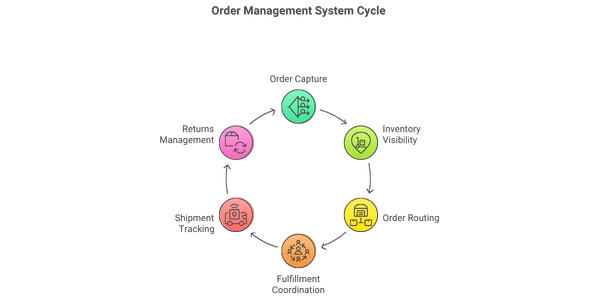
- Order capture — Receiving orders from multiple sales channels (website, store, marketplace, B2B portal)
- Inventory visibility — Showing what stock is available, where, and in what condition
- Order routing — Deciding which warehouse, store, or supplier should fulfil the order
- Fulfilment coordination — Communicating instructions to the warehouse or 3PL
- Shipment tracking — Monitoring orders in transit and providing status updates
- Returns management — Processing exchanges, refunds, and restocks
The OMS is the system of record for orders. It knows what was ordered, by whom, when, and what happened to it.
What Is Order Orchestration?
Order Orchestration sits at a higher level. It’s the intelligent coordination of people, systems, and processes to fulfil an order in the most efficient way possible, especially when things get complicated.
Think of orchestration as the decision-making engine that runs above your operational systems. It asks and answers questions like:
- Which fulfilment node is best positioned to serve this order given current inventory, capacity, and shipping cost?
- If one warehouse is out of stock, should we split the order across two locations or wait for a restock?
- What is the optimal sequence of fulfilment steps given the customer’s delivery promise?
- When an exception occurs — a shipping delay, a pick failure, a payment issue — what should happen next, automatically?
Order orchestration doesn’t just track orders. It actively manages the logic and decisions that determine how orders flow through your operation.
The Key Differences
In short: Order Management tells you the story of an order. Order Orchestration writes the next chapter in real time.
Why the Distinction Matters
Here’s a scenario that illustrates the difference.
A customer places an order for three items. Your OMS captures the order and routes it to a fulfilment centre. But when the warehouse goes to pick the order, one item is out of stock.
With OMS only: The order goes on hold. A warehouse associate or customer service agent has to manually decide what to do. The customer may not hear anything for hours. The resolution depends on whoever picks up the ticket.
With Order Orchestration: The system detects the exception automatically. It checks inventory across all nodes, identifies that another warehouse has the item, and determines whether splitting the shipment is within cost and delivery parameters. If it is, the order is rerouted automatically. If it isn’t, the system triggers a customer notification with updated delivery options, all without human intervention.
This isn’t a hypothetical scenario. It happens thousands of times a day in large retail and logistics operations. The companies handling it well have invested in orchestration, not just management.
When Does Order Orchestration Become Necessary?
Not every business needs sophisticated order orchestration from day one. A small e-commerce brand with a single warehouse and a simple product range can manage perfectly well with a solid OMS.
But orchestration becomes critical when:
- You operate multiple fulfilment nodes — multiple warehouses, stores, 3PLs, or suppliers
- You have complex routing logic — orders need to be allocated based on proximity, cost, carrier preference, or inventory position
- You sell across multiple channels — orders arrive from different sources with different SLAs and fulfilment rules
- Your volumes are high — manual exception handling doesn’t scale; you need automated decision-making
- Customer expectations are demanding — same-day, next-day, and BOPIS (buy online, pick up in store) require precise orchestration to deliver consistently
- You handle frequent exceptions — supply chain disruptions, stockouts, carrier failures, and payment issues need automated responses
For omnichannel retailers and large-scale B2B distributors, orchestration is no longer optional. It’s the difference between meeting customer expectations and consistently falling short.
Do You Need One or Both?
You need both, but they serve different purposes.
Your OMS is the foundation. It captures orders, maintains the record, and coordinates with operational systems. Without a solid OMS, you have no reliable source of truth for order data.
Your orchestration layer sits on top. It uses the data from your OMS and other systems to make intelligent decisions about how orders should flow through your network.
Some modern platforms are beginning to combine these capabilities into unified solutions. But even then, its worth understanding which functionality is doing which job , because the requirements are genuinely different.
An OMS without orchestration is like a GPS with no routing algorithm. It knows where you are. It just can’t tell you the best way to get to where you’re going.
Common Misconceptions
“Our OMS already does orchestration.” Most OMS platforms include basic routing rules. But rule-based routing isn’t the same as dynamic orchestration. When conditions change, inventory levels shift, a carrier fails, a warehouse goes down, static rules break. Orchestration engines adapt.
“Orchestration is only for large enterprises.” Mid-market companies with multiple fulfilment points or complex product ranges benefit significantly from orchestration. The ROI comes from reduced manual intervention, fewer exceptions, and better delivery performance — not just order volume.
“We can build this ourselves.” Custom-built orchestration logic tends to become a maintenance burden. Business rules change, systems get upgraded, and the custom code that handles orchestration quickly becomes technical debt. Purpose-built platforms handle this far more sustainably.
How Acuver Helps With Order Management and Orchestration
Acuver Consulting was built around order management. It’s one of the company’s founding areas of expertise, and it shows in the depth of capability they bring to clients.
Here’s how Acuver supports both order management and orchestration:
- OMS Implementation – Acuver implements leading OMS platforms with configurations tailored to each client’s fulfilment model, channel mix, and business rules. The goal is always a system that’s reliable, flexible, and ready to grow.
- Orchestration Design and Build – Acuver works with clients to design order orchestration logic that reflects real-world complexity: multi-node routing, exception handling, split shipments, and dynamic decision-making across the fulfilment network.
- Integration via Aekyam – Effective orchestration requires deep integration between systems. Acuver’s AI Orchestration platform, Aekyam platform provides the integration backbone that connects OMS, WMS, TMS, ERP, and carrier systems, ensuring that the orchestration engine always has accurate, real-time data to work with.
- Quality Engineering – Acuver’s QE team stress-tests order flows, routing logic, and exception scenarios before go-live. This is especially critical for orchestration, where edge cases can have serious customer-facing consequences.
- Managed Services – Post-implementation, Acuver monitors and optimizes order management and orchestration systems continuously, adjusting business rules, tuning performance, and responding to operational changes.
Acuver has delivered transformation programs for global retailers, logistics companies, and manufacturers. If you’re rethinking how your orders flow, from capture to delivery talk to the team at Acuver.