Introduction
The holiday season presents a critical challenge for businesses relying on Order Management Systems (OMS), as they must handle surges in demand while maintaining efficiency and accuracy. Traditionally, ensuring the reliability of these systems requires rigorous testing, which can be both time-consuming and resource-intensive. However, advancements in automation and artificial intelligence (AI) are transforming this process. By automating test case generation, execution, and analysis combined with AI-driven anomaly detection, businesses can streamline testing, reduce manual effort, and enhance system performance. This not only minimises human strain but also ensures seamless operations during peak periods, ultimately improving customer satisfaction and business outcomes.
Overcoming Operational Silos
To effectively address the problem statement, we are dividing it among the key teams involved: Managed Services, Quality Assurance, and Project Management. While this approach helps facilitate focused discussions and accountability, it is essential to prevent silos that may hinder cross-team collaboration. Ensuring seamless communication and cooperation between these teams is crucial for achieving a unified goal. Rather than working in isolation, all teams must align their efforts to enhance overall project execution and holiday support, ultimately driving efficiency and success.
Managed Services: Keeping Operations Seamless
The Managed Services team plays a crucial role in addressing customer issues promptly, providing clear explanations, outlining resolution steps, and ensuring smooth communication. Their primary responsibilities include:
- Monitoring projects during peak hours to mitigate risks and prevent disruptions.
- Managing multiple tasks simultaneously may lead to human errors, missed details, or miscommunication.
A common challenge faced by this team is maintaining quality while handling increased workloads. The concept that “when quantity increases, quality decreases” is often discussed in historical materialism, where an excessive focus on quantity can result in a qualitative shift—sometimes leading to reduced efficiency. To combat this, businesses must implement automated monitoring systems that detect potential issues early, reducing reliance on manual intervention.
By utilizing technology, businesses can enhance quality control processes, allowing employees to focus on more critical tasks. Automated monitoring systems can provide real-time data and alerts, enabling quick decision-making and problem-solving. Overall, by prioritizing quality over quantity and leveraging technology, businesses can maintain high standards while efficiently managing increased workloads. This can lead to improved productivity, customer satisfaction, and overall success in the long run.
Quality Assurance: Ensuring System Reliability
The Quality Assurance (QA) team is responsible for upholding the integrity of products, code, and workflows, ensuring they meet business requirements. Key responsibilities include:
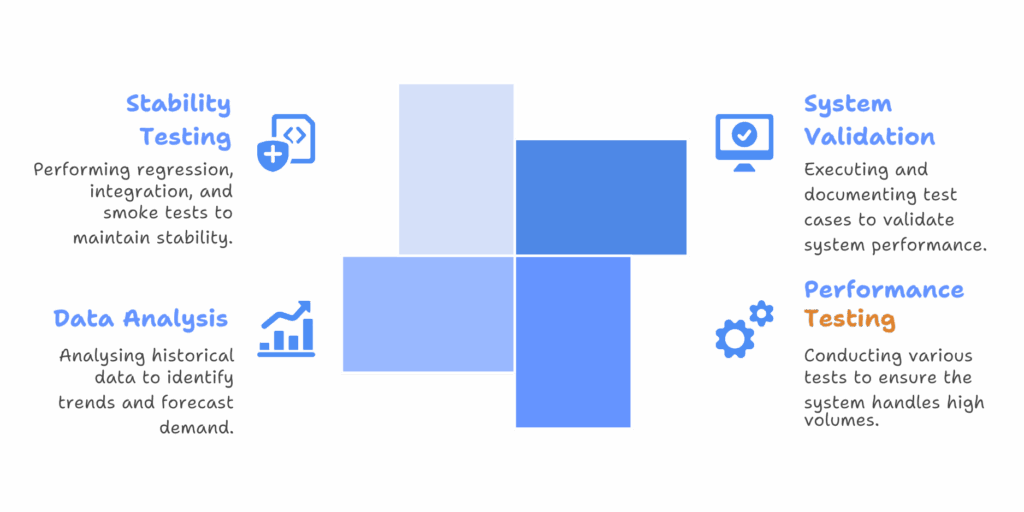
- Test case execution and documentation to validate system performance.
- Conducting performance, load, stress, integration, and acceptance testing to ensure the system can handle high order volumes without slowdowns or failures, especially during peak traffic periods.
- Analysing historical data from past years to identify trends and forecast demand for the current season.
- Performing regression, integration, and smoke testing for any introduced code changes to maintain system stability.
With AI-driven test automation, QA teams can accelerate testing cycles, detect anomalies in real time, and ensure faster issue resolution, ultimately enhancing system resilience during high-demand periods.
By leveraging AI-driven test automation, QA teams can streamline the testing process and improve overall efficiency. This allows for quicker identification of potential issues and prompt resolution before they impact system performance. Additionally, AI technology can provide valuable insights and recommendations for optimizing system performance and enhancing user experience. Overall, incorporating AI-driven testing into the QA process can significantly improve system resilience and ensure smooth operation during high-demand periods.
Project Management: Driving Coordination and Success
The Project Management team serves as the bridge between Managed Services, Quality Assurance, and clients. Their primary responsibilities include:
- Overseeing daily goals, challenges, and progress of both the Managed Services and QA teams.
- Ensuring that accurate and reliable information is shared with clients while preventing misinformation.
- Addressing errors in production that Managed Services may have overlooked, particularly during peak seasons.
- Collaborating with the QA team to ensure smooth releases of new products, features, and server configurations.
By fostering effective communication and coordination, the Project Management team ensures that all departments work towards a common goal, reducing risks and enhancing overall system performance.
The Project Management team also plays a crucial role in identifying potential roadblocks and resolving them swiftly to keep projects on track. They work closely with all teams to streamline processes and implement best practices, ultimately leading to improved efficiency and customer satisfaction. Through their proactive approach and strategic planning, the Project Management team contributes significantly to the success of the organization as a whole. Ultimately leading to improved efficiency and customer satisfaction. Through their proactive approach and strategic planning, the Project Management team contributes significantly to the success of the organization.
Solution: Leveraging AI and Automation for Continuous Monitoring
To address these challenges effectively, businesses can implement AI and automation tools to monitor systems in real-time. These tools can:
- Continuously track system performance, order processing speed, and potential bottlenecks.
- Detect anomalies and send automated alerts to relevant teams before issues escalate.
- Reduce human dependency by automating repetitive tasks such as log analysis, error detection, and system updates.
- Improve predictive analysis by forecasting traffic spikes and recommending proactive measures to prevent disruptions.
With AI-driven monitoring and automation, businesses can significantly reduce human effort and minimize errors, leading to a more efficient, resilient, and reliable Order Management System during peak seasons. In addition, AI and automation can also help businesses analyse data more effectively, identify patterns, and make real time adjustments to optimize operations. By harnessing the power of technology, companies can stay ahead of the competition and deliver superior service to their customers. With AI-driven solutions in place, businesses can not only survive peak seasons but thrive in them, setting themselves up for long-term success and growth. Embracing innovation in order management is not just a trend, but a necessity for businesses looking to stay relevant and competitive in today’s fast-paced market.
Conclusion
As businesses navigate the challenges of peak-season order management, integrating AI and automation can significantly enhance system reliability and efficiency. By streamlining testing, reducing manual effort, and fostering seamless collaboration between Managed Services, QA, and Project Management teams, companies can ensure smooth operations and improved customer experiences. Ultimately, adopting AI-driven testing and detection allows businesses to minimize human strain, enhance system performance, and ensure success during high-demand periods. In addition, AI and automation can also help businesses analyse data more effectively, identify patterns, and make real-time adjustments to optimize operations.
With AI-driven solutions in place, businesses can not only survive peak seasons but thrive in them, setting themselves up for long-term success and growth. Embracing innovation in order management is not just a trend, but a necessity for businesses looking to stay relevant and competitive in today’s fast-paced market.
At Acuver we bring deep domain expertise and innovative solutions to help businesses implement intelligent monitoring, AI-driven testing, and agile support models tailored for high demand seasons. Acuver delivers not just the tools to stay competitive but the strategic edge to lead and grow— during peak seasons and beyond.
Author:
Sunil Kumar | Senior Consultant