Your warehouse works fine today. But what happens when order volumes double next quarter?
This is the question that separates companies that scale smoothly from those that scramble. A scalable warehouse architecture is not just about bigger storage or more staff. It is about designing systems, processes, and technology that grow without breaking.
Let’s break down exactly how companies do it.
Why Warehouse Architecture Matters More Than Ever
Modern warehouses aren’t just storage units. They’re complex operational hubs handling:
- Real-time inventory tracking across multiple locations
- Same-day and next-day fulfillment expectations
- Returns processing alongside outbound orders
- Multi-channel demand from retail, e-commerce, and B2B
When the underlying architecture is weak, every one of these functions suffers under pressure. Errors multiply, cost spike, and ultimately customers notice.
Getting the architecture right from the start, or upgrading it before the cracks show, is one of the most important investments a supply chain leader can make.
The Core Layers of a Scalable Warehouse Architecture
Think of warehouse architecture as a stack. Each layer supports the one above it. If any layer is fragile, the whole structure becomes unreliable at scale.
- Physical Infrastructure
This is the foundation. It includes:
- Layout design — Slotting strategies that minimize travel time and maximize throughput
- Storage systems — Racking, mezzanines, automated storage and retrieval systems (AS/RS)
- Material handling equipment (MHE) — Conveyors, sorters, pick stations
- Dock management — Inbound and outbound dock scheduling to prevent bottlenecks
Scalable physical infrastructure means designing peak capacity, not average capacity. It also means building flexibility into your layout, so you can reconfigure product mix and volumes change.
- Warehouse Management System (WMS)
The WMS is the brain of the operation. It controls:
- Inventory positioning and slotting
- Task management and labor allocation
- Pick, pack, and ship workflows
- Real-time inventory visibility
A scalable WMS is one that can handle volume spikes without degrading performance. It should support configurable business rules, handle multiple warehouses, and integrate with the rest of your technology ecosystem without custom workarounds.
Cloud-native WMS platforms are increasingly preferred here. They eliminate the hardware constraints of on-premises systems and allow companies to scale compute capacity up or down based on demand.
- Integration Layer
No warehouse system lives in isolation. A scalable architecture requires clean, reliable integration with:
- ERP systems for financial and inventory data
- Order Management Systems (OMS) for order routing and fulfillment logic
- Transportation Management Systems (TMS) for carrier selection and shipment tracking
- Supplier and vendor portals for inbound coordination
Poor integration is one of the most common reasons warehouse architectures fail at scale. Data silos, delayed syncs, and brittle point-to-point connections create errors that cascade across the operation.
The best architectures use a middleware or integration platform that acts as a single, reliable data highway, eliminating direct dependencies between systems and making upgrades far easier.
- Data and Analytics Layer
You can’t scale what you can’t see. Scalable warehouses are built on real-time data flows and actionable analytics.
This layer includes:
- Operational dashboards — Real-time visibility into throughput, labor productivity, and order status
- Inventory analytics — Demand forecasting, dead stock identification, and reorder triggers
- Exception management — Automated alerts when something goes wrong before it becomes a crisis
- Historical reporting — Trend analysis to inform capacity planning and process improvement
Companies that invest in this layer find they can anticipate problems rather than react to them.
- Automation Layer
Automation does not replace people; it lets people focus on higher-value work. Scalable architectures identify where automation delivers the most impact:
- Goods-to-person systems bring inventory to the picker, dramatically increasing pick rates
- Automated label printing and packing reduce errors and increase throughput
- Robotics and AMRs (autonomous mobile robots) support flexible, scalable picking operations
- Voice and scan technologies improve accuracy and speed on the warehouse floor
The key is to automate processes that are repetitive, high-volume, and prone to human error, not to automate for its own sake.
Key Design Principles for Scalability
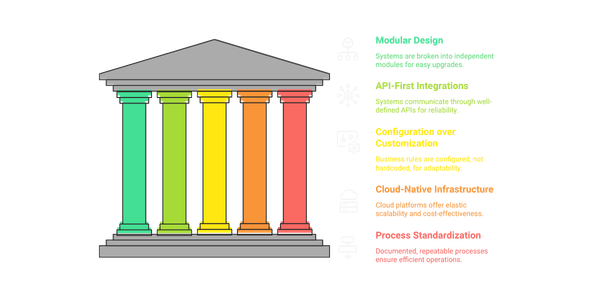
Companies that build warehouse architectures that scale well tend to follow a set of common principles.
Modular design. Systems and processes are broken into independent modules. This means you can upgrade or replace one component without rebuilding the entire operation.
API-first integrations. Every system communicates through well-defined APIs. This makes integrations reliable, testable, and easy to extend as new systems are added.
Configuration over customization. The best WMS platforms allow business rules to be configured, not hardcoded. This makes it far easier to adapt to changing requirements without expensive development work.
Cloud-native infrastructure. Cloud platforms offer elastic scalability, automatic failover, and lower total cost of ownership compared to on-premises alternatives. For warehouses experiencing seasonal peaks, this is particularly valuable.
Process standardization. Scalable operations run on documented, repeatable processes. Ad-hoc workflows don’t scale. Standard operating procedures do.
Common Pitfalls to Avoid
Even well-intentioned warehouse architecture projects go wrong. Here’s what to watch out for:
- Designing for today, not tomorrow. A system that handles current volumes perfectly may buckle at 3x volume. Always design with future growth in mind.
- Under-investing integration. A best-in-class WMS connected to other systems with brittle; custom-built integrations will create operational problems at scale.
- Ignoring change management. New architecture only delivers value if your teams use it correctly. Training and adoption are as important as technology itself.
- Treating automation as a silver bullet. Automating a broken process just makes it break faster. Fix the process first, then automate it.
What Does a Scalable Architecture Look Like in Practice?
Here’s a simplified picture of how a mature scalable warehouse architecture comes together:
- A cloud-native WMS manages all warehouse operations and is connected via APIs to the broader ecosystem
- An integration platform routes data reliably between the WMS, OMS, ERP, and TMS, with full visibility and error handling
- Automation handles high-volume, repetitive tasks like picking, packing, and labelling
- Real-time dashboards give operations managers visibility into every key metric
- A flexible physical layout supports multiple product types and can be reconfigured without major disruption
This isn’t a one-time project. It’s an architecture that evolves continuously as the business grows.
How Acuver Helps Companies Build Scalable Warehouse Architecture
At Acuver Consulting, warehouse scalability is a core area of expertise. Acuver works with enterprise clients across retail, manufacturing, pharmaceuticals, and logistics to design, implement, and optimize warehouse management architectures that can grow with the business.
Here’s what Acuver brings to the table:
- WMS Implementation — Acuver has deep experience implementing leading WMS platforms, ensuring they are configured for performance, flexibility, and long-term scalability
- Integration Excellence — Acuver’s integration capabilities, powered by their enterprise orchestration platform Aekyam, ensure that your WMS connects seamlessly with ERP, OMS, TMS, and other systems, with zero data loss and full reliability
- Quality Engineering — Acuver’s quality engineering practice ensures that warehouse systems are thoroughly tested under real-world and peak-load conditions before go-live
- Managed Services — Post-implementation, Acuver provides ongoing managed services to keep warehouse systems optimized, up-to-date, and aligned with evolving business needs
- Bespoke Development — Where standard platforms fall short, Acuver’s software engineering team builds custom solutions tailored to unique operational requirements
With over a decade of supply chain expertise and a track record of working with global enterprises, Acuver is a partner that understands both the technical and business dimensions of scalable warehouse architecture.
Ready to build a warehouse architecture that grows with your business? Connect with our team to start the conversation.