Introduction
Every OMS modernization project eventually runs into the same wall: a budget conversation with someone who wasn’t in the room for the peak-season outage, the failed integration, or the vendor end-of-support notice that started this whole process. To them, modernization is a cost center competing with every other capital request on the list. Your job is to make it obviously not that.
This is part of our complete guide to Order Management System Modernization. For help choosing which modernization path and architecture to budget for in the first place, see Modernize, Replatform, or Replace? and Cloud-Native vs. Hybrid vs. On-Premise.
The good news is the numbers are genuinely on your side. This blog walks through how to build a total cost of ownership model that doesn’t get blindsided by hidden costs, how to frame ROI in terms your leadership already tracks, and how to avoid the budgeting mistakes that turn a strong business case into a stalled one.
What Are the Three OMS Deployment Architectures?
Beyond the License: What’s Actually in TCO?
Total cost of ownership for OMS modernization goes well beyond the platform license or subscription fee. A complete model accounts for infrastructure and hosting costs, integration and API development work, data migration and cleansing, testing and quality assurance, staff training, and the ongoing cost of managed services or in-house support once the system is live. Teams that budget only for the license and implementation labor are the ones who get blindsided six months in.
Where Do OMS Modernization Budgets Actually Overrun?
The two most common sources of budget overrun aren’t the platform license, they’re data migration complexity and customization rework, and both tend to surface later than teams expect:
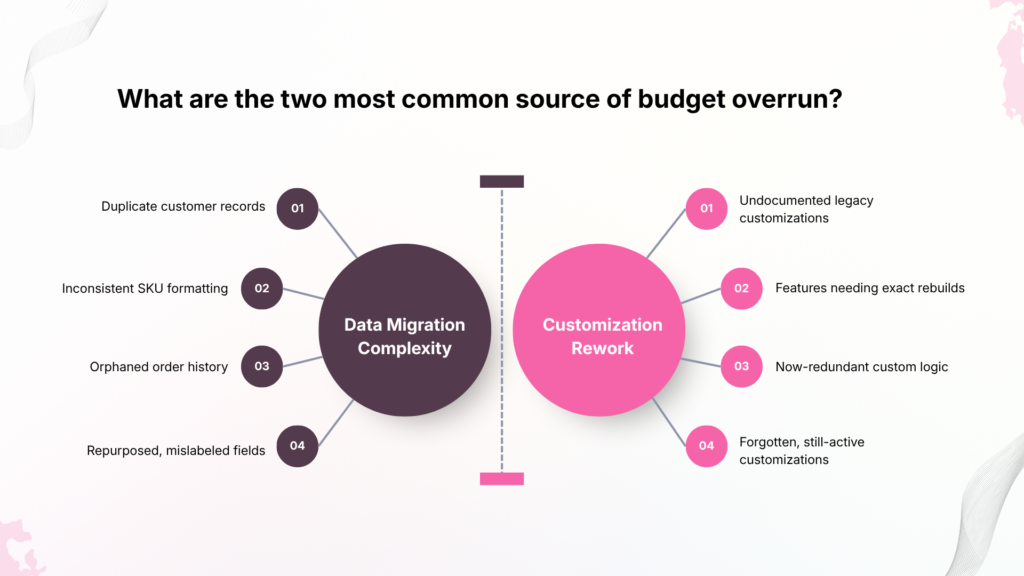
- Data migration complexity: Migration projects frequently uncover years of accumulated inconsistencies that were invisible until someone actually tried to map old records to a new schema duplicate customer records, inconsistent SKU formatting, orphaned order history, or fields that were repurposed for something other than their original intent somewhere along the way. None of this shows up in a pre-migration estimate built from a schema diagram; it only surfaces once the data itself is in motion, which is exactly when it’s most expensive to fix.
- Customization rework: Every customization built on the legacy system forces a decision on the new platform: rebuild it as-is, replace it with a now-native capability, or retire it because it’s no longer needed. Enterprises that skip an early customization audit routinely discover this cost mid-project rather than during planning. This happens because nobody kept a complete inventory of what was customized and why, so the full scope only becomes visible once developers start migrating functionality piece by piece.
Both of these risks share the same root cause: they’re invisible until someone goes looking for them. A platform license quote is easy to get accurately upfront because it’s a known number from a vendor. Data debt and customization sprawl are not. They live inside years of operational history that nobody has fully mapped, which is exactly why they blow budgets that looked solid on paper. The fix for both is the same: audit before you scope, not after you’ve started building.
What's the ROI Case for OMS Modernization?
What Does the Data Say About Modernization Returns?
The return profile for legacy and infrastructure modernization is strong across the board. Industry research puts ROI from mainframe and legacy modernization initiatives at 288% to 362%, and 98% of organizations report a measurable benefit in at least one critical operational area after modernizing. On the flip side, the cost of inaction is just as quantifiable: enterprises collectively carry an estimated $1.52 trillion in accumulated technical debt, and many organizations spend 60-80% of their IT budget simply keeping legacy systems running rather than building new capability.
How Do You Translate Modernization Into Numbers Your Business Actually Feels?
Generic ROI percentages rarely move a budget conversation on their own — what works is translating modernization into metrics your leadership already watches. A UK multinational retailer that moved to managed services for their OMS saw a 15% increase in sales through dynamic inventory reallocation alone, plus roughly 20% savings in infrastructure costs through automated environment management. A leading Indian lifestyle company migrating to a cloud-ready, unified OMS cut overall infrastructure tenancy cost by roughly 30%. Those are the kinds of numbers that make a modernization budget request read like a growth investment instead of a maintenance ask.
How to Avoid Unnecessary Cost in Modernization?
Don’t underweight cost avoidance in the business case. It’s often larger than the direct efficiency gains. A U.S. security services provider running an outdated, on-premise OMS had already absorbed the cost of multiple failed in-house upgrade attempts before bringing in a structured methodology that got them through the transition with near-zero post-upgrade production issues. The business case there wasn’t just future efficiency, it was avoiding a repeat of costs the business had already paid once.
Cost avoidance is easy to miss because it doesn’t show up as a new revenue stream or a headcount reduction. Instead, it appears as problems that never happen: failed upgrades, prolonged outages, emergency support costs, integration rework, delayed channel launches, and revenue losses during peak demand periods. These costs are often treated as isolated incidents, but over time they can outweigh the visible costs of modernization itself.
When evaluating ROI, organizations should account not only for what a modern OMS enables, but also for the operational and financial risks it helps eliminate. In many cases, avoiding one major disruption can justify a significant portion of the modernization investment.
How to Budget for OMS modernization?
Structure the Case Around Risk, Not Just Opportunity
Leadership responds differently to “this will make us more efficient” than to “this is the deadline our vendor has already set.” Lead with concrete, time-bound risks — an approaching end-of-support date, a peak season your current architecture can’t reliably survive — before moving into the efficiency and growth upside. Risk framing gets budget approved faster than opportunity framing alone.
Phase the Investment to Match Phased Value
Where possible, structure the budget request around phases that each deliver a measurable win, rather than asking for the full multi-year investment up front. This mirrors how the strongest modernization strategies work in practice — a phased rollout let one omnichannel retailer prove a 23% fulfillment accuracy improvement within just 10 weeks, which is a far easier number to get budget-approved incrementally than a single large, multi-year ask.
Sample Cost Category Breakdown
| Cost Category | Commonly Underestimated? | Notes |
|---|---|---|
|
Platform license/subscription |
Rarely |
Usually the most visible, best-quoted cost |
|
Infrastructure/hosting |
Sometimes |
Cloud elasticity can reduce this vs. legacy on-premise |
|
Data migration and cleansing |
Frequently |
Biggest source of budget overrun |
|
Integration/API development |
Frequently |
Scope grows as legacy integrations are audited |
|
Scope grows as legacy integrations are audited |
Frequently |
Requires an early audit to size accurately |
|
Testing and QA |
Sometimes |
Underscoped when timeline pressure is high |
|
Training and change management |
Frequently |
Often left out of initial budgets entirely |
|
Post-launch managed services |
Rarely omitted, often underscoped |
Ongoing cost, not one-time |
Building the Business Case for OMS Modernization
A modernization business case succeeds or fails on completeness, not optimism — a TCO model that accounts for data migration, customization rework, and post-launch support will survive budget scrutiny far better than one built only around the platform license. Pair that complete cost picture with ROI framed in metrics your leadership already tracks, and risk framing anchored to real deadlines, and modernization stops competing with other capital requests on ambiguous terms.
Once the business case is approved, the next challenge is rarely technical, it’s organizational. If you’d like help building a TCO model specific to your environment, our order management consulting team at Acuver can walk through it with you. What’s the number your leadership cares about most — cost savings, uptime, or revenue impact? Discuss it with our team of experts.