Introduction
As commerce channels expand, legacy infrastructure and manual processes can create hidden operational bottlenecks. What once worked for single-channel sales often struggles under multi-channel demand, complex inventory fulfillment, and rising customer expectations.
If your operational teams encounter frequent order delays, inventory errors, or system outages during peak sales events, your business architecture may be reaching its limit.
This blog provides a practical 10-question self-assessment to help you evaluate your current setup and determine if it is time to move to a modern Cloud Order Management System (OMS).
To learn about what a cloud OMS is, read our core guide: What Is A Cloud Order Management Solution? The Complete Guide.
The Hidden Cost of Legacy Order Handling
Many growing enterprises rely on customized ERP extensions, spreadsheets, or legacy on-premise software to manage fulfillment. Over time, these legacy setups build up operational friction:
- Manual Workarounds: Staff spend hours resolving mismatched inventory figures across channels.
- Order Processing Bottlenecks: Orders sit in queues waiting for batch updates between systems.
- High Operational Costs: Shipping orders from distant warehouses due to a lack of local inventory visibility increases last-mile carrier expenses.
- Lost Sales & Trust: Stockouts, delayed notifications, and cancelled orders hurt customer retention rates.
The 10-Question Self-Assessment Checklist
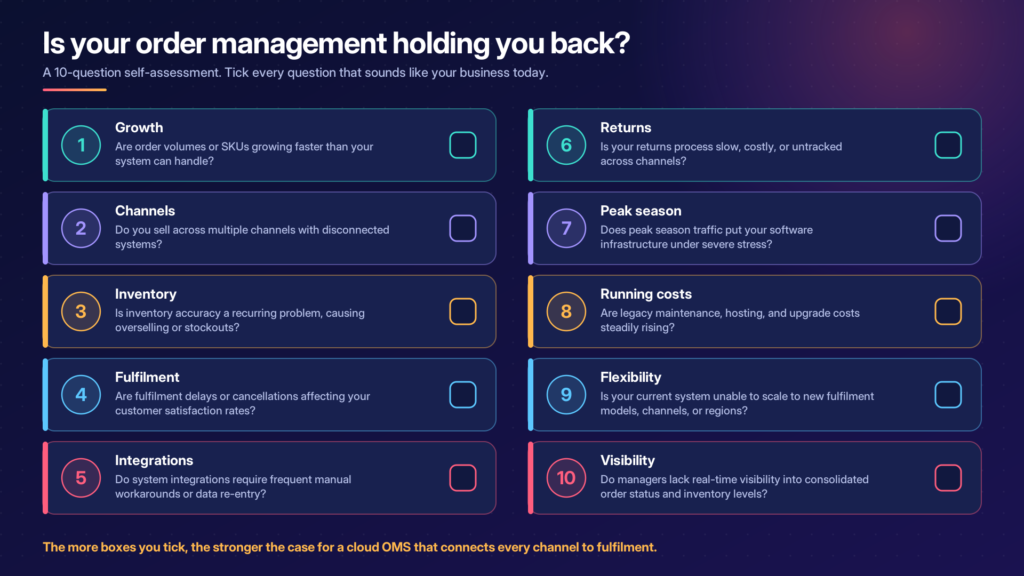
Review the following 10 questions to assess your current order management health:
- Are order volumes or SKUs growing faster than your system can handle?
- Do you sell across multiple channels with disconnected systems?
- Is inventory accuracy a recurring problem (causing overselling or stockouts)?
- Are fulfillment delays or cancellations affecting your customer satisfaction rates?
- Do system integrations require frequent manual workarounds or data re-entry?
- Is your returns process slow, costly, or untracked across channels?
- Does peak season traffic put your software infrastructure under severe stress?
- Are legacy maintenance, hosting, and upgrade costs steadily rising?
- Is your current system unable to scale to new fulfillment models, channels, or geographic regions?
- Do managers lack real-time visibility into consolidated order status and inventory levels?
Let’s explore them in detail:
- Are order volumes or SKUs growing faster than your system can handle?
- Why it matters: Legacy databases often face performance degradation during transaction spikes, delaying order processing.
- Next Step: Measure average order throughput speeds during high-volume hours to check for processing delays.
- Example: A retailer launching 500 new SKUs discovers their catalog system requires overnight batch processing to update inventory metrics across channels.
- Do you sell across multiple channels with disconnected systems?
- Why it matters: Running marketplace, web, mobile, and physical store channels on separate systems leads to fragmented data silos.
- Next Step: Audit how many independent databases store customer and order records across your selling touchpoints.
- Example: Web orders cannot view physical store stock levels, missing opportunities for fast local fulfillment.
- Is inventory accuracy a recurring problem (overselling, stockouts)?
- Why it matters: Out-of-sync inventory data causes overselling, leading to backorders or unexpected order cancellations.
- Next Step: Calculate your inventory accuracy percentage across distribution centers and physical retail locations.
- Example: An item sold online is simultaneously purchased in-store, forcing customer support to cancel the online order.
- Are fulfillment delays or cancellations affecting customers?
- Why it matters: Order delays damage brand reputation and lower customer lifetime value (LTV).
- Next Step: Track your order-to-shipment duration and cancellation rates resulting from stock mismatches.
- Example: Orders take 48 hours to clear validation due to manual credit checks across separate financial tools.
- Do integrations require frequent manual workarounds?
- Why it matters: Relying on manual CSV uploads to sync inventory and sales data creates high error rates and slows operations.
- Next Step: Document all manual data entry steps currently performed between your storefront, ERP, and WMS.
- Example: Operations staff manually export order files every evening to re-upload them into an external logistics tool.
- Is your returns process slow, costly or untracked?
- Why it matters: High return costs erode margins, while complex return policies frustrate shoppers.
- Next Step: Measure customer return processing time from initial request to final restocking and refund authorization.
- Example: Customers cannot return online purchases at physical store locations due to disconnected POS and ecommerce systems.
- Does peak season put your systems under stress?
- Why it matters: System downtime during major holiday sales events directly impacts revenue and brand trust.
- Next Step: Review system uptime performance and error rates during your last peak holiday promotional window.
- Example: During Cyber Week sales, server load spikes cause storefront checkout timeouts and double-booked orders.
- Are legacy maintenance and upgrade costs rising?
- Why it matters: Supporting aging on-premise hardware diverts budget and engineering resources away from innovation.
- Next Step: Calculate the total cost of ownership (TCO) for your current infrastructure, including hardware upgrades, support contracts, and patch maintenance.
- Example: Upgrading custom code on a legacy on-premise ERP requires an expensive 9-month IT project.
- Can your system scale to new channels, regions, or business models?
- Why it matters: Expanding into B2B sales or international markets becomes difficult if your software lacks flexible multi-currency, multi-entity, or multi-node routing features.
- Next Step: Evaluate how fast your current software stack can onboard a new carrier, marketplace, or 3PL network.
- Example: Launching a Buy Online Pick Up In Store (BOPIS) model is delayed by a year due to rigid legacy system limitations.
- Do you lack real-time visibility into orders and inventory?
- Why it matters: Without clear operational dashboards, leaders struggle to spot fulfillment bottlenecks or make data-driven inventory balancing decisions.
- Next Step: Determine how quickly managers can generate an accurate report on order status across all channels.
- Example: Determining overall inventory availability requires running manual data pulls across three different software systems.
How to Score Yourself
Count the total number of “Yes” answers from the 10 questions above to determine your score:
Score: 0-3 ── System Stable (Optimize Existing Setup)
Score: 4-6 ── Moderate Risk (Plan Cloud OMS Strategy)
Score: 7-10 ── Critical Bottleneck (Transition Required Soon)
| Score Band | Status Level | Diagnosis & Recommended Action |
|---|---|---|
|
0 – 3 “Yes” Answers |
Low Risk / Stable |
Your current software stack meets baseline operational requirements. Focus on optimizing existing API performance and data cleaning routines. |
|
4 – 6 “Yes” Answers |
Moderate Operational Friction |
Systems are showing signs of strain under growth. Channel siloing and manual processes are eroding profit margins. Recommended: Begin building a business case for a Cloud OMS upgrade over the next 6–12 months. |
|
7 – 10 “Yes” Answers |
High Risk / Urgent |
Legacy systems are actively capping growth, inflating costs, and hurting customer retention. Recommended: Prioritize an architecture review immediately to plan a transition to a modern Cloud OMS platform. |
What Are the Next Steps?
If your score indicates a need for system modernization, follow these key steps:
- Define Business Requirements and Key Metrics: Document pain points across fulfillment routes, order volumes, and channel integrations.
- Build an Internal Business Case: Quantify the financial return of lowering fulfillment costs, reducing split shipments, and automating processing logic.
- Shortlist Software Platforms and Partners: Evaluate Cloud OMS software platforms and choose an experienced integration partner to guide your architectural design.
If Your Answers Keep Coming Back "Yes," It’s Time to Act
Continuing to run multi-channel sales on legacy software introduces growing operational risks over time. Upgrading to a Cloud Order Management Solution eliminates data silos, improves inventory accuracy, and supports business expansion.
Modernizing your supply chain architecture requires careful execution. At Acuver Consulting, we specialize in guiding enterprise brands through order management modernization.
From conducting operational readiness assessments to selecting technology stacks and leading system integrations, Acuver ensures a smooth transition to modern cloud architectures.
Connect with our team of experts to request an order management evaluation for your organization.
Choosing a Cloud OMS Is a Strategy Decision, Not Just a Software Purchase
Transitioning to a Cloud Order Management System is an investment in your operational foundation. The right solution connects disconnected channels, reduces fulfillment costs, and delivers dependable customer experiences across every touchpoint.
However, software alone cannot transform operations; proper architecture, robust integrations, and disciplined execution are essential for long-term success.
At Acuver Consulting, we specialize in delivering end-to-end digital supply chain and order management solutions. As a trusted implementation partner for global enterprise retail, B2B, and consumer brands, Acuver bridges the gap between technology capabilities and operational realities.
Whether you are evaluating platform options, planning a cloud migration, or architecting complex omnichannel fulfillment models, Acuver offers domain expertise across system integration, technical architecture, and post-go-live optimization.
Talk to our team of order management specialists to discuss your modern supply chain strategy.