Frontend teams often face delays because development usually depends on the backend being built first. Even when designs are ready, developers cannot move forward if the required backend services or APIs are not available yet. This creates frustration and slows down the entire development process.
An alternative approach is to let the frontend needs guide the system design from the beginning. Instead of waiting for backend systems to define how data should be delivered, teams start with the user experience.
In this approach, the backend is designed to support the interface rather than the other way around. The BFF layer helps make this possible by shaping the data specifically for the UI and allowing frontend teams to control how information is delivered.
This shift gives frontend teams more ownership over development, reduces waiting time between teams, and allows features to be built faster while keeping the user experience as the main focus.
What does frontend ownership actually mean? Teams gain control over API contracts, data modeling, and release cycles. Domain isolation strategies keep services focused while backend alignment becomes a collaborative process rather than a dependency chain.
In the following sections examine how frontend ownership changes architecture fundamentals, implementation patterns that make this approach work, and practical solutions for teams transitioning from legacy backend-driven models.
The Evolution from Backend-Driven to Front-Led Design
Traditional Architect-Led Design-Build Models
Earlier web applications were built mainly for desktop computers. In this model, backend teams controlled most of the system design, how APIs worked, how data was structured, and when changes were released. The frontend (the user interface) had to adjust to whatever the backend provided.
At first, this worked well because there was only one main interface — the desktop web UI.
However, things changed when mobile devices and multiple types of interfaces became common. Systems that were designed mainly for desktop started struggling to support mobile apps.
The same backend APIs were expected to serve both desktop and mobile applications. This created problems because mobile devices often had to download more data than they needed.
The core issue was that the architecture was not designed for multiple types of interfaces. Desktop systems could handle large amounts of data, but mobile apps required smaller and more focused responses, which the existing backend APIs were not designed to provide.
Why User Experience Became the Primary Driver
Mobile experiences differ drastically from desktop patterns. Desktop users tolerate data-heavy screens and complex navigation. Mobile contexts demand focused interactions with minimal payload sizes.
Frontend developers transitioning from backend work noticed this shift firsthand. Building customer-centric experiences meant caring about UI flows and user interactions first, then designing appropriate backend structures. User experience became the lens through which technical decisions were filtered.
This shift taught teams that starting with user needs produced better technical outcomes than forcing UI adaptation to backend limitations.
The Rise of BFF Patterns and GraphQL
To support this new approach, developers began using patterns like Backend for Frontend (BFF). The idea was simple: instead of one large API serving every application, each user interface (such as a web app or mobile app) would have its own backend service designed specifically for its needs.
A common guideline became “one experience, one BFF.” For example, if iOS and Android apps have very different user experiences, each can have its own BFF to deliver the right data efficiently.
Another solution that emerged was GraphQL, which allows the frontend to request exactly the data it needs from the backend.
Both BFF and GraphQL aim to solve the same problem: giving frontend teams more control over the data they need to create better user experiences.
Core Principles of Front-Led Architecture
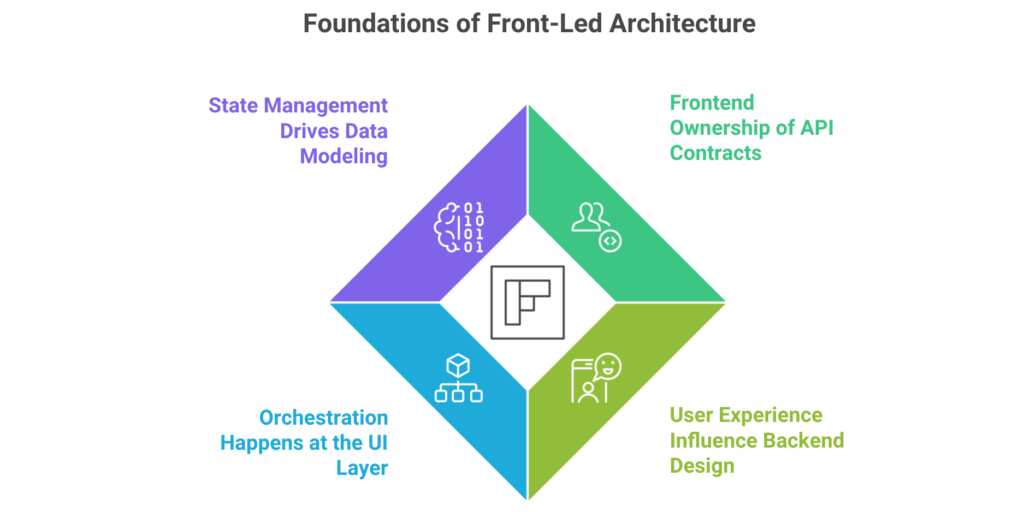
Frontend Ownership of API Contracts
Frontend teams control API contracts rather than passively consuming backend decisions. OpenAPI specifications define API interfaces in a unified way, allowing multiple teams to share knowledge with minimal investment. Contract-first development flips the traditional sequence: write the specification before any code exists, then both sides implement to match that contract.
Frontend developers understand user needs and UI constraints better than backend teams, which makes them ideal candidates for API design. Backend and frontend work in parallel instead of sequentially, cutting development time dramatically. API contracts become the single source of truth when frontend teams own them from the start.
Experience Requirements Influence Backend Design
User experience requirements filter technical decisions from day one. Frontend teams driving API shape ensure backend structures fit the product rather than forcing UI adaptation to infrastructure constraints. The interface becomes the visible expression of system architecture, not a layer on top of it.
Backend services optimize inside a structure that serves actual user interactions. This inversion means technical decisions support experience goals rather than working around infrastructure limitations.
Orchestration Happens at the UI Layer
Micro-app composition: Splitting frontends into independent micro-apps requires assembling them into seamless experiences. The UI layer handles composition, making the interface a computed function rather than a static file.
Runtime coordination: Logic handling interacts with APIs to manage persistent state while orchestration coordinates feature rendering at runtime. This approach enables dynamic feature loading and real-time user experience optimization.
State Management Drives Data Modeling
State architecture defines how modules communicate through explicit boundaries. Modules expose public APIs with specific interaction patterns:
- Reads via selectors: Clean data access without exposing internal structure
- Writes via commands: Controlled state updates through defined entry points
- Events for cross-module reactions: Loose coupling between domain boundaries
Domain-centric state uses normalization for large collections while enforcing invariants in reducers. This separation reduces coupling and makes refactoring safe across module boundaries.
Implementation Patterns That Enable Frontend Control
Backend for Frontend (BFF) as the Orchestration Layer
Each frontend gets its own tailored backend service rather than sharing a general-purpose API. The BFF sits between the frontend client and backend services, handling client-specific logic related to user experience. Mobile apps receive lightweight payloads optimized for bandwidth constraints while web dashboards fetch detailed analytics.
BFF responsibilities include:
- Aggregating data from multiple APIs
- Transforming responses into frontend-compatible formats
- Managing authentication through secure cookies
- Implementing caching strategies to reduce backend load
Feature Flags and Experimentation at the Edge
Running experiments at the network edge ensures swift user experiences without sacrificing performance. Multiple platforms like Statsig integrated with Vercel Edge Config provide ultra-low latency access to feature flags by storing configurations close to users.
DevCycle’s Edge Flags enable saving user data to the edge and using it for feature targeting, making custom data pipelines unnecessary. Engineers send only a User ID to access that data through lightning-fast SDKs and APIs. This approach eliminates the traditional bottleneck of centralized feature flag services.
Domain Isolation Strategies
Multiple teams shipping independently require frontend architecture that reflects organizational boundaries.
Microfrontends make sense only when organizational boundaries are stable, ownership is explicit, and integration contracts are well-defined. Teams should evaluate whether the coordination overhead justifies the architectural complexity before adopting this pattern.
API Aggregation and Composition
API composers query multiple downstream services and merge responses into single results for clients. Fan-out aggregation sends parallel requests to multiple services, while chained aggregation uses one service’s result as input to another.
Composers should remain thin, coordinating, and merging without accumulating business logic. This keeps the orchestration layer focused on data assembly rather than domain logic, maintaining clear separation of concerns across the architecture.
Addressing Common Implementation Challenges
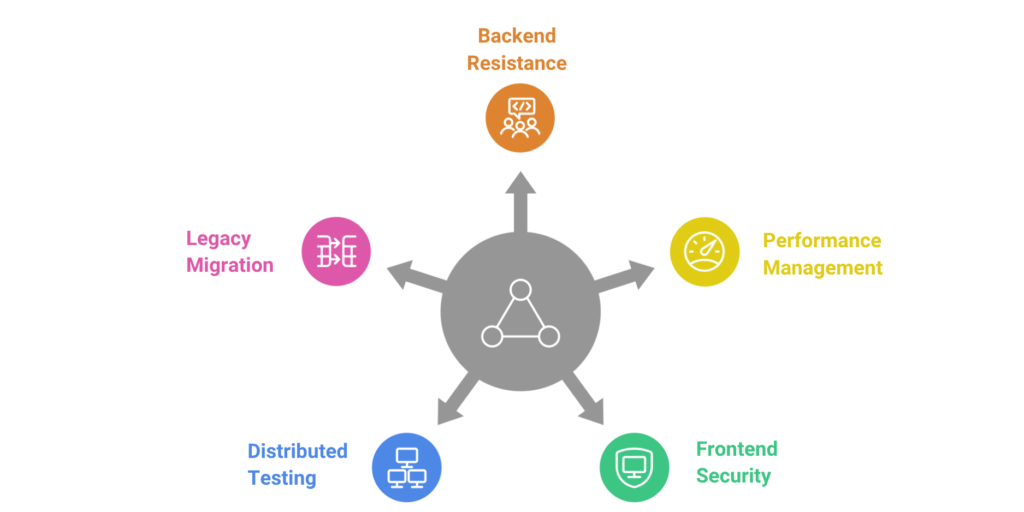
Backend team resistance and alignment strategies
Separate backend teams create disconnection between frontend and backend development, causing delays when teams need consensus on requirements. Frontend developers expect non-nullable fields while backend teams implement optional ones, creating integration problems.
Shared SLOs make both teams accountable for user experience rather than operating independently.
Another alternative is cross-functional pairing that helps teams understand each other’s constraints. Backend engineers gain perspective on UI performance requirements when they see how API responses affect loading times. Frontend developers appreciate data consistency challenges when they understand backend scaling concerns.
Managing performance with increased complexity
Frontend complexity creates UI slowdowns when applications handle large datasets, manage frequent updates, or execute complex browser calculations. Poor optimization shows up through excessive DOM manipulation, inefficient event handling, and memory leaks that degrade user experience.
Modern toolchains help developers, and it is the key to measuring performance before implementing fixes – unmeasured optimization often introduces unexpected bugs.
Security in frontend-driven architectures
Frontend applications are often the first point where security risks appear, such as exposing sensitive data or mishandling authentication.
To improve security:
- Authentication tokens should be stored securely in protected cookies.
- All communication between systems should use secure HTTPS connections.
- Authentication flows should be carefully managed between the frontend and backend to keep users safe without slowing down the application.
Testing across distributed systems
Testing becomes more challenging when many services and systems work together.
To manage this, teams often:
- Use contract testing to ensure frontend and backend systems follow the same API agreements.
- Test individual components instead of relying only on full end-to-end tests.
This makes testing faster, more reliable, and easier to maintain.
Migration strategies for legacy systems
Older systems cannot always be replaced at once. Instead, organizations often migrate gradually using approaches like the strangler pattern, where new components slowly replace parts of the old system over time.
Feature flags help manage this transition by allowing teams to release new features to small groups of users first. This reduces risk and allows quick rollback if problems occur.
A major challenge during migration is often the database, since changes to data models must be planned carefully to avoid breaking existing systems.
Front-Led Architecture Delivers Measurable Development Velocity
Frontend teams gain control over API design and technical decisions when architecture puts user experience requirements first. BFF patterns and edge-based feature flags create measurable velocity gains while improving user satisfaction metrics.
Teams adopting front-led models report faster iteration cycles and better alignment between product vision and technical execution. This architectural approach eliminates dependency loops that slow development.
Teams moving from backend-driven architectures benefit from incremental adoption, measuring performance improvements at each step, and maintaining clear boundaries between frontend and backend responsibilities.
At Acuver, our front-led architecture changes how engineering teams build digital products. User experience drives technical decisions, frontend ownership reduces development bottlenecks, and measurable performance improvements justify the architectural investment. Get in touch with us to know how.