What Is Digital Warehouse Management?
Digital warehouse management is the use of technology like, software, sensors, automation, and data to plan, execute, and optimize every activity inside a warehouse. It covers receiving, putaway, picking, packing, shipping, and returns, all managed through connected digital systems rather than paper-based or manual processes.
At its core, a digital warehouse operates on a Warehouse Management System (WMS) that acts as the central brain. From there, it connects to technologies like barcode scanners, RFID, conveyor automation, robotics, IoT sensors, and AI-powered analytics. Each layer adds a new level of speed, accuracy, and visibility.
Why Does Digital Warehouse Management Matter
Manual warehouse operations have limitations. Beyond a certain volume, errors multiply, throughput stalls, and costs climb. Digital warehouse management removes those limitations. It gives operations teams real-time control, surfaces problems before they escalate, and frees up human capacity for tasks that require judgment rather than repetition.
For enterprises managing large, multi-location supply chains, digitalization is not optional; it is the foundation of staying competitive.
Warehouses are no longer just storage facilities. They are the operational backbone of modern commerce. As order volumes rise, customer expectations tighten, and supply chains become more complex. The pressure on warehouse teams has never been higher.
Digital warehouse management is the answer to that pressure. It replaces slow, error-prone manual processes with connected systems, real-time data, and intelligent automation. The result is a warehouse that moves faster, costs less to run, and scales without breaking.
What Are the Benefits of Digitalizing Your Warehouse Management Operations?
Digitalization transforms warehouse performance across every dimension. Here are the key benefits:
Greater Inventory Accuracy
Real-time tracking eliminates discrepancies between system records and physical stock. You always know exactly what you have, where it is, and how much is available.
Higher Throughput
Automated workflows and optimized pick paths mean more orders processed in less time, with no proportional increase in headcount.
Lower Operational Costs
Fewer errors mean fewer reships, fewer write-offs, and less wasted labor. Automation handles repetitive tasks at a fraction of the cost of manual effort.
Faster Order Fulfillment
Digital systems prioritize, route, and execute orders faster than any manual process. Customers receive their orders sooner, which drives satisfaction and loyalty.
Real-Time Visibility
Operations managers can see the status of every order, every shipment, and every inventory movement in real time from any location.
Improved Workforce Productivity
Digital task assignments, guided workflows, and performance dashboards help warehouse teams work more effectively without being micromanaged.
Scalability Without Disruption
A digitalized warehouse can absorb volume spikes of seasonal peaks, promotions; sudden demand surges without the chaos that breaks manual operations.
Stronger Compliance and Audit Readiness
Every transaction is logged automatically. Regulatory reporting, audits, and traceability requirements have become far easier to manage.
Smarter Decision Making
Data from across the warehouse feeds into dashboards and analytics tools, giving leadership the insight to improve processes continuously.
Better Customer Experience
Accurate inventory, faster fulfillment, and reliable shipping updates translate directly into a better experience for the end customer.
What Are the Top Strategies to Master Digital Warehouse Management in 2026?
Mastering digital warehouse management requires more than buying software. It requires a deliberate approach across technology, processes, people, and data. Here are the seven strategies that separate high-performing warehouses from the rest:
- Strategy 1: Implement a Robust Warehouse Management System (WMS) as Your Digital Core
- Strategy 2: Leverage Real-Time Inventory Visibility Across Every Node
- Strategy 3: Automate Repetitive Warehouse Processes to Eliminate Bottlenecks
- Strategy 4: Use AI and Predictive Analytics to Stay Ahead of Demand
- Strategy 5: Digitize Workforce Management and Training
- Strategy 6: Integrate Your Warehouse Digitally With the Broader Supply Chain
- Strategy 7: Build a Culture of Continuous Improvement Using Warehouse Data
Strategy 1: Implement a Robust WMS as Your Digital Core
Every digital warehouse starts with a WMS. It is the system of record for all warehouse activity receiving, putaway, picking, packing, shipping, and returns. Without a strong WMS at the center, every other digital initiative lacks a foundation to build on.
When choosing a WMS, prioritize API-first architecture so it connects easily to your ERP, TMS, and ecommerce platforms. Look for configurable workflows that match your specific operations rather than forcing you to adapt to the software. Cloud-based WMS platforms offer faster deployment, easier updates, and lower infrastructure costs compared to on-premise alternatives.
A well-implemented WMS typically delivers measurable improvements in order accuracy, pick rates, and inventory shrinkage within the first few months of going live.
Strategy 2: Leverage Real-Time Inventory Visibility Across Every Node
Inventory data that is hours or even minutes old is already outdated in a high-velocity warehouse. Real-time visibility means knowing the exact quantity, location, and status of every SKU at every moment across every warehouse, store, and fulfillment node you operate.
Achieve this by combining barcode scanning, RFID technology, and IoT-enabled bin and shelf sensors with a WMS that updates in real time. Extend that visibility to your sales channels, so inventory counts are always accurate at the point of purchase eliminating overselling and improving fulfillment speed.
For enterprises with multiple distribution centers, a unified inventory view across all nodes enables smarter fulfillment decisions routing each order to the location best positioned to fulfill it quickly and cost-effectively.
Strategy 3: Automate Repetitive Warehouse Processes to Eliminate Bottlenecks
Repetitive tasks are the biggest source of bottlenecks and errors in any warehouse. Picking, sorting, labeling, and packing are time-consuming when done manually and prone to mistakes under volume pressure. Automation removes both problems.
Start with process automation inside your WMS automated task assignment, optimized pick paths, and wave planning. From there, evaluate physical automation: conveyor systems, goods-to-person robotics, automated sorting, and autonomous mobile robots (AMRs) that move inventory without human assistance.
The goal is not to automate everything at once. Identify the specific workflows where manual effort is creating delays or errors, automate those first, and measure the impact before expanding further.
Strategy 4: Use AI and Predictive Analytics to Stay Ahead of Demand
Reacting to demand is expensive. Anticipating it is a competitive advantage. AI and predictive analytics let warehouse teams prepare for what is coming rather than scrambling to catch up when it arrives.
AI-powered demand forecasting uses historical sales data, seasonal patterns, promotional calendars, and external signals to predict what you will need, when you will need it, and in what quantity. This drives better inventory positioning, smarter replenishment cycles, and more accurate staffing plans.
Beyond forecasting, AI can optimize slotting by placing high-velocity SKUs in the most accessible locations and flag operational anomalies before they become costly problems. In 2026, AI is no longer a future investment for large enterprises. It is a practical tool that delivers measurable returns for warehouses of all sizes.
Strategy 5: Digitize Workforce Management and Training
Technology alone does not build a high-performing warehouse people do. Digitalizing workforce management means giving your team the tools to work smarter, stay informed, and grow their skills continuously.
Digital task management systems assign work dynamically based on real-time priorities, skill sets, and labor availability. Performance dashboards give supervisors visibility into throughput, accuracy, and downtime at the individual and team level. Mobile-first interfaces reduce reliance on fixed terminals and keep workers moving.
On the training side, digital learning platforms and augmented reality (AR) tools allow new hires to get up to speed faster and with fewer errors. Ongoing micro-learning keeps experienced staff sharp as processes evolve. A digitally empowered workforce is more engaged, more productive, and more adaptable to change.
Strategy 6: Integrate Your Warehouse Digitally With the Broader Supply Chain
A warehouse that operates in isolation is a bottleneck waiting to happen. True digital transformation means connecting your warehouse operations to every upstream and downstream system in your supply chain, suppliers, logistics partners, retail channels, and customers.
Integrate your WMS with your ERP for seamless financial and inventory alignment. Connect to your Transportation Management System (TMS) for optimized carrier selection and real-time shipment tracking. Link to your supplier portals for advance shipment notices (ASNs) that let you prepare for inbound loads before they arrive.
This level of digital connectivity removes the handoff delays that slow supply chains down. Information flows automatically; decisions get made faster, and your entire network operates as a single coordinated system rather than a set of disconnected parts.
Strategy 7: Build a Culture of Continuous Improvement Using Warehouse Data
Digital systems generate enormous amounts of operational data. The warehouses that pull ahead are the ones that use that data to improve constantly not just to monitor what happened, but to understand why it happened and how to do better.
Build a performance review cadence around key warehouse metrics: order accuracy, pick rate, dock-to-stock time, cost per order, and return processing time. Use dashboards that are accessible to both operations teams and leadership. Empower floor managers to act on data without waiting for weekly reports.
When the entire team sees the data, understands the goals, and has the tools to act, continuous improvement becomes part of how the warehouse operates not a separate initiative that competes with day-to-day priorities.
What Are the Common Pitfalls Enterprises Face When Going Digital, and How to Avoid Them?
The most common pitfall is moving too fast without a clear plan. Enterprises that jump straight into automation or AI without first fixing foundational data quality and process gaps end up automating broken workflows, which makes problems faster, not smaller.
Here are the pitfalls to watch for, and how to avoid each one:
Treating digitalization as a one-time project
Digital transformation is continuous. Technology evolves, business needs change, and new capabilities emerge. Build for ongoing iteration, not a single finish line.
Neglecting change management
New systems fail when people do not adopt them. Invest in training, communication, and leadership buy-in before go-live not after.
Poor data quality going in
Digitalization amplifies what is already in your data. Clean your master data item records, locations, supplier details before implementation, not during.
Trying to do everything at once
Large, all-at-once rollouts carry high risk and long timelines. Start with the highest-impact use case, prove value, then expand.
Choosing technology over process fit
Impressive technology that does not fit your workflow creates friction rather than efficiency. Always evaluate how a solution works with your specific operations, not just its feature list.
Underestimating integration complexity
Systems that do not talk to each other create new silos. Prioritize platforms with strong integration capabilities and plan your integration architecture before selecting tools.
How to Build a Digital Warehouse Management Roadmap?
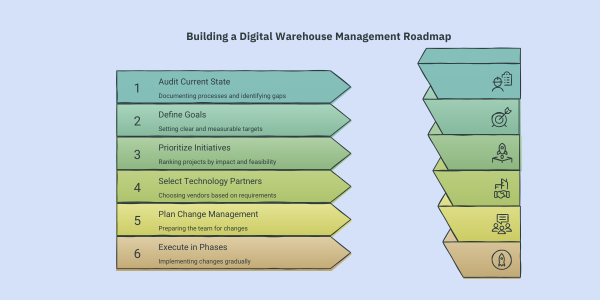
A digital warehouse roadmap starts with an honest assessment of where you are today. Map your current processes, identify where errors, delays, and inefficiencies occur most often, and quantify the cost of those gaps. This baseline gives you a clear picture of what to fix first.
From there, follow these steps to build a roadmap that is realistic and outcome-driven:
Step 1 — Audit your current state
Document every warehouse process end to end. Identify manual steps, integration gaps, data quality issues, and process bottlenecks. Be specific about where time and money are lost.
Step 2 — Define your goals
Set clear, measurable targets. Do you want to reduce order errors by 30%? Cut fulfilment time by two days? Handle 50% more volume without adding headcount? Goals shape every decision that follows.
Step 3 — Prioritize by impact and feasibility
Not every improvement is equal. Rank initiatives by the combination of business impact and ease of implementation. High-impact, low-complexity projects go first.
Step 4 — Select the right technology partners
Evaluate WMS vendors, automation providers, and integration platforms based on your specific use cases, integration requirements, and support model. Reference customers in your industry are a strong signal of fit.
Step 5 — Plan for change management
Define how you will communicate the changes to your warehouse team, how you will train them, and how you will measure adoption alongside technical metrics.
Step 6 — Execute in phases
Run a phased rollout. Start with the highest-priority module or process. Measure results. Refine your approach. Then move to the next phase with greater confidence and a stronger foundation.
Step 7 — Review and iterate
Build a quarterly review cadence to assess progress against your goals, surface new opportunities, and adjust priorities as the business evolves.
Mastering Digital Warehouse Management Is a Journey, Not a One-Time Project
The warehouses winning in 2026 are not the ones with the most technology. They are the ones that have made digital thinking part of how they operate every day questioning processes, acting on data, and continuously raising the bar on what their operations can deliver.
Digital transformation in warehouse management does not happen all at once. It happens in deliberate steps each one building on the last, each one generating the data and confidence needed to go further.
The seven strategies in this guide are not a checklist to complete. They are an operating philosophy to adopt. Start where the pain is greatest. Measure what matters. Expand what works. With the right partner, the right technology, and a clear roadmap, your warehouse can become one of your biggest competitive advantages.
Acuver Consulting is a supply chain firm specializing in Order Management, Warehouse Management and Software Engineering solutions. Whether it is digitalizing warehouse management or streamlining warehouse operations with a WMS, Acuver works with you to design a roadmap that fits your operations, your budget, and your growth plans. Connect with Acuver’s team of experts to transform your warehouse operations.