Introduction
As digital commerce expands across multiple sales channels: from brand websites and mobile apps to online marketplaces and physical stores, managing order lifecycles with legacy tools becomes increasingly complex. Today’s customers expect fast, accurate, and transparent fulfillment regardless of where or how they place an order.
To meet these demands, modern enterprises rely on Cloud Order Management Solutions (OMS). This comprehensive blog covers everything you need to know about Cloud OMS technology, how it differs from traditional systems, key capabilities, benefits, and how to plan a successful implementation strategy.
What is a Cloud Order Management System (OMS)?
A Cloud Order Management System (OMS) is a software platform hosted in the cloud that centralizes, orchestrates, and tracks orders across every sales channel from point of capture through to final delivery and post-purchase service.
What does “cloud” change?
Traditionally, order management software was installed on physical servers located within an enterprise’s data center (on-premise). A Cloud OMS shifts this architecture to cloud infrastructure (typically offered as Software-as-a-Service or SaaS). This shift removes physical hardware limits, reduces operational overhead, and allows real-time data sync across geographically dispersed channels and fulfillment centers.
The OMS as the “Brain” of Commerce
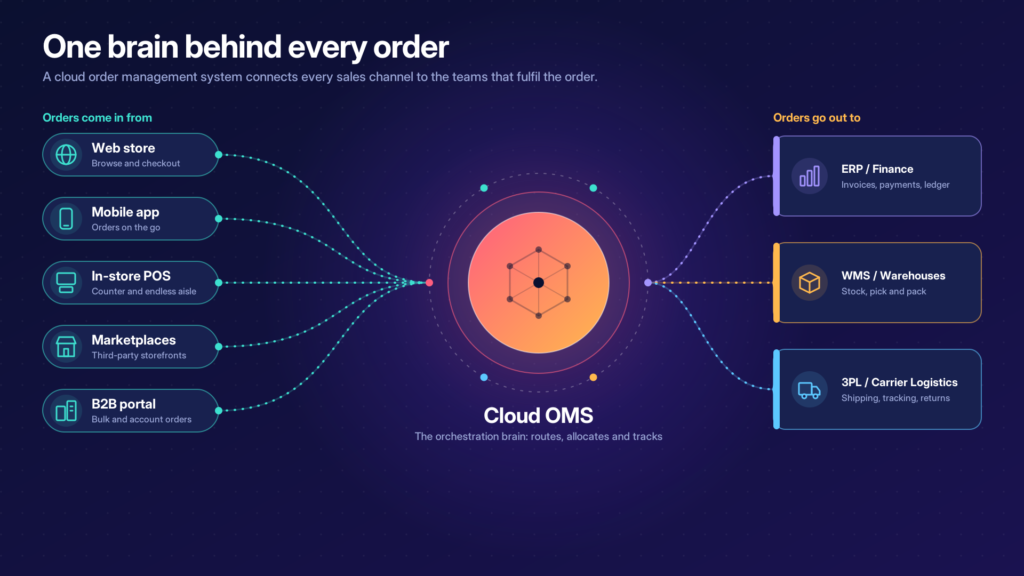
Think of the Cloud OMS as the central orchestration engine: or the “brain” of your supply chain and commerce stack. It connects consumer-facing touchpoints directly to backend fulfillment networks:
- Sales Channels: Web stores, mobile apps, POS systems, social commerce, marketplaces (e.g., Amazon, Flipkart), and B2B portals.
- Inventory & Fulfillment Nodes: Central distribution centers (DCs), regional warehouses, third-party logistics (3PL) providers, and retail stores.
- Customer Service: Customer support tools, order status tracking engines, and returns management hubs.
How an OMS Differs from ERP, WMS, and E-commerce Platforms
It is common for growing enterprises to confuse an OMS with adjacent business technologies:
| System | Primary Focus | Key Difference vs. Cloud OMS |
|---|---|---|
|
E-commerce Platform (e.g., Shopify, Magento) |
Front-end digital storefront, product display, shopping cart. |
Manages the buy-side experience; lacks deep cross-channel inventory routing and complex warehouse rules. |
|
ERP (Enterprise Resource Planning) |
Financial management, procurement, ledger accounting, HR. |
Excellent system of record; lacks real-time, flexible order routing logic across complex omnichannel nodes. |
|
WMS (Warehouse Management System) |
Execution inside the four walls of a specific warehouse or DC. |
Controls bin locations, picking, packing, and put-away; does not orchestrate orders across multiple fulfillment nodes. |
|
Cloud OMS |
End-to-end order orchestration, inventory promising, and cross-channel fulfillment. |
Acts as the intelligent middleware binding front-end sales channels to backend ERP and WMS tools. |
Cloud vs. On-Premise OMS
Choosing between cloud and on-premise deployment options represents a major strategic milestone for enterprise supply chains.
Lets understand how cloud OMS and on-premise OMS are different looking at the table below:
|
Cloud (SaaS / Managed) |
On-Premise / Legacy |
|
Pay-as-you-grow (OpEx) |
High upfront capital (CapEx) |
|
Elastic auto-scaling |
Fixed compute capacity |
|
Continuous cloud updates |
Manual, costly upgrade projects |
|
API-first integration framework |
Custom point-to-point connections |
- Deployment Models
- SaaS (Software-as-a-Service): Multi-tenant or single-tenant cloud architecture managed fully by the software vendor. Upgrades are continuous and automatic.
- Hosted Cloud: Dedicated cloud instances managed on infrastructure-as-a-service (IaaS) environments like AWS, Azure, or GCP.
- Hybrid: Legacy core systems remain on-premise, while customer-facing order routing and availability engines run in the cloud.
- Cost Structure: CapEx vs. OpEx
On-premise solutions demand heavy upfront Capital Expenditure (CapEx) for server hardware, perpetual licenses, and initial infrastructure setup. A Cloud OMS operates primarily on an Operational Expenditure (OpEx) model, using subscription-based or volume-tiered pricing that aligns software spend with business growth.
- Scalability, Upgrades, and Maintenance
During peak holiday shopping surges, order volumes can spike by $5\times$ to $10\times$ baseline rates. Cloud OMS platforms scale compute resources dynamically to meet demand without requiring hardware investments. Upgrades occur seamlessly without taking systems offline or disrupting live operations.
- Security, Compliance, and Control
Leading Cloud OMS providers maintain stringent compliance certifications (such as ISO 27001, SOC 2 Type II, and PCI-DSS). While on-premise models give internal IT teams complete control over physical hardware, they also place the full burden of security patching, data back-ups, and disaster recovery squarely on internal staff.
- When On-Premise or Hybrid Still Makes Sense
On-premise or hybrid models are typically retained by legacy enterprises with heavily customized, mission-critical infrastructure, or by organizations operating under strict data residency mandates where cloud adoption must occur in phased stages.
How a Cloud OMS Works
A Cloud OMS connects each step of the transaction journey into a smooth, automated workflow:
- Order Capture: Collects order details real-time from storefronts, mobile apps, marketplaces, B2B portals, and physical POS registers.
- Order Orchestration & Smart Sourcing: Applies business rules to determine the optimal fulfillment node (e.g., nearest warehouse, retail store with surplus stock, or drop-ship supplier) to minimize freight costs and delivery times.
- Real-Time Inventory Visibility: Aggregates stock levels across distribution centers, stores, and in-transit shipments into a unified view, recalculating Available-to-Promise (ATP) inventory continuously.
- Fulfillment, Shipping & Tracking: Sends pick and pack instructions to the selected WMS or store fulfillment app, generates shipping labels via carrier APIs, and tracks delivery status.
- Returns, Exchanges & Refunds: Streamlines reverse logistics by generating return labels, managing drop-offs, authorizing refunds, and restocking items efficiently.
- Customer Communication: Sends automated order confirmations, shipping updates, and delay notifications across email, SMS, and messaging channels.
Key Features and Capabilities
- Distributed Order Management (DOM): Evaluates variables such as distance, item availability, shipping costs, and split-shipment rules to select the best fulfillment location automatically.
- Omnichannel Fulfillment Support: Powers fulfillment workflows like Buy Online Pick Up In Store (BOPIS), Buy Online Return In Store (BORIS), Ship-from-Store, and Drop-shipping.
- Inventory Availability & Promising (ATP): Provides precise delivery promises on product pages prior to checkout, boosting conversion rates.
- Rules Engine & Workflow Configuration: Allows business administrators to update order routing rules, hold policies, and split order logic visually without writing custom code.
- APIs and Integration Ecosystem: Uses RESTful APIs and webhooks to sync data across ERPs, WMSs, payment gateways, CRM tools, and shipping carriers.
- Analytics and Reporting: Offers dashboards to track key metrics like order fulfillment cycles, split-shipment rates, inventory turnover, and return rates.
Benefits and Business Impact
Implementing a modern Cloud OMS delivers measurable operational gains:
- Faster, More Accurate Fulfillment: Automated routing reduces order processing times from hours to seconds.
- Lower Shipping and Fulfillment Costs: Sourcing orders from the closest fulfillment node lowers last-mile carrier fees and minimizes split shipments.
- Fewer Stockouts and Cancellations: Unified inventory views prevent overselling across fast-moving channels.
- Improved Customer Retention: Accurate delivery promises and proactive tracking build customer trust.
- Seamless Seasonal Scaling: Cloud infrastructure handles unexpected traffic spikes effortlessly during peak sales events.
- Reduced IT Maintenance Burden: Automatic cloud updates allow internal IT teams to focus on core strategic initiatives instead of manual server maintenance.
Who Needs a Cloud Order Management Solution?
A Cloud OMS delivers value across multiple business models:
- Retail & Omnichannel Brands: Operating across online stores and physical retail locations needing cross-channel inventory visibility.
- CPG & D2C Manufacturers: Transitioning from traditional distribution to direct-to-consumer digital channels.
- B2B & Wholesale Distributors: Managing complex buyer tiers, split shipments, bulk orders, and custom pricing contracts.
- Fast-Growing E-commerce Merchants: Outgrowing spreadsheet tracking or basic e-commerce store plug-ins.
Implementation Overview & The Role of an Implementation Partner
Upgrading your order management architecture is a core operational shift.
Typical Implementation Stages
- Discovery & Architecture Design: Defining business workflows, inventory rules, integration requirements, and success metrics.
- Data Migration & Clean-up: Mapping customer profiles, SKU masters, open orders, and historical data.
- Integration & Configuration: Connecting APIs across ERPs, WMSs, storefronts, and carrier engines while configuring routing rules.
- Testing & Validation: Performing end-to-end testing, load testing, and edge-case validation under high volume conditions.
- Change Management & Training: Training store associates, customer service agents, and warehouse teams on new tools.
- Go-Live & Hypercare Support: Managing cutover execution with dedicated technical support during initial live operations.
Why Software Selection Alone Isn't Enough
Selecting enterprise software is only half the battle. Successful execution depends heavily on system architecture design, integration stability, and process alignment.
An experienced implementation partner helps eliminate deployment risks by anticipating edge-cases, designing scalable integrations, and aligning the platform with your unique business workflows.
Common Challenges and Mistakes to Avoid
- Underestimating Integration Complexity: Failing to map API limits and data schemas between legacy systems and the cloud OMS.
- Poor Data Quality: Importing inaccurate SKU masters or dirty inventory records into a new system.
- Over-Customization: Building custom code for processes that standard out-of-the-box workflows handle easily.
- Neglecting Change Management: Deploying systems without properly training store associates or customer service representatives.
- Skipping Load Testing: Launching without validating system throughput under simulated peak order volumes.
Choosing a Cloud OMS Is a Strategy Decision, Not Just a Software Purchase
Transitioning to a Cloud Order Management System is an investment in your operational foundation. The right solution connects disconnected channels, reduces fulfillment costs, and delivers dependable customer experiences across every touchpoint.
However, software alone cannot transform operations; proper architecture, robust integrations, and disciplined execution are essential for long-term success.
At Acuver Consulting, we specialize in delivering end-to-end digital supply chain and order management solutions. As a trusted implementation partner for global enterprise retail, B2B, and consumer brands, Acuver bridges the gap between technology capabilities and operational realities.
Whether you are evaluating platform options, planning a cloud migration, or architecting complex omnichannel fulfillment models, Acuver offers domain expertise across system integration, technical architecture, and post-go-live optimization.
Talk to our team of order management specialists to discuss your modern supply chain strategy.