It’s peak season, and orders are flooding in from every channel: your website, your app, marketplaces, even physical stores. But then something breaks.
One service goes down, and because everything is tightly connected in a monolithic system, the ripple effect takes down the rest. Customers can no longer place orders, the fulfillment freezes, and your team is scrambling.
This is the reality for businesses still running legacy, monolithic order management systems, and this is exactly the problem microservices architecture was built to solve.
Microservices are not just a technology trend. They’re a business continuity strategy.
In this blog, we break down what microservices architecture means in the context of order management, why monolithic OMS systems are increasingly becoming a liability, the business case for making the switch, and how to start the migration without disrupting what’s already live.
What Is Microservices Order Management Architecture?
In a traditional monolithic OMS, all functions, order capture, inventory lookup, payment processing, routing, fulfilment, notifications, live inside one large, tightly coupled application.
In a microservices architecture, each of these functions becomes its own independent service. They communicate through APIs. They can be deployed, scaled, and updated individually.
Think of it like a city versus a single building. A city can keep running when one block has a power cut. A building cannot.
The core components of a microservices OMS
- Order capture service: Receives and validates orders from all channels
- Inventory service: Provides real-time stock visibility across locations
- Pricing and promotions service: Applies discounts, offers, and pricing rules
- Payment service: Handles authorization, capture, and refunds independently
- Routing and fulfilment service: Determines the optimal node to fulfil each order
- Notification service: Sends updates to customers without touching order logic
- Returns service: Manages reverse logistics without disrupting forward flow
Each service does one thing. It does it well. And it fails independently.
Why Monolithic OMS Systems Are Holding Businesses Back
The problem with a monolith system is not just technical. It’s operational.
Scaling is expensive and inefficient
In a monolith, if your order capture service needs more compute power during a flash sale, you have to scale the entire application even the parts that do not need it. With microservices, you scale only what needs scaling.
Deployments are risky
In a monolithic system, a small change to one function requires a full deployment of the entire application. One bug can take down everything.
Microservices allow continuous deployment. Teams can push changes to individual services without touching the rest.
Integrations become nightmares
Modern retail runs on dozens of tools: ERPs, WMS platforms, marketplaces, payment gateways, carrier APIs. Integrating all of these into a monolithic OMS creates a web of dependencies that becomes impossible to maintain.
Microservices expose clean APIs. Integrations become modular, replaceable, and testable.
Innovation slows to a crawl
When a single change requires months of testing and coordination across a massive codebase, innovation stalls. Teams stop taking risks. Features get delayed. And competitors move faster.
The Business Case for Microservices OMS
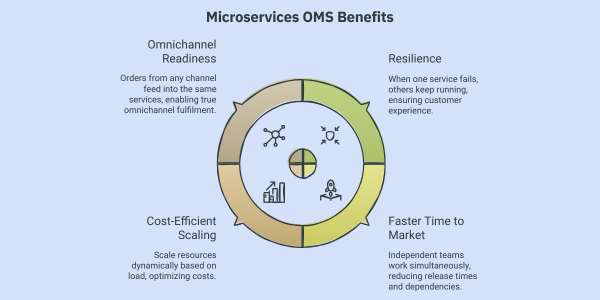
Resilience at scale
When one service fails, others keep running. Customers can still browse, add to cart, and check out even if, say, the notifications service is temporarily down. This is the kind of resilience that matters on Black Friday.
Faster time to market
Independent teams can work on different services simultaneously. There’s no waiting for other teams to finish before you can release. A new returns workflow can go live without touching the order capture service.
Cost-efficient scaling
Scale exactly what’s under load. Nothing more. Cloud-native microservices on containerized infrastructure (Kubernetes, for example) allow dynamic, cost-efficient resource allocation.
Omnichannel readiness
Microservices make true omnichannel fulfilment possible. Orders from any channel feed into the same services. The architecture doesn’t care whether the order came from an app, a website, or a store associate’s device.
Key Design Principles to Get Right
Microservices only deliver their promise when they’re designed well. A few principles that separate successful implementations from failed ones:
- Design for failure: Assume any service can fail at any time. Build retry logic, circuit breakers, and fallbacks.
- Use event-driven communication: Services should communicate asynchronously via events where possible. This reduces tight coupling and improves resilience.
- Own your data: Each microservice should own its own database. Shared databases bring back the coupling problems of monoliths.
- API contracts matter: Define clear, versioned APIs between services. This allows teams to evolve services independently without breaking integrations.
- Observability is non-negotiable: Distributed systems are harder to debug. Invest in centralized logging, distributed tracing, and real-time alerting from day one.
- Don’t over-decompose: More services are not always better. Group related functionality sensibly. A micro-microservice architecture creates operational overhead with no added benefit.
Common Pitfalls to Avoid
Microservices are not a silver bullet. Done poorly, they create more problems than they solve.
- Migrating everything at once: Big bang migrations almost always fail. Start with one domain and expand gradually.
- Ignoring latency: Network calls between services add up. Design with latency in mind.
- Underinvesting in DevOps: Microservices require strong CI/CD pipelines, container orchestration, and monitoring. These are not optional extras.
- Poor service boundaries: Services that are too fine-grained create a distributed monolith. Services that are too coarse lose the benefits of independence.
Acuver's Approach to Order Management
Migrating from a monolithic OMS to a microservices architecture is not a lift-and-shift exercise, it requires deep order management expertise, a clear understanding of your fulfilment complexity, and the engineering rigor to do it without breaking live operations.
At Acuver, OMS is at the heart of what we do. We have designed, implemented, and optimized order management systems for some of the world’s largest retailers and enterprises, across omnichannel, marketplace, and direct-to-consumer models.
Whether you are evaluating your first OMS, re-platforming away from a legacy monolith, or untangling a system that has grown too complex to manage, our team brings the architecture experience and the operational context to get it right.
From service boundary design and API strategy to phased migration planning and post-go-live performance tuning, we manage the complexity so you don’t have to.
Get in touch with our team of experts to enhance your Order Management strategy.