Why Most OMS Failures Are Implementation Failures, Not Product Failures
When an OMS rollout goes wrong, most businesses blame the software. In reality, the software is rarely the real problem. Most OMS failures trace back to how the system was set up. They are implementation failures, not product failures.
For a comprehensive understanding of what an OMS is, read our blog titled, What is an Order Management System: The Complete Guide for Modern Businesses.
A powerful OMS platform can still fail. This happens when a business skips proper planning, rushes data migration, or launches without training staff. The technology only works as well as the process built around it. This is why implementation deserves as much attention as the platform a business picks.
For a closer look at how an OMS handles orders behind the scenes, read our blog on how an OMS works.
What Are Some Pre-Implementation Best Practices to Follow?
The best pre-implementation practice is to prepare the business before the system goes live. This beats fixing problems after launch. A few steps make the biggest difference.
- Decide on what kind of OMS fits your business needs. Read our blog on the different types of OMS for a detailed breakdown.
- Conduct a data audit. Clean up SKUs, customer records, and historical orders before they move into the new system.
- Map the current order process end to end. This helps the team understand exactly what is being automated.
- Get stakeholder alignment across operations, IT, customer service, and finance. Every team should agree on goals before work starts.
- Set clear success criteria upfront. This tells everyone what a successful launch actually looks like.
If you have not yet confirmed your business needs one, read our blog titled, What Are the Signs to Know if Your Business Needs an OMS? before starting the steps above.
What Does the Implementation Phase Cover?
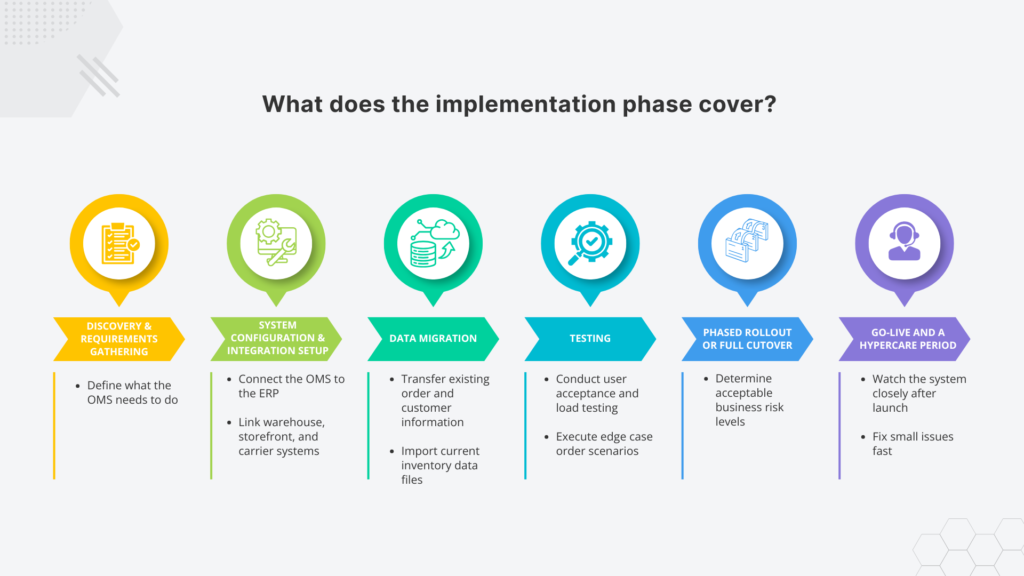
The implementation phase covers everything from early planning through the first days after launch. It usually moves through six stages. Each stage builds on the one before it.
- Discovery and requirements gathering, where the team defines what the OMS needs to do
- System configuration and integration setup, connecting the OMS to the ERP, warehouse, storefront, and carriers
- Data migration, moving existing order, customer, and inventory data into the new system
- Testing, including user acceptance testing, load testing, and edge case order scenarios
- Phased rollout or full cutover, depending on how much risk the business wants to take on at once
- Go-live and a hypercare period, when the team watches the system closely and fixes small issues fast
What Are the Best Practices to Follow During OMS Rollout?
The best practice during rollout is to protect the business from disruption while the new system beds in. A few habits help make that possible.
- Run parallel systems during the transition. The old process stays available as a backup until the new one proves stable.
- Train staff by role. A warehouse worker, a customer service agent, and a finance team member each need different training.
- Communicate any changes to customers if the order process shifts in a way they will notice, such as new tracking emails or a different returns process.
What Are the Post-Implementation KPIs That Must Be Tracked?
The KPIs that matter most after launch are order accuracy, fulfillment speed, returns, and inventory accuracy. These four numbers show whether the new system is actually delivering on its promise.
- Order accuracy rate, how often orders are fulfilled correctly the first time
- Fulfillment cycle time, how long it takes from order placement to shipment
- Return rate, how often customers send items back
- Inventory accuracy, how closely recorded stock levels match what is actually on the shelf
These KPIs should be checked weekly for the first month after launch. After that, a monthly check is usually enough, once the system settles into a steady rhythm. A good target is an order accuracy rate above 98 percent. Inventory accuracy should sit above 95 percent. Numbers below this range usually point to a process gap worth a closer look.
What Are Some Common OMS Implementation Pitfalls?
The most common pitfall is treating implementation as a purely technical task. In reality, it is a business change that needs planning and buy-in. A few specific mistakes show up again and again.
- Underestimating data migration complexity, which often takes far longer than the first timeline allows
- Skipping process mapping and simply automating workflows that were already broken
- Providing too little training, which leads staff to build workaround habits that undo much of the automation
- Choosing too many integrations at launch, instead of phasing them in over time. This is especially common with AI powered features, which are increasingly built into modern OMS platforms. Read our blog titled, How Is AI Changing the OMS Scene? to see what’s possible.
What Does a Sample OMS Implementation Timeline Look Like?
A typical OMS implementation takes anywhere from six weeks to nine months. The exact time depends mostly on business size and complexity. A rough breakdown looks like this.
- Small business: about six to eight weeks total, covering discovery, configuration, a short testing period, and go-live
- Mid-market business: about three to four months total, with more time for integrations, data migration, and staff training across several teams
- Enterprise business: about five to nine months total, since these projects usually involve many integrations, custom configuration, and a phased rollout across multiple locations
These ranges are only a starting point. A business with especially messy data should expect to add extra time. The same is true for a business with many sales channels.
Successful OMS Implementations Are Built on Preparation, Not Just Technology
The businesses that get the most out of their OMS are rarely the ones with the flashiest platform. They are the ones that took the time to audit their data. They mapped their processes. They aligned their teams. They trained their staff properly. Preparation, not technology alone, is what turns an OMS into a real advantage instead of an expensive tool.
However, getting an OMS implementation right takes more than picking good software. It takes a partner who understands how to plan the rollout, manage the data, and prepare every team for the change.
Acuver Consulting has guided businesses through OMS implementations across retail, eCommerce, and supply chain operations. Its team handles the full journey. This starts with the early data audit and process mapping. It continues through configuration, testing, and the hypercare period after go-live. Acuver focuses on getting the groundwork right the first time, so a business does not end up revisiting the same problems a year later.
Connect with Acuver’s team of experts to attain a successful OMS implementation.