Introduction
Selecting a modern Cloud Order Management System (OMS) platform is only the first step in digital supply chain transformation. The way you implement the system: from partner selection to delivery methodology, is what ultimately determines project success.
A well-executed implementation unlocks channel agility, real-time inventory visibility, and optimized fulfillment costs. A poorly planned implementation can cause project delays, cost overruns, and business disruption.
This blog evaluates the primary implementation approaches for Cloud OMS deployments to help you choose the right strategy for your business.
If you are new to Cloud OMS, explore our Complete Guide to Cloud Order Management to understand how it works.
If you are still evaluating your needs Ask yourself these 10 Key Questions to Know If It’s Time to Switch.
Why Your Implementation Approach Matters as Much as Your Platform
The same Cloud OMS software can succeed in one enterprise and encounter friction in another. Why? Because platform software provides features, while implementation methodology aligns those features with real-world business operations.
When planning a deployment, companies face several structural decisions:
- Should we use internal IT teams, software vendor services, or an independent specialist partner?
- Should we choose a single “big-bang” release or a phased, multi-stage rollout?
- Should we select an out-of-the-box configuration or build customized business logic?
Evaluating these trade-offs early helps mitigate project risks.
Implementation Dimensions to Evaluate
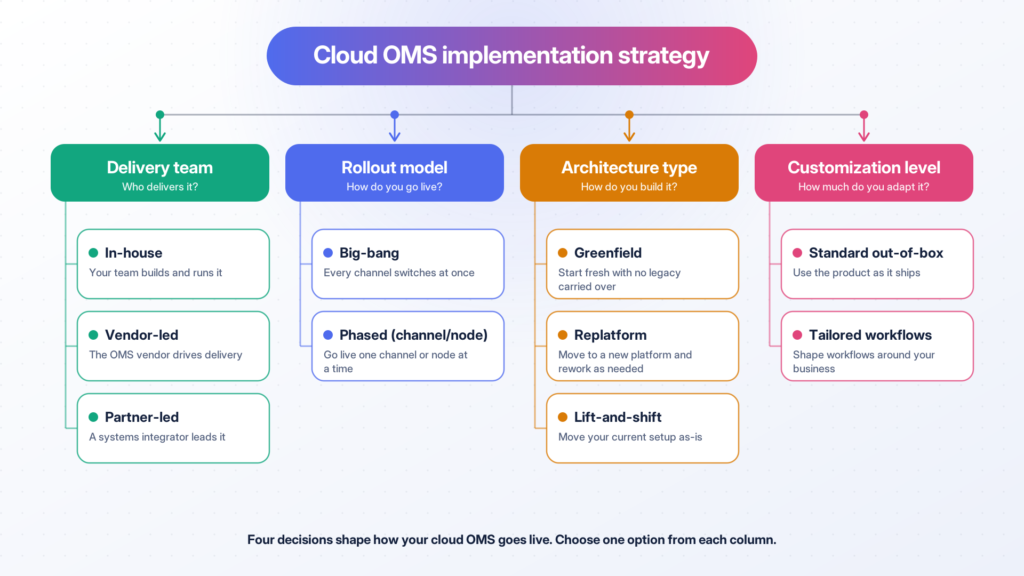
- Delivery Team Structure: In-House, Vendor-Led, or Partner-Led
Model | Primary Characteristics | Best Suited For | Risk & Effort Considerations |
In-House Team | Internal IT handles configuration, integration development, and deployment. | Organizations with large, specialized cloud integration teams. | High internal resource burden; potential gaps in specialized platform knowledge. |
Vendor-Led | The software provider’s professional services team handles implementation. | Standard deployments using traditional, out-of-the-box features. | Vendor expertise is high, but domain focus may skew heavily toward their specific tool rather than broader system integrations. |
Partner-Led | An independent supply chain implementation consultant designs, builds, and deploys the solution. | Complex multi-system enterprise environments requiring end-to-end integration expertise. | Provides broad system expertise (OMS, ERP, WMS), deep domain knowledge, and flexible delivery models. |
- Rollout Methodology: Big-Bang vs. Phased Rollout
Big-Bang Implementation
- Concept: All sales channels, fulfillment nodes, markets, and product categories switch to the new Cloud OMS simultaneously on a single go-live date.
- Advantages: Shorter overall project timeline; eliminates the need to maintain legacy bridges long term.
- Disadvantages: Higher operational risk during cutover; requires comprehensive organizational readiness on day one.
Phased Rollout
- Concept: Deployment occurs incrementally—phased by sales channel (e.g., e-commerce first, retail store POS second), geographic region, or fulfillment node.
- Advantages: Lower operational risk; allows teams to apply learnings from initial phases to subsequent rollouts.
- Disadvantages: Longer overall project duration; requires temporary middleware adapters to sync legacy and cloud systems during phase transitions.
- Migration Strategy: Greenfield vs. Replatform vs. Lift-and-Shift
- Greenfield (Fresh Start): Designing workflows, data schemas, and integrations from scratch. Ideal for business expansions, new brand launches, or legacy architectures beyond repair.
- Replatforming: Redesigning order workflows and updating system integrations while preserving existing business logic. Ideal for replacing aging legacy tools.
- Lift-and-Shift: Migrating existing order routing scripts directly to cloud infrastructure with minimal redesign. While fast, this model often carries forward legacy inefficiencies.
- Configuration Level: Standard Out-of-the-Box vs. Custom Extensions
- Standard Out-of-the-Box (OOTB): Using pre-built workflows for inventory allocation, order holds, and carrier routing.
- Pros: Rapid deployment, lower upfront costs, smooth upgrade paths.
- Cons: Requires business processes to align with pre-built software functions.
- Custom Extensions: Writing custom business logic to handle complex commercial agreements or unique fulfillment rules.
- Pros: Adapts software to exact enterprise specifications.
- Cons: Increases testing requirements and development costs; requires careful design to ensure seamless future platform upgrades.
- Architectural Approach: Monolithic Platform vs. Composable Architecture
- Monolithic / Single Suite: Deploying a unified software suite that manages storefront, OMS, and inventory modules within one platform ecosystem.
- Composable Architecture (MACH / Best-of-Breed): Assembling specialized microservices connected via APIs (Microservices, API-first, Cloud-native, Headless). This model gives enterprises flexibility to select best-in-class components for OMS, PIM, WMS, and payments.
Comparison at a Glance
| Approach Model | Best For | Typical Timeline | Cost Profile | Operational Risk | Internal Effort |
|---|---|---|---|---|---|
|
Phased + Partner-Led |
Complex enterprise retail & B2B brands |
6 – 12 Months |
Moderate – High |
Low – Controlled |
Balanced |
|
Big-Bang + Vendor-Led |
Single-channel or mid-market operations |
3 – 6 Months |
Predictable |
High |
High during go-live |
|
Greenfield + OOTB |
New business lines or D2C brand launches |
2 – 4 Months |
Low – Moderate |
Low |
Low |
|
Composable + Custom |
High-volume multi-brand enterprises |
9 – 15 Months |
Investment-heavy |
Managed via APIs |
High technical requirement |
Factors That Determine the Right Approach
When deciding on an implementation approach, evaluate the following factors:
- Business Complexity & Integration Landscape: How many ERPs, WMS environments, POS tools, and carrier networks need to connect?
- Internal Technical Capacity: Does your in-house IT team have hands-on experience building API integrations for cloud platforms?
- Peak Season Windows: Does your project timeline leave sufficient buffer before major holiday sales events?
- Risk Tolerance: Can your business absorb temporary operational friction during cutover, or is a zero-downtime phased rollout mandatory?
Commercial Models to Expect
When working with an implementation partner or vendor service team, implementations are typically structured under one of three models:
- Fixed-Scope / Fixed-Price: Well-defined projects with strict requirements. Ideal for standard OOTB deployments.
- Time & Materials (T&M): Flexible execution model where work is billed based on actual engineering hours used. Best suited for complex, enterprise composable architectures.
- Managed Services / Hybrid: Combines fixed deployment costs with ongoing post-go-live support and performance tuning.
Match the Approach to Your Business Reality
There is no universal “best” implementation strategy. A mid-market D2C brand may succeed with an out-of-the-box vendor deployment, while a global retailer with complex omnichannel routes needs a phased, partner-led rollout.
Before finalizing your deployment strategy, stress-test your chosen approach against a peak-season scenario: If order volume triples on day two of launch, does your delivery model provide the support needed to maintain system stability?
Successful cloud order management projects require deep supply chain expertise, proven integration frameworks, and clear architectural design.
At Acuver Consulting, we bring specialized expertise to Cloud OMS implementations. As an independent supply chain technology partner, we help enterprise retailers, manufacturers, and distributors design, deploy, and optimize complex order management systems.
Our services include:
- Architecture & System Design: Defining scalable API integrations across ERP, WMS, POS, and OMS platforms.
- Seamless System Migration: Managing complex data mapping, legacy migration, and interface development.
- Phased Rollout Management: Executing phased deployment strategies that protect live operations.
- Optimization & Support: Providing post-go-live hypercare and continuous system tuning.
Talk to our team of experts to discuss your Cloud OMS strategy.