Third-party failures now rank among the top five disruptive events, accounting for 9.3% of all business disruptions. Yet only 48% of organizations assess and mitigate supply chain disruption effects as part of their continuity programs. This gap creates dangerous exposure—at least 89% of companies have experienced supplier risk events within the last five years.
Reactive approaches fail when disruption strikes. The companies that survive supply chain crises share a common trait: they test their supplier networks before problems emerge, not after failures expose weaknesses.
Standard risk assessment practices miss critical vulnerabilities that continuous testing reveals. This article examines the blind spots in traditional supplier evaluations, outlines essential components for effective supply chain risk management, and shows how leading organizations build ongoing testing capabilities that identify risks before disruption occurs.
The Hidden Vulnerabilities in Standard Supply Chain Risk Assessment
Supply chain complexity creates a dangerous paradox. Over half of large organizations identify this complexity as the single greatest barrier to cyber resilience, yet their assessment methods cannot handle the very complexity they acknowledge. Traditional supplier evaluations rely on questionnaires and certifications—static tools that miss dynamic threats like insider activity, open-source vulnerabilities, and physical tampering.
The visibility problem runs deeper than surface-level assessments reveal. Only 13% of companies could map their entire supply chain in 2023, with 22% having no visibility beyond immediate suppliers. This blind spot matters because 85% of major supply chain incidents originate in Tier 2-4 suppliers. Consider the scale: the average S&P 500 enterprise manages 1,700 direct suppliers across its first three tiers, creating 1.5 million buyer-supplier relationships that standard assessments cannot monitor effectively.
Software supply chain attacks have tripled in the past year. Attackers target open-source libraries, physical infrastructure, and hidden dependencies that traditional risk frameworks never examine. Specialized suppliers create concentration risks that amplify this exposure—a single compromise within a supplier’s CI/CD pipeline can spread rapidly across the entire customer base.
Geographic risks compound these assessment gaps. Traditional frameworks focus on third-party evaluations while ignoring the cities or regions where vendors operate. Standard risk assessment practices cannot detect these multilayered vulnerabilities because they evaluate suppliers as isolated entities rather than interconnected systems.
Essential Testing Components for Supply Chain Risk Management
What does effective supply chain testing require?
Supply chain testing starts with complete supplier network mapping. Companies need centralized visibility across all suppliers, sub-suppliers, components, and their relationships. This mapping enables rapid risk identification and mitigation when issues emerge.
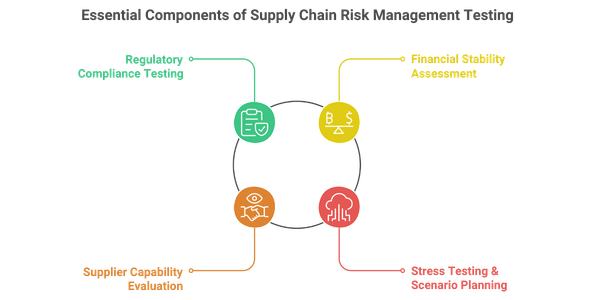
Regulatory Compliance Testing
Compliance verification combines scheduled audits with surprise inspections. Information requests alone miss operational realities that onsite visits reveal. Border detention risks now require supply chain documentation during customs reviews.
Financial Stability Assessment
Financial health indicators predict supplier failures before disruptions cascade through your operations. Credit ratings, liquidity ratios, profitability ratios, and debt-to-equity ratios reveal both short-term vulnerabilities and long-term stability. Credit risk monitoring tools generate scores on a 1-100 scale, representing default probabilities over one-year periods. Private suppliers need different validation methods since they lack public reporting requirements.
Supplier Capability Evaluation
Production capacity assessments examine technical expertise, quality management systems, and workforce capabilities. Key performance indicators include defect rates, on-time delivery metrics, lead time adherence, and capacity utilization rates. Suppliers often overstate their capabilities. Independent validation through onsite inspections prevents unexpected bottlenecks.
Stress Testing and Scenario Planning
Stress testing simulates high-risk events to develop response protocols. Scenario analysis examines demand fluctuations, regulatory changes, and transportation disruptions. This approach identifies single points of failure and builds mitigation strategies before crises occur.
Building Continuous Testing Capabilities
What separates annual assessments from continuous monitoring? The timing of when you test matters more than the depth of individual evaluations. Testing integrated into operational workflows catches vulnerabilities while they’re still manageable. Testing conducted after disruptions reveals problems too late to prevent damage.
Synchronized testing schedules prevent quality checks from falling behind operational changes. Continuous testing requires shared ownership across developers, operations teams, and quality assurance specialists. Modern test automation platforms operate autonomously within CI/CD pipelines, connecting with GitHub Actions, Azure DevOps, Jenkins, GitLab, and Bitbucket Pipelines. Tests execute with every system change, creating immediate feedback loops that flag failures without manual intervention.
Automated testing from CI servers keeps pace with development cycles rather than lagging behind releases. Pairing testers with developers ensures both groups maintain automation responsibilities. This approach prevents testing from becoming a bottleneck that slows deployment schedules.
AI-powered forecasting and supplier diversification now drive supply chain risk mitigation for leading organizations. This represents a fundamental shift from reactive recovery to proactive risk detection. According to Gartner research, organizations using continuous testing consistently exceed customer expectations. Embedding these processes into deployment pipelines maintains system resilience under pressure, reducing failures that impact operations and customer trust.
The companies implementing continuous testing today build competitive advantages that compound over time. Static annual reviews cannot match the precision of ongoing risk monitoring.
The Path Forward
Supply chain disruptions remain inevitable. The organizations that thrive during these events share a common approach: they test continuously rather than react to failures.
Annual assessments and static questionnaires belong to an outdated risk management era. Companies now building continuous testing capabilities position themselves to detect vulnerabilities before they escalate into operational crises.
What Sets Acuver’s Quality Engineering Apart
At Acuver, testing becomes an integral part of daily supply chain operations rather than an annual checkbox exercise. Suppliers undergo continuous evaluation across critical areas such as financial stability, operational capacity, and compliance standards. Risk monitoring is supported by automated systems that track changes in real time, allowing potential issues to be identified and addressed before they disrupt operations.
Beyond monitoring, Acuver works closely with organizations to design and implement robust supply chain testing frameworks tailored to their unique operational environments. By combining supply chain expertise, advanced technology solutions, and data-driven insights, Acuver helps businesses move from reactive risk management to a proactive resilience strategy.
Through these capabilities, Acuver enables organizations to build stronger, more transparent supply chain ecosystems that can withstand uncertainty and adapt quickly to disruptions.
Partner with Acuver today to begin building continuous testing capabilities that strengthen your supply chain resilience. The strategies you put in place today will determine how effectively your organization navigates the disruptions of tomorrow.