The digital supply chain moves fast. Orders are placed in seconds, fulfilment windows are measured in hours, and customer patience has a half-life of about thirty seconds. Beneath all of this, powering every click, every warehouse pick, every last-mile handoff is software. When this software doesn’t perform, the whole chain breaks.
That’s why quality engineering for digital supply chains is no longer a back-office checkbox. It’s a competitive differentiator. Yet, many businesses treat it as an afterthought. They believe it is something that happens at the tail end of a release cycle, just before go-live. That approach is costing them more than they realize.
The Digital Supply Chain Is More Complex Than It Looks
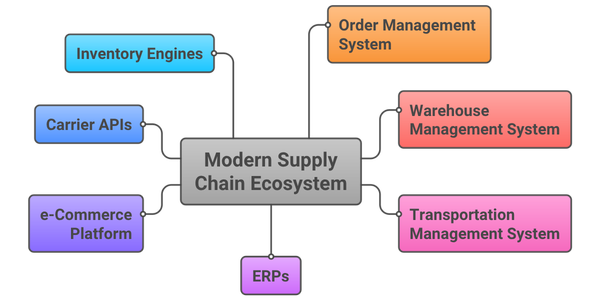
A modern digital supply chain isn’t a single system. It’s an ecosystem — Order Management Systems (OMS), Warehouse Management Systems (WMS), Transportation Management Systems (TMS), ERPs, e-commerce platforms, carrier APIs, and inventory engines, all talking to each other in real time. Each integration is a potential failure point. Each data handoff is an opportunity for something to go wrong.
The complexity compounds quickly. A retailer running omnichannel operations might be managing inventory across physical stores, dark stores, third-party logistics partners, and direct-to-consumer channels simultaneously. One failed API call between the OMS and the WMS, and suddenly an order that was promised in two days doesn’t ship.
The consumer doesn’t see the system failure. They see a broken promise.
This is why quality engineering in the supply chain context goes well beyond traditional software testing. It’s about validating end-to-end business flows, not just individual modules. It’s about ensuring that data integrity holds across integrations, that systems perform under peak load, and that releases don’t introduce regression into live operations.
What Goes Wrong Without It
The fallout from poor quality engineering in supply chains tends to be invisible — until it isn’t.
Inventory discrepancies quietly build up when data sync errors between the OMS and WMS go undetected. A logic gap in order routing means certain orders fall into a processing dead zone. An untested edge case in the payment reconciliation flow leads to settlement errors that only surface weeks later. None of these are dramatic. But each one chips away at operational efficiency and, eventually, customer trust.
The stakes are even higher during peak seasons. When order volumes spike and every system is running at full tilt, the margin for error drops to near zero. Performance bottlenecks that were invisible at regular load become catastrophic at scale. This is precisely when businesses learn, the hard way, that their QA strategy wasn’t built for the real world.
Shift Left, or Pay Later
The principle of “shift left” in quality engineering is simple: find issues early in the development cycle, before they become expensive to fix. In supply chain implementations and digital transformations, this means bringing QA into the conversation from the requirements stage, and not just at UAT (User Acceptance Testing).
When quality is baked into every sprint, teams catch integration inconsistencies early. Defects that would have cost ten times more to fix post-release get resolved during development. Business logic is validated against real-world scenarios, not just technical unit tests, so that the system behaves the way the business actually needs it to.
Agile QA methodologies, when applied correctly to supply chain programmes, also shorten release cycles significantly. Continuous testing integrated into CI/CD pipelines means teams aren’t waiting for a three-week test cycle to learn whether a new feature is ready. The feedback loop tightens, velocity increases, and quality doesn’t become the bottleneck.
The Automation Imperative
Supply chain systems are high-volume, high-complexity environments. Manual testing at scale is neither sustainable nor reliable. A regression suite that takes three weeks to run manually is a suite that doesn’t get run and that’s when things break in production.
QA automation for supply chain platforms addresses this directly. By automating high-frequency, high-impact test scenarios like, order creation flows, inventory allocation logic, warehouse task generation and carrier selection rules, teams get broad coverage without proportional resource spend. Automated regression suites can be triggered with every build, ensuring that new code doesn’t break existing functionality.
However, automation alone isn’t the answer. The intelligence behind it matters. It is important to know which test cases to automate, which to prioritize, and how to structure test data so it reflects real-world complexity. That’s where expertise makes the difference between an automation suite that delivers value and one that collects dust.
Performance Testing: The Reality Check
Digital supply chains are stress-tested by their very nature. Events like peak selling seasons, flash sales or new market launches, do not wait for systems to be ready. Performance testing is how businesses find out whether their platforms are ready before the traffic arrives.
Load testing, stress testing, and endurance testing aren’t just technical exercises. They’re business-critical activities. A checkout system that degrades under load doesn’t just lose revenue in the moment. It also loses customers for the long term. An order management platform that slows to a crawl during peak hours creates a backlog that can take days to clear.
The right performance testing strategy simulates real-world conditions such as, concurrent users, data volumes, integration latency and infrastructure constraints surfaces bottlenecks before they appear in production. For supply chain systems, this also means testing the performance of integrations, not just the application layer. An OMS might handle 10,000 concurrent orders without breaking a sweat, but if the API call to the logistics partner starts timing out at volume, the impact is the same.
Independent Verification: Trust But Verify
One underappreciated dimension of quality engineering in supply chains is independent verification and validation (IV&V). When QA is done solely by the team that built the system, blind spots are inevitable. Teams get close to their own work, and assumptions made during development get carried into testing.
Independent verification brings an objective lens. It validates that the system does what the business actually needs it to do, and not just what the development team assumed was required. For supply chain implementations, this is particularly valuable at integration points: verifying that data flowing between systems is accurate, complete, and consistent; that business rules are correctly implemented across platforms; and that the system holds up under scenarios that weren’t in the original specification.
In large-scale supply chain transformations like, ERP migrations, OMS implementations and platform re-platforms, IV&V is the safeguard that ensures go-live confidence.
Quality Engineering as a Business Strategy
Here’s the reframe that forward-looking supply chain leaders are making: quality engineering isn’t a cost centre. It’s a risk mitigation strategy and a growth enabler.
Every defect caught before go-live is a customer experience that doesn’t break. Every performance bottleneck identified before peak season is a revenue event that doesn’t fail. Every integration issue surfaced during testing is a data discrepancy that doesn’t compound into an operational crisis.
The numbers bear this out. Businesses that embed quality engineering early and consistently see meaningful reductions in post-release defects, faster release cycles, and lower total cost of ownership for their technology platforms. The investment in QA pays back multiple times over, in operational stability, customer retention, and the confidence to scale.
The Road Ahead
Digital supply chains are only going to get more complex. As businesses expand across geographies, add fulfilment channels, and integrate with more partners and platforms, the surface area for quality risk grows. Capabilities like, AI-driven order routing, real-time inventory visibility or hyper-personalized fulfilment are powerful, but they require the software underneath them to work flawlessly.
Quality engineering is how businesses make sure it does. Not as a phase at the end of a project, but as a discipline embedded into every layer of the supply chain technology stack, from the moment a code is written to the moment it scales in production.
For businesses serious about building supply chains that can handle whatever the market throws at them, the question isn’t whether to invest in quality engineering. It’s whether they’re investing in it early enough and deeply enough.
Acuver’s Quality Engineering practice is purpose-built for supply chain and logistics environments. From shift-left test strategies and QA automation to performance engineering and independent verification, we help businesses build digital supply chains that perform when it matters most. Get in touch to learn how we can help.