Warehouse operations face a fundamental challenge: most companies operate without knowing where their inventory actually sits. The numbers tell a stark story:
Only 6 percent of businesses achieve full inventory visibility, while U.S. retail operations manage just 63 percent inventory accuracy. This means roughly one-third of your stock records contain errors that impact daily decisions.
The financial consequences are staggering. Global inventory distortion from overstocks and stockouts reaches an estimated $1.77 trillion annually. When items appear out of stock, nearly 70% of online shoppers abandon their cart and move to competitors. Companies that establish real-time visibility cut their inventory costs by 20% on average.
What does this mean for your operation? Operating every day without accurate, real-time inventory data, means making critical decisions based on incomplete information.
This article explores why guesswork drains resources, the technical infrastructure required for true visibility, proven implementation approaches, and how to achieve operational control over your inventory.
The Hidden Costs of Manual Inventory Management
Manual inventory tracking drains resources faster than most operations realize. Employees spend 20 to 40 hours monthly counting stock, updating spreadsheets, and reconciling discrepancies. This time excludes preparation costs, overtime pay, production slowdowns, or the inevitable recounts when errors surface.
The financial damage spreads across multiple areas: direct operational costs where each mispick can cost and lead to heavy annual losses, shrinkage impact and inventory inflation, where when stock records fail, purchasing teams over-order as protection.
Inaccurate data forces reactive decisions that compress margins further. Companies operating on guesswork spend 30% more on expedited shipping to cover unexpected shortages. Orders ship incomplete, detention fees accumulate when trailers can’t be located, and customer trust erodes with each delayed fulfillment.
The vulnerability intensifies as operations scale. Nearly 43% of small businesses either don’t track inventory or depend on outdated systems. These gaps create operational blind spots that worsen with growth, turning minor inefficiencies into major cost centers.
Technical Infrastructure for Real-Time Inventory Visibility
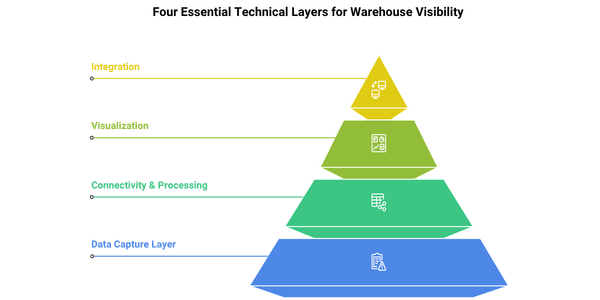
Real-time warehouse visibility depends on four essential technical layers working together. Each layer serves a specific function in capturing, processing, and presenting inventory data.
- Data Capture Layer
The foundation requires hardware that identifies and tracks items as they move. Your options include:
- Handheld or vehicle-mounted barcode scanners for manual verification
- Fixed RFID portals that automatically detect tagged items passing through
- IoT sensors for environmental monitoring and location tracking
- GPS-enabled telematics for in-transit load visibility
RFID tags communicate with scanners to update inventory records automatically as items move through warehouses. Barcode scanning ensures stock levels remain accurate with each scan at receiving, storage, or checkout.
- Connectivity and Processing
The connectivity layer relays scans or sensor pings without latency, using Wi-Fi, cellular, or LPWAN networks. Edge or middleware processing filters duplicate reads, validates data against master tables, and publishes clean events to upstream systems. Your WMS serves as the system of record, storing real-time stock by SKU, location, lot/serial, and status.
- Visualization
Visualization comes through dashboards, heat maps, and exception alerts covering low stock, dwell-time breaches, and cold-chain alarms accessible on web and mobile. Your operations dashboard must pull live data streams via APIs from core technologies to create a single source of truth.
- Integration
Essential integrations include WMS for inventory and order tracking, ERP for financial alignment, TMS for shipping logistics, and WCS for monitoring robotics and automation hardware.
Achieving Operational Control Through Systematic Implementation
Most visibility projects fail because companies attempt enterprise-wide rollouts without establishing foundations. This approach creates chaos rather than clarity.
Start by identifying your information gaps. Where do you consistently lack critical data? Common blind spots include in-transit milestones, yard locations, staging areas, and carrier performance metrics. Interview dispatchers, planners, warehouse supervisors, and customer service teams to understand their daily frustrations with missing information.
Focus on specific business outcomes, not technology features. Select two or three measurable goals such as reducing detention fees, decreasing stockouts, improving delivery accuracy, or stabilizing just-in-time replenishment. These targets should directly impact your bottom line and address the pain points identified by your teams.
Clean your data before building dashboards. The most sophisticated visualization tools fail when item IDs, location codes, and timestamps don’t align across systems. Consolidate data sources from your WMS, TMS, ERP, carrier feeds, scanners, and telematics to ensure consistent, reliable information flows.
Establish clear operational ownership. Define who monitors alerts, contacts carriers, adjusts dock schedules, and manages handoffs between departments. Create simple response protocols: “When a truck runs more than 60 minutes late, customer service receives automatic notification, dock schedules adjust automatically, and picking priorities shift to available inventory.”
Pilot your approach before scaling. Begin with one facility, region, or shipping lane. Track key metrics including on-time-in-full delivery, dwell time, inventory turns, overtime hours, and customer complaints. Most operations achieve measurable improvements within 3-6 months as staff adapt to new workflows. Scale systematically once processes prove stable and valuable.
Warehouse Visibility Implementation with Acuver
Implementation success depends on choosing partners who understand both the technical requirements and operational realities of warehouse management. Our WMS practice begins with detailed analysis of your business model, warehouse process model, organizational security model, infrastructure model, and operational expertise to ensure proper alignment.
Our approach centers on practical outcomes: real-time inventory tracking that prevents overstocking and stockouts, automation systems that reduce operational costs, and workflows designed for accuracy and efficiency. Each client receives WMS product recommendations based on their specific operational requirements rather than one-size-fits-all solutions.
Domain Expertise Across Industries
We apply domain knowledge across retail, manufacturing, consumer goods, and logistics sectors. Each industry presents unique challenges requiring tailored approaches to inventory management, order fulfillment, and operational efficiency. Our team brings more than 500 man-years of combined experience to deliver customizable solutions that address specific client requirements while supporting customer retention goals.
Get in touch with our team to transform your warehouse operations.