If you are dealing with, clipboards, handwritten pick lists and stock counts that take three days and still come back wrong, then you are not alone.
A surprising number of warehouses still run on manual processes, not because people do not want to change, but because they’re not sure where to start, or they’re afraid of disrupting what’s already (barely) working.
The good news: moving from manual to digital warehouse operations does not have to be a chaotic overhaul. When done right, it’s a phased, manageable shift that pays dividends at every stage.
This blog walks you through the true cost of staying manual, a step-by-step digital transformation roadmap, the common pitfalls to avoid along the way, and what a fully digital warehouse operation actually looks like when it’s done right.
The True Cost of Manual Warehouse Operations
Manual processes feel safe because they’re familiar. But familiarity isn’t the same as efficiency. The real cost of staying manual adds in ways that don’t always show up directly on the balance sheet.
- Picking errors: Manual pick lists lead to mismatches between what was ordered and what gets shipped. Returns spike. Customer satisfaction drops.
- Inventory inaccuracy: When stock levels are tracked on spreadsheets or paper, you’re always working with yesterday’s data. Overselling, stockouts, and phantom inventory become routine.
- Labor inefficiency: Workers spend time searching for items, walking inefficient routes, and double-checking counts. Productive capacity is wasted.
- Compliance risk: In regulated industries, manual records are hard to audit, easy to lose, and difficult to trace.
- Scalability ceiling: You can hire more people, but manual processes don’t scale. You hit a ceiling where adding headcount stops solving the problem.
The shift to digital isn’t about replacing people. It’s about giving people better tools to do their jobs.
The Digital Transformation Roadmap: Step by Step
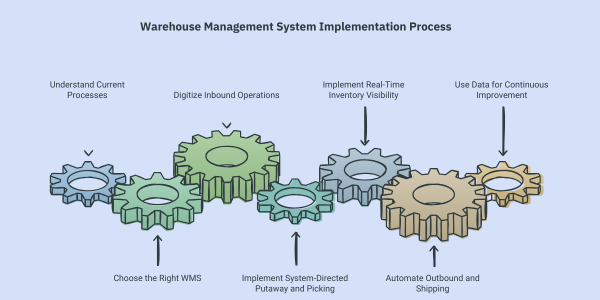
Step 1 — Understand what you have
Before implementing anything, map your current processes in detail.
- How do goods arrive, and how is receipt recorded?
- How is stock stored, located, and counted?
- How are pick lists generated and fulfilled?
- How are outbound shipments tracked and confirmed?
- Where do errors most commonly occur, and what causes them?
This process audit is not a formality. It’s the foundation. Every system you implement should solve a real problem identified here.
Step 2 — Choose the right WMS for your scale
A Warehouse Management System (WMS) is the core of digital operations. But not every WMS is built for every business.
- Small to mid-size operations: Need simple, configurable solutions with fast implementation timelines.
- Large, complex operations: Require enterprise-grade platforms with multi-site support, advanced slotting, and deep integration capabilities.
- Omnichannel retailers: Need tight OMS-WMS integration so inventory is visible and allocatable across all fulfilment channels.
The wrong WMS creates as many problems as it solves. Choose based on your actual operational complexity, not on a vendor’s marketing materials.
Step 3 — Digitize inbound operations first
Start at the beginning of the warehouse journey: receiving.
Implement barcode scanning or RFID for goods receipt. Connect it to your purchase orders. When a pallet arrives, the system knows what should be on it and flags discrepancies instantly.
This single change eliminates a massive source of downstream error. Bad data at inbound corrupts everything that follows.
Step 4 — Move to system-directed put-away and picking
Once goods are received digitally, the WMS can direct where they go.
- Put-away logic: The system assigns storage locations based on rules product velocity, size, weight, hazard classification, and proximity to pick zones.
- Directed picking: Workers receive optimized pick tasks on handheld devices. Routes are calculated to minimize travel. Pick sequences are validated by scan.
This is where the efficiency gains become immediately visible. Picking errors drop. Pick rates increase. Training time for new staff shrinks significantly.
Step 5 — Implement real-time inventory visibility
Digital operations mean every movement is recorded. Every scan updates the inventory record. Stock levels are accurate in real time, not at the end of a shift.
Connect this to your OMS and you have a single source of truth. Overselling becomes a thing of the past. Fulfilment promises become reliable.
Step 6 — Automate outbound and shipping
Packing and dispatch are often the most error-prone parts of manual operations.
- Pack verification scans confirm every item in every order before sealing.
- Carrier integration generates labels automatically and books collections.
- Proof of dispatch is captured digitally, not on paper.
Automation here doesn’t just reduce errors it speeds up your output significantly, especially during high-volume periods.
Step 7 — Use data to continuously improve
Digital warehouses generate data that manual warehouses never had. Use it.
- Labor analytics: Identify high performers and bottlenecks. Coach based on evidence, not assumptions.
- Slotting optimization: Regularly review whether your fastest-moving SKUs are in the most accessible locations.
- Error pattern analysis: Track where mistakes happen and redesign processes to prevent them.
- Throughput reporting: Understand your capacity and plan accordingly for seasonal peaks.
Common Mistakes to Avoid
- Going live all at once — phase your rollout. Pilot in one zone or one process before expanding.
- Underestimating change management — the technology is often the easy part. Getting teams to adopt new ways of working takes investment, communication, and patience.
- Choosing a WMS based on price alone — the cheapest solution usually lacks the flexibility to grow with you.
- Neglecting integration — a WMS that doesn’t talk to your OMS, ERP, or carrier systems creates information silos, not visibility.
- Skipping the process audit — implementing technology on top of broken processes just automates the problems.
What Success Looks Like
A mature digital warehouse operation looks like this:
- Inventory accuracy above 99%
- Picking errors measured in fractions of a percent
- Real-time visibility from receiving to dispatch
- Seamless integration with OMS, ERP, and carrier systems
- A team empowered by technology, and not constrained by it
The transition takes time. But every phase delivers value. You don’t have to wait until the end to see the results.
How Acuver Helps Warehouses Make the Shift
Moving from manual to digital warehouse operations is not just a technology project, it is an operational transformation. At Acuver, our warehouse management practice is built around making that shift structured, low-risk, and fast to value.
From WMS selection and implementation to OMS-WMS integration, process reengineering, and post-go-live optimisation, we work across the entire warehouse lifecycle not just the technology layer. Our teams have delivered warehouse transformations for Fortune 500 companies and global retailers, across complex multi-site, omnichannel, and high-velocity fulfilment environments.
Whether you are dealing with inventory inaccuracy, picking inefficiencies, or a WMS that no longer fits your scale, Acuver brings the expertise to diagnose the root cause and implement the right solution.
Connect with our team of experts to start with your tailored WMS strategy.