What AI Model Testing Means in the Context of Supply Chain
AI model testing checks if an AI system is accurate, reliable, and safe before it goes live.
Supply chains have many moving parts. These include inventory, demand forecasting, logistics, and supplier coordination. AI models help manage these tasks. But they must be tested first.
Testing answers three questions:
- Does the model read and process data correctly?
- Does it produce results that match real-world expectations?
- Does it hold up under stress, such as seasonal spikes or supply disruptions?
In short, testing makes sure the system is ready before it handles real decisions.
How AI Model Testing Differs from Traditional Software Testing
AI model testing and traditional software testing are very different. The key reason: AI output is not fixed.
Traditional software follows fixed rules. If you input A, the output is always B. Testing checks that the code does what it was built to do.
AI models are different. They learn from data. They make predictions based on patterns. The same input can give different outputs depending on the model version or the training data. This makes testing more complex.
Here is how the two differ:
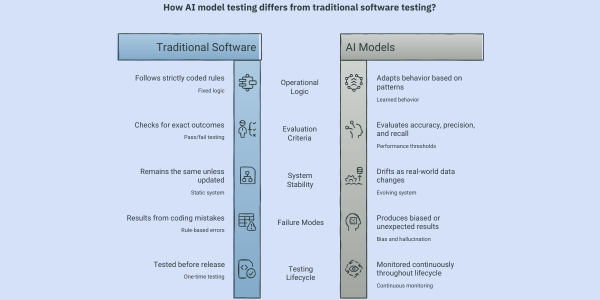
- Fixed logic vs. learned behavior: Traditional software follows coded rules. AI models learn from data and adapt.
- Pass/fail vs. performance thresholds: Traditional tests check exact outcomes. AI tests measure accuracy and precision within acceptable ranges.
- Static vs. evolving systems: Traditional software stays the same unless updated. AI models can drift as data changes. Ongoing testing is needed.
- Rule-based errors vs. bias: Traditional bugs are code mistakes. AI models can produce biased or wrong results even when the code is correct.
- One-time vs. continuous testing: Traditional software is tested before release. AI models need testing before deployment and monitoring throughout their lifecycle.
Why Does AI Model Testing Matter More in the Context of Supply Chain Systems?
Supply chains are high-stakes environments. One wrong AI decision can trigger large-scale, costly failures.
AI in supply chain does not just support decisions. It drives them. It affects inventory levels, order fulfilment, procurement budgets, and delivery times. An untested model can create errors that spread fast across the entire chain.
Here is why testing matters more here, and what you gain:
- Demand forecasting errors are expensive: A model that predicts demand wrong leads to overstocking or stockouts. Testing keeps forecasts accurate. The benefit: lower inventory costs and fewer lost sales.
- Logistics decisions affect customers: AI models that plan routes affect delivery speed and reliability. A poorly tested model causes delays and failed deliveries. The benefit: better on-time rates and stronger customer trust.
- Procurement decisions carry financial risk: Models that automate purchasing must be tested against real contract terms and lead times. The benefit: more accurate procurement and fewer supplier failures.
- Disruptions amplify errors: Supply chains face port delays and material shortages. A model trained on stable data may fail when conditions change. The benefit: a model that holds up in abnormal conditions.
- Compliance and audit requirements: Many industries require documentation of how automated decisions are made. Testing helps prove systems meet regulatory standards. The benefit: lower compliance risk and more transparency.
- ERP and WMS integration: AI models connect to systems such as SAP and Oracle. Testing ensures these connections work without data errors. The benefit: smooth integration and reliable data flow.
Where Should Enterprises Begin Testing AI Models Within Supply Chain Operations?
Start with the AI models that control the most critical or most frequent decisions in your supply chain.
Not every model needs the same level of testing right away. Prioritize by business impact. Here is a practical place to start:
- Identify your AI touchpoints: Map every place where AI is active: demand forecasting, route optimization, inventory replenishment, quality inspection, and supplier selection.
- Rank by risk and volume: Focus first on models that run often and make high-value decisions. A daily forecasting model is a higher priority than one used monthly for minor adjustments.
- Establish a baseline for performance: Define what good looks like before you test. Set targets such as acceptable forecast error rates, accuracy thresholds, or latency limits.
- Test with historical and synthetic data: Use past supply chain data to see how the model would have performed. Also build test scenarios for edge cases such as demand spikes and supplier failures.
- Test integrations separately: AI models rarely work alone. Test how the model connects with ERP, WMS, or TMS systems. Confirm data flows correctly in both directions.
- Document everything: Keep records of what was tested, what the results were, and what changes were made. This creates an audit trail and helps you improve over time.
What Are the Risks of Deploying Untested AI Models in Supply Chain?
Deploying an untested AI model is like making critical decisions with incomplete information.
The risks include:
- Cascading failures: One wrong prediction, such as an incorrect inventory count, can lead to stockouts, production delays, and missed deliveries. These errors spread fast in interconnected systems.
- Financial losses: Poor AI decisions can cause excess stock, emergency procurement at high prices, or fulfillment failures. The financial impact can be severe at enterprise scale.
- Reputational damage: Customers notice late deliveries and wrong orders. Repeated failures caused by poor AI performance damage the enterprise’s reputation over time.
- Regulatory violations: In regulated industries, automated decisions must meet specific standards. An untested model may produce outputs that trigger audits or fines.
- Data and security risks: Untested models may interact poorly with data pipelines. This can expose sensitive data or cause incorrect data to enter core systems.
- Difficult root-cause analysis: When an untested model fails, finding the cause is hard. There is no baseline to compare against. This extends downtime and slows recovery.
How Can Enterprises Build an Effective AI Testing Framework for Supply Chains?
An effective AI testing framework combines structured processes, clear benchmarks, and continuous monitoring.
Here are the core components:
- Define testing objectives: Every AI model needs a clear purpose and measurable success criteria. The team must agree on what the model should do and how performance will be measured.
- Build a structured test environment: Create a test environment that mirrors production as closely as possible. This includes real data, integrated systems, and realistic workloads.
- Apply multiple testing types: A complete framework covers unit testing, integration testing, performance testing, regression testing, and adversarial testing. Each type checks a different aspect of model behavior.
- Monitor models in production: Testing does not end at deployment. Use ongoing monitoring to track accuracy, detect data drift, and flag anomalies before they become problems.
- Establish a retraining process: Set clear criteria for when a model should be retrained or reviewed. This keeps the model accurate as conditions change.
- Involve domain experts: Supply chain professionals understand things that data scientists may not. Include logistics managers, procurement teams, and operations staff in test design and review.
- Maintain documentation and version control: Track every model version, every test run, and every change made. This supports compliance and builds a clear performance history.
The Future of AI-Driven Supply Chains Starts with Reliable AI Testing
AI is now central to how enterprises run their supply chains. Autonomous procurement, real-time logistics, and predictive maintenance are all being deployed today.
But AI only delivers its full value when the models are reliable. Enterprises that invest in rigorous testing will scale AI faster, reduce operational risk, and make more confident decisions.
As AI systems grow more complex, the need for structured testing will only grow.
The future of AI-driven supply chains depends on trust. Trust is built through testing.
How Can Acuver Help in AI Model Testing in Supply Chain Systems?
Acuver helps enterprises design, implement, and improve AI testing frameworks built for supply chain environments.
With deep expertise in supply chain technology and quality engineering, Acuver works with enterprises to:
- Identify the right testing approach for your existing AI models
- Build testing environments that reflect real operational conditions
- Validate AI integrations with ERP, WMS, and TMS platforms
- Set up monitoring frameworks that track model performance after deployment
Whether you are testing an AI model for the first time or improving your existing process, Acuver provides the expertise and tools to help your supply chain AI perform reliably at scale.