Introduction
The quietest failure mode in enterprise software is the one where nothing breaks. The system runs. Orders flow. Support tickets stay within tolerance. And three years later, the business case that justified the program has never been revisited, because nobody owned the question of whether it was actually delivered.
That’s the gap Gartner’s finding that roughly 70% of recently implemented enterprise software initiatives fail to achieve their original business goals is really describing. Not systems that fell over, but systems that went live and then stopped improving.
IBM Sterling OMS managed services exist to close that gap, and as of March 2026, the definition of what they should include has changed materially, because agentic AI now sits inside the platform rather than alongside it. This blog covers what a run engagement should cover, how to structure it, and how to think about activating AI agents once your core order flows are stable. For the delivery view that precedes all of this, see our phase-by-phase implementation roadmap.
What Do IBM Sterling OMS Managed Services Include?
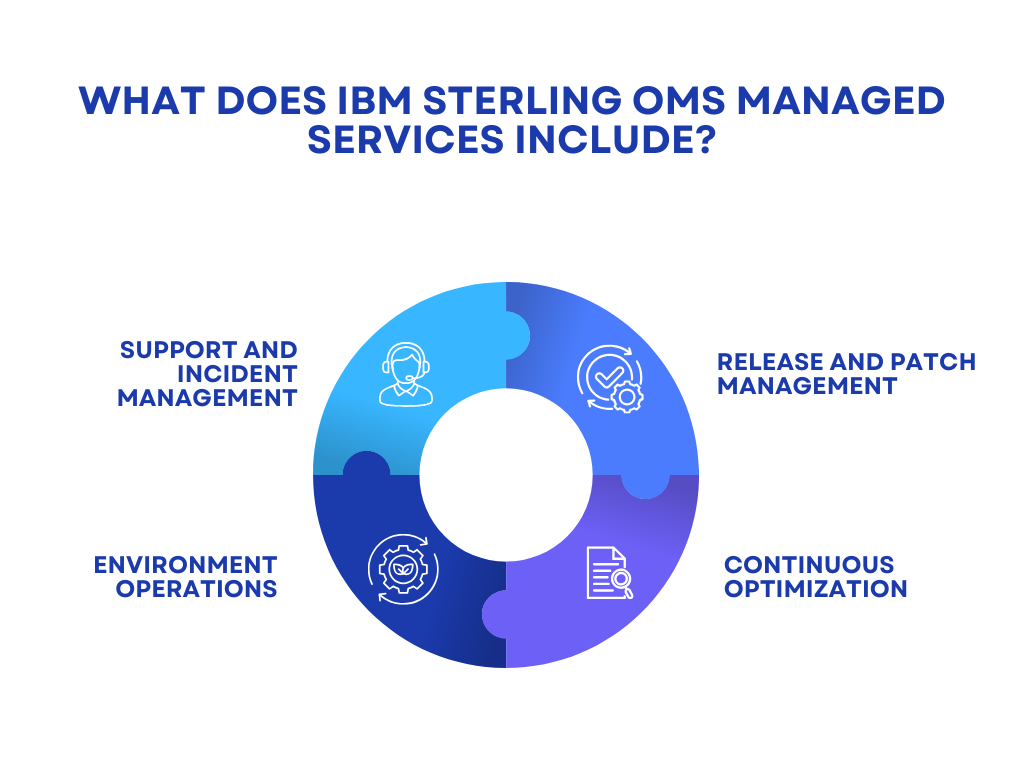
IBM Sterling OMS managed services are the ongoing support and optimization activities that keep a live Sterling estate healthy and improving. They usually span four areas: incident and defect management against agreed service levels, release and patch management aligned to IBM’s continuous delivery cadence, environment operations including provisioning and refresh, and continuous optimization of sourcing rules, inventory logic, and performance.
The first three are table stakes. The fourth is where the difference shows up.
Support and Incident Management
Tiered support against defined service levels, with clear escalation into IBM Support for genuine product defects. The distinction matters: your partner owns your business logic, integrations, and configuration; IBM owns the product beneath them. A run team that can tell the difference quickly resolves incidents faster than one that escalates everything.
Release and Patch Management
Sterling moves on a continuous delivery cadence, which means your run model needs a standing regression capability rather than an annual testing event. This is the single strongest argument for automated test coverage built during implementation, it becomes the thing that makes routine updates routine.
Environment Operations
Provisioning, refresh, configuration parity, and cost management across environments. Automated environment management is quietly one of the highest-return activities in a run engagement
Continuous Optimization
Sourcing rule tuning, node prioritization, promise accuracy, cancellation root-cause analysis, and peak readiness. This is the part of the contract most often written vaguely and delivered thinly. Ask for it to be specified: which metrics, reviewed how often, with what mandate to change things.
Why Are Enterprises Migrating Now?
Three models, and the choice tends to follow how much internal Sterling capability you want to retain.
| Model | Full managed | Co-managed | Advisory retainer |
|---|---|---|---|
|
Partner owns |
Support, releases, environments, optimization |
Deep technical work and releases |
Architecture guidance and reviews |
|
You own |
Business process and priorities |
Day-to-day support and triage |
Everything operational |
|
Best when |
No internal Sterling practice, or you want the build team to stay |
You have a capable team needing depth on tap |
Mature internal practice needing a second opinion |
|
Watch for |
Knowledge concentration outside your organization |
Unclear ownership boundaries at the seam |
Too thin to catch drift |
Whichever model you choose, settle one question explicitly at contract stage: does the team that built the system stay? Continuity of the people who made the design decisions is worth more than almost any service level clause, because they carry the reasoning that documentation never fully captures.
What Is Agentic AI in IBM Sterling OMS, and Should You Activate It?
IBM made agentic AI capabilities generally available inside Sterling OMS on 6 March 2026 through the Sterling OMS Agentic Toolkit Add-On. The toolkit includes agents for order information, coupon enforcement, order cancellations, inventory segmentation, and contract risk assessment — each aimed at a specific operational decision rather than at general automation.
Two capabilities matter more than the agent list itself.
Extensibility through MCP. IBM’s documentation confirms that you can extend OMS and integrate your own externally developed AI agents through a Model Context Protocol server, available in the Agentic Toolkit Add-on. That turns Sterling from an endpoint into a participant in workflows that span commerce, service, and supply chain systems.
Embedded operational agents. IBM has also been rolling out watsonx-powered agents inside Order Hub and Sterling Call Center, including administrator tooling that lets teams create, modify, and remove AI tools directly in the Order Hub interface, with some capabilities running through a private preview program for SaaS customers first.
When Should You Activate?
Not during your implementation. Three preconditions are worth insisting on.
Your core order flows are stable. Agents make decisions on top of your data and rules. If sourcing logic is still being tuned, an agent will make confident decisions based on assumptions you’re still changing.
Your data is trustworthy. Agent output inherits the quality of the inventory and order data underneath it. This is the least glamorous precondition and the most important one.
You’ve picked the two or three that matter. Activating every available agent is a way to generate change management work without a matching business case. Start where your operational pain is measurable, call handling time, cancellation rate, promise accuracy and expand from what works.
IBM has also packaged this as a service: an Expert Labs activation package for Sterling OMS agentic AI that deploys and configures agents within a client’s OMS and Sterling Intelligent Promising environment. Whether you route through IBM, a partner, or your own team, the sequencing advice stays the same.
Where the constraint is orchestration across systems rather than intelligence within Sterling, that’s a different problem with a different answer, our AI orchestration platform Aekyam handles the integration layer, and we’ve used it alongside IBM Sterling NextGen OMS where inventory unification was the real blocker.
Getting Long-Term Value From IBM Sterling OMS Managed Services
Three things to carry forward. IBM Sterling OMS managed services are four capabilities, and continuous optimization is the one that separates a supported system from an improving one. Continuity of people beats contractual detail, so settle the “does the build team stay” question before signing. And agentic AI is genuinely available now, but it belongs after stability and data quality, not before them, activated deliberately, two or three agents at a time.
Acuver Consulting is a supply chain consulting firm, specializing in Order Management, Warehouse Management and Software Engineering solutions. As an IBM Business partner, Acuver has run application managed services for IBM Sterling Order Management, across retail, manufacturing, and logistics enterprises in India, the UK, the US, and APAC. If you’re still shaping the wider engagement, our complete guide to IBM Sterling OMS implementation partner services covers how build and run fit together, and if you’re migrating an existing estate first, start with on-premises to OMoC migration.
Want to know more go-live services for IBM Sterling OMS Managed Services? Connect with our team of experts for a detailed idea.