Introduction
Most IBM Sterling OMS programs don’t fail loudly. They drift. A design decision gets deferred, the pilot gets shortened to protect the go-live date, cutover happens six weeks before peak season because the calendar had already been announced, and by January everyone is exhausted and the business case is quietly forgotten.
The antidote isn’t heroics. It’s a roadmap where each phase has a clear exit condition, and where nobody moves forward until it’s met. That sounds obvious written down. McKinsey’s research on supply chain IT modernization found 35% of executives reported that a new planning system’s impact simply didn’t meet expectations, which is what happens when phases blur into each other.
This blog walks the six phases of an IBM Sterling OMS implementation roadmap, what “done” looks like at each gate, and where programs most commonly lose time. It’s the delivery view — for the commercial view, see our blog on what drives IBM Sterling OMS implementation cost.
What Are the Phases of an IBM Sterling OMS Implementation?
An IBM Sterling OMS implementation roadmap typically moves through six phases: discovery and current-state assessment, solution and integration design, build and configuration, conference room pilot with integrated testing, cutover and go-live, and hyper care transitioning into managed services. Enterprise programs usually run these in overlapping waves rather than strict sequence, phased by geography, channel, or business unit.
Here’s what each one actually involves.
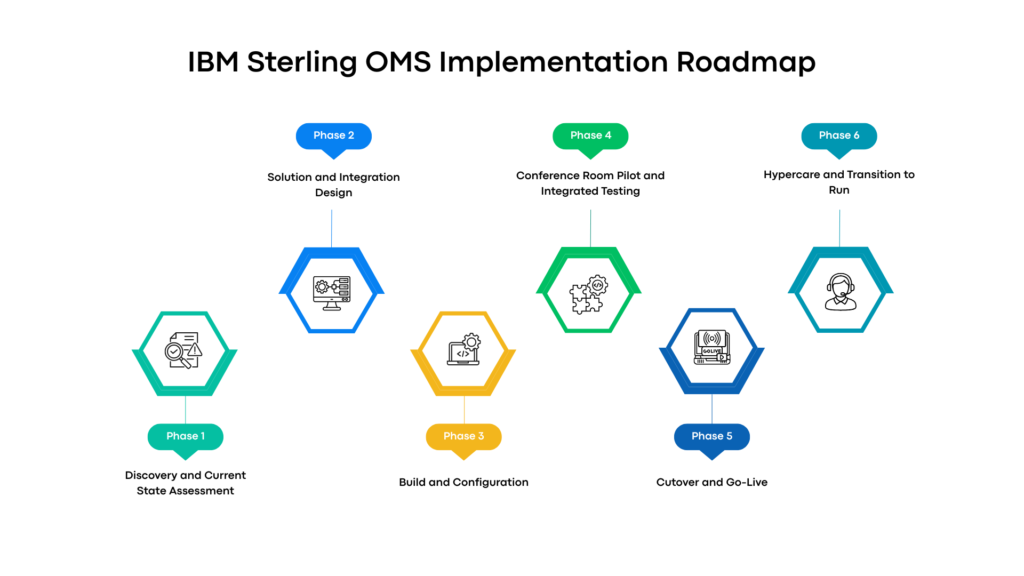
Phase 1: Discovery and Current-State Assessment
What happens: Order lifecycle mapping across every channel, integration inventory, data profiling, node and network modelling, and the deployment decision: on-premises, on cloud, or hybrid.
Exit condition: A signed-off current-state map where every integration has an owner and every data domain has a quality assessment. Not a slide deck. A register.
Where it goes wrong: Discovery gets treated as a formality because “we already know our business.” The integrations nobody remembered are the ones that surface during build, at four times the cost of surfacing them here.
A useful test: ask your team to name every system that receives an order status update. If the list takes more than a day to compile, discovery is doing exactly what it should.
Phase 2: Solution and Integration Design
What happens: Target architecture, organization and item modelling, sourcing and scheduling rules, pipeline design, extension strategy, and the integration contracts, payloads, error handling, retry logic, reconciliation.
Exit condition: Design decisions documented with rationale, and the configure-versus-customize line drawn explicitly. Every deviation from standard Sterling behavior should have a written reason, because in three years someone will need it during an upgrade.
Where it goes wrong: Customization decisions made locally, sprint by sprint, without anyone holding the cumulative view. Ten reasonable local decisions become one very expensive upgrade path.
Phase 3: Build and Configuration
What happens: Configuration, extensions, integration development, and running in parallel, not after the automated test development.
Exit condition: Feature-complete against the signed design, with automated regression coverage on the critical order paths.
Where it goes wrong: Testing queued behind build. On a system that carries live revenue, quality engineering that starts after build has already lost the ability to influence design. The defects it finds are the expensive kind.
Environment note: this is the phase where teams discover they budgeted four environments and need six. Parallel workstreams collide over shared environments, and the resulting queue is invisible in the plan but very visible in the burn rate.
Phase 4: Conference Room Pilot and Integrated Testing
What happens: End-to-end business scenarios run by actual business users, not the project team. Integration testing across the full landscape. Performance and peak-load testing against realistic volumes. Mock go-lives.
Exit condition: Business sign-off from the people who’ll operate the system daily, plus performance results at your projected peak volume with headroom.
Where it goes wrong: This is the phase that gets compressed, every time, because it sits between a build that overran and a go-live date that was announced externally. Compressing the pilot doesn’t remove the work, it moves it into hyper care, where it costs more and damages confidence.
Peak-load testing deserves emphasis. Test at your peak volume, not your average. A system that handles Tuesday beautifully and falls over on the first Saturday of the festive season hasn’t been tested; it’s been sampled.
Phase 5: Cutover and Go-Live
What happens: Data migration and reconciliation, parallel running where feasible, phased or big-bang switchover, and rollback readiness.
Exit condition: Reconciled data, a validated rollback path, and a go/no-go decision made against pre-agreed criteria rather than sentiment on the night.
Where it goes wrong: Timing. Build the calendar backwards from your busiest trading week and leave a genuine stabilization buffer in front of it. A go-live four weeks before peak is a decision to run your peak on an unproven system.
Phase 6: Hypercare and Transition to Run
What happens: Elevated support cover, rapid defect triage, user coaching, and the structured handover into application managed services.
Exit condition: Defect rate and support volume back within agreed thresholds, business KPIs trending toward the case, and a run team who genuinely understands the system.
Where it goes wrong: Everywhere, honestly. This is the least-planned phase in most programs and the one that determines whether value is realized. Gartner’s 2026 CIO and Technology Executive Survey of more than 3,100 CIOs found that only 48% of digital initiatives meet or exceed their business outcome targets, and the divergence between the successful half and the rest usually shows up in the ninety days after launch, when users either adopt the new process or quietly rebuild the old one around it.
Plan hyper care during design, not during go-live week. It is also crucial to decide early whether the build team stays; that single answer shapes how much knowledge survives the transition.
Making Your IBM Sterling OMS Implementation Roadmap Hold
Three things to carry forward. An IBM Sterling OMS implementation roadmap needs an explicit exit condition at every phase, or the phases blur and the pilot pays for it. The conference room pilot is the gate most worth defending against schedule pressure. And hyper care deserves to be designed in phase one, because that’s where 48% of initiatives separate themselves from the rest.
Acuver Consulting is a supply chain consulting firm, specializing in Order Management, Warehouse Management and Software Engineering Solutions. As an IBM Business Partner, Acuver has delivered IBM Sterling Order Management programs, across retail, manufacturing, and logistics enterprises in India, the UK, the US, and APAC.
If you’re mapping out a program, our complete guide to IBM Sterling OMS implementation partner services covers how the delivery model fits the wider engagement.
Want to start your IBM Sterling OMS Implementation journey today? Connect with our team of experts and get a specialized roadmap.