What Is OMS Modernization?
OMS modernization is the process of upgrading or replacing an outdated order management system so it can handle today’s order volumes, sales channels, and customer expectations. It usually means moving from a rigid, on-premise or heavily customized platform to a flexible, cloud-ready one that connects easily with inventory, payments, shipping, and storefronts.
Most teams know they need to modernize. The hard part is knowing how to do it without disrupting live orders. That is where a clear roadmap helps. It turns strategy into a sequence of manageable steps.
Learn more about what oms modernization is, and its importance in our blog, Order Management System Modernization: The Complete Guide for Enterprise Supply Chains.
Why Do You Need a Roadmap for OMS Modernization?
A roadmap bridges the gap between “we need a new OMS” and “our new OMS is live and stable.” Without one, projects tend to drift. Scope grows, data issues appear late, and go-live dates slip.
A good roadmap gives you:
- A shared plan that business and IT teams both understand
- Clear milestones and owners for each phase
- Early visibility into risks
- A way to measure progress
The six phases below cover the full journey.
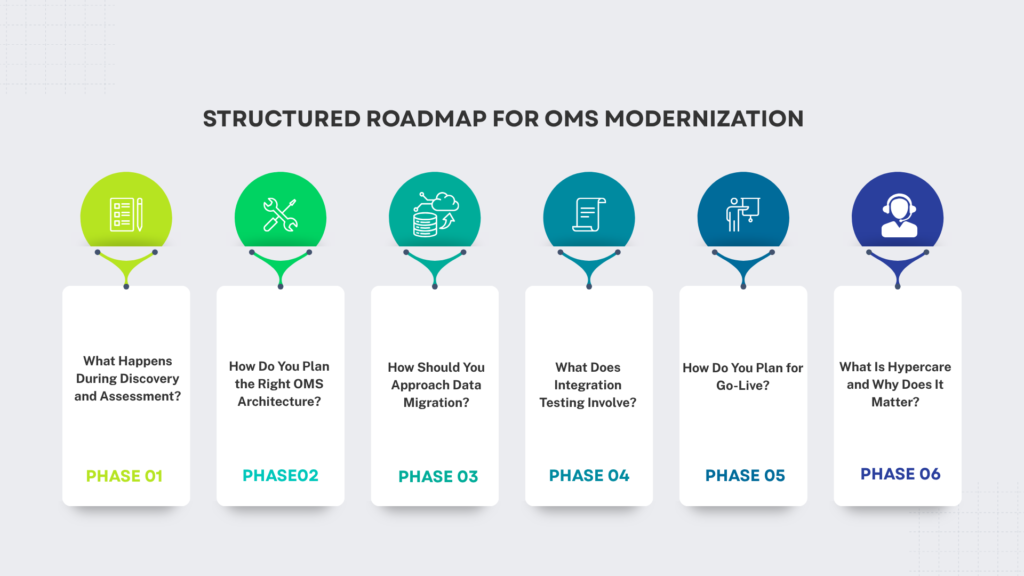
Phase 1: What Happens During Discovery and Assessment?
Discovery and assessment is where you document how your current OMS works and decide what the new one must do. It answers the question: “What do we have, what is broken, and what do we need?”
Key activities include:
- Mapping current order flows from order capture to fulfillment and returns
- Listing all integrations, such as ERP, WMS, payment gateways, and carriers
- Identifying pain points, like slow order processing, split-shipment errors, or poor inventory visibility
- Gathering stakeholder input from operations, customer service, finance, and IT
- Defining success metrics, such as order accuracy, fulfillment speed, and cost per order
Tip: Do not skip the “hidden” workarounds. Spreadsheets, manual overrides, and custom scripts often hold critical business rules that nobody has written down.
By the end of this phase, you should have a clear requirement document and a prioritized list of what to fix first.
Phase 2: How Do You Plan the Right OMS Architecture?
Architecture planning is where you decide how the new system will be built, hosted, and connected. The goal is a design that supports today’s needs and can grow with you.
Questions to settle in this phase:
- Will you choose a packaged platform, a custom build, or a composable approach?
- Where will the system run: public cloud, private cloud, or hybrid?
- How will the OMS communicate with other systems, through APIs, events, or middleware?
- How will it scale during peak seasons?
- What security and compliance standards must it meet?
A strong architecture plan also defines the target state clearly. Draw it out. Show every system, every data flow, and every connection point. This diagram becomes the reference for every later phase.
Phase 3: How Should You Approach Data Migration?
Data migration is the process of moving order history, customer records, product data, and open orders from the old system into the new one. It is often the most underestimated part of the project.
A reliable approach follows these steps:
- Profile your data. Find duplicates, missing fields, and inconsistent formats.
- Clean it before moving it. Fixing problems at the source is cheaper than fixing them after migration.
- Map old fields to new ones. Document every transformation rule.
- Run trial migrations. Practice multiple times and compare results.
- Validate carefully. Check record counts, totals, and sample orders against the source.
Decide early what to migrate. Not every record needs to move. Archiving very old orders can reduce risk and speed up the process.
Phase 4: What Does Integration Testing Involve?
Integration testing checks that the new OMS works correctly with every system around it. A system can pass its own tests and still fail when real data flows through connected tools.
Focus your testing on:
- End-to-end order scenarios, such as standard orders, backorders, partial shipments, cancellations, and returns
- Edge cases, like split payments, address errors, and out-of-stock items
- Performance under load, using volumes that match or exceed your busiest days
- Error handling, so failed messages are caught and retried instead of lost
- User acceptance testing, where real business users run real workflows
Automate repeat tests where possible. This saves time and makes it easy to retest after every fix.
Phase 5: How Do You Plan for Go-Live?
Go-live planning prepares your people, systems, and customers for the switch. The aim is to make launch day uneventful.
A solid go-live plan includes:
- A readiness checklist covering technical, data, and business items
- A detailed runbook with step-by-step tasks, owners, and timings
- A rollback plan in case a critical issue appears
- Training for customer service, warehouse, and finance teams
- Clear communication to internal teams, partners, and, when needed, customers
- A go/no-go meeting where leaders confirm that exit criteria have been met
Choose your launch timing carefully. Avoid peak sales periods, promotions, and financial close dates.
Phase 6: What Is Hypercare and Why Does It Matter?
Hypercare is the period right after go-live when the project team gives extra, close support to the new OMS. It usually lasts a few weeks. Its purpose is to catch and fix issues quickly while the system is still settling in.
During hypercare, you should:
- Monitor orders, errors, and system performance daily
- Run a dedicated support channel with fast response times
- Track every issue by severity and resolve the critical ones first
- Hold short daily check-ins with key stakeholders
- Compare real results with the success metrics you set in discovery
Hypercare ends when the system is stable, issues are under control, and ownership moves to the regular support team. Capture lessons learned so your next project runs even smoother.
What Are the Most Common OMS Modernization Mistakes?
Avoiding these pitfalls can save months of effort:
- Rushing discovery and missing key requirements
- Treating data migration as a last-minute task
- Testing only individual components, not full order journeys.
- Ignoring training and change management
- Ending support too soon after launch
Get Ready of for Your Modernization Journey
OMS modernization is a big undertaking, but it does not have to be a risky one. By moving through discovery, architecture, data migration, integration testing, go-live planning, and hypercare in order, you give your team a clear path from strategy to results. Each phase builds on the last, and together they help you launch a system that is stable, scalable, and ready for growth.
Acuver Consulting focuses on order management and supply chain commerce, and works with retailers and brands to plan, build, and support modern OMS programs. Whether you are replacing a legacy platform, moving to the cloud, or improving how orders flow across channels, Acuver can support you at every stage, from the first assessment to post-launch hypercare.
With the right roadmap and an experienced team beside you, your OMS can become a real advantage: faster fulfillment, fewer errors, and a better experience for every customer.
Connect with our team of experts to get a tailored roadmap made for your business.