Introduction
Every order carries promises beyond “send it by Friday.” A customer’s contract may say one purchase order gets one invoice. A regulator may require a minimum remaining shelf life. A key account may refuse split deliveries outright.
When allocation logic only looks at availability and cost, those promises get broken quietly. Planners step in, exceptions pile up, and orders ship in ways the customer never agreed to. In B2B channels the price can be explicit: Walmart fines suppliers 3% of cost of goods on non-compliant orders under its on-time-in-full program.
This blog shows how constraint-aware order allocation works, why it’s harder than it sounds, and how IBM Sterling Intelligent Promising (SIP) supports it alongside Sterling OMS. It’s one of five use cases in our pillar guide to IBM Sterling Intelligent Promising.
What Is Constraint-Aware Order Allocation?
Constraint-aware order allocation is a way of choosing where and how to fulfill an order that treats customer, compliance and operational rules as the starting filter, then optimizes within the options that remain.
Hard vs. soft constraints
- Hard constraints must never be violated. Examples: one purchase order, one invoice; minimum remaining shelf life; no split shipments for a specific account.
- Soft constraints are preferences that can be traded off. Examples: preferred ship-from node, lowest cost, shortest transit.
The distinction decides everything downstream. A hard constraint removes options. A soft constraint ranks them.
What it evaluates
Eligible inventory, not just on-hand, plus:
- batch and quality status
- reservations and holds
- node capacity
- lead times
- cost to serve
How it differs from conventional allocation
Conventional logic optimizes for availability, nearest node and lowest shipping cost, then someone checks for violations. Constraint-aware allocation flips the order: compliance first, optimization second.
Why it matters
Without it, planners intervene manually, exceptions accumulate, and customers receive orders in ways they never agreed to. Academic work on distributed order management, such as Microsoft Research’s formal models, treats “unsplittable” assignment (an order must ship whole from one location) as a distinct and harder variant of the problem, which tells you something about how much a single hard constraint changes the answer.
Why Is Constraint-Aware Order Allocation Hard to Fulfill?
Multi-department rules clash
Sales wants to honor the customer’s terms. Finance wants the lowest cost. Operations wants stable workloads. Compliance wants an audit trail. Each team holds a legitimate rule, and the rules often point in different directions. Someone has to decide which are hard and which are soft, and that decision is rarely documented in one place.
Lack of fulfillment time
Allocation decisions arrive in bulk or in seconds. If constraint checking takes minutes, it either slows the order or gets bypassed, and bypassed constraints are how violations happen.
Dynamic uncertainty due to data
A shelf-life rule is only as good as the batch data behind it. If batch attributes are stale, quality holds are unrecorded or stock counts lag, the engine will approve an allocation that looks compliant and isn’t. For a sense of scale, one 2026 analysis cites inventory accuracy as low as 63% against 95% for top performers.
Hidden sub-constraints
The stated rule is rarely the whole rule. “One PO, one invoice” can also imply a single ship-from location, a single carrier, one delivery window and consistent batch documentation. These sub-constraints surface only when an exception forces someone to read the contract.
Exploring a Real-Life Business Case
A customer places an order for 200 units. Their terms are strict:
- One purchase order, one invoice
- No split shipments or multiple invoices
- At least 90 days of remaining shelf life at delivery
- Delivery within 7 days
Here’s the inventory picture (illustrative figures):
| Location | Units available | Order eligibility | Transit time to customer |
|---|---|---|---|
|
Plant A |
120 |
120 eligible (shelf life 150 days) |
2 days |
|
DC B |
90 |
60 eligible; 30 fail minimum shelf life (40 days left) |
1 day |
|
DC C |
80 |
80 eligible (shelf life 120 days) |
3 days |
|
Plant D |
40 |
0 eligible (quality hold) |
2 days |
On paper there are 330 units in the network. Eligible, there are 260. And no single location holds 200.
The Challenge: Finding the Right Fulfillment Strategy
Option 1: Split fulfillment
Ship 120 from Plant A and 80 from DC C. Availability logic would call this a success. But it breaks one PO, one invoice, and sends two shipments and likely two invoices. It violates a hard constraint.
Option 2: Reject or backorder
Tell the customer you can’t fulfill it. It’s “safe” for compliance and costly for everything else: lost revenue on 200 units and a damaged relationship, when compliant stock exists.
Option 3: Constraint-aware sourcing with consolidation via interplant transfer (preferred path)
Choose one ship-from node and bring the missing stock to it through an interplant transfer order, an internal order that moves stock between your own plants or nodes so one location can ship the full order.
Here, move the 80 eligible units from DC C to Plant A (2 days), then ship all 200 from Plant A in one shipment on one invoice. The timeline works: 2 days for the transfer, 1 day to process, 2 days of transit, which is 5 days against a 7-day requirement. Every hard constraint holds.
How Constraint-Aware Order Allocation Solves the Problem
Step 1: Identify and classify constraints
List every rule that touches this customer, product and channel, then label each as hard or soft. This is where most of the business value is created, because it forces the clash between departments into the open.
Step 2: Evaluate eligible inventory across all nodes
Apply the hard filters: shelf life, quality status, reservations. The 330-unit network becomes 260 eligible units, and Plant D drops out entirely.
Step 3: Detect constraint violation risks
Test each candidate plan against the rules. Split fulfillment fails at this step, flagged as non-compliant before it ships, not discovered afterward.
Step 4: Generate and evaluate compliant alternatives
Build the options that pass: consolidate at Plant A, or at DC B. For each, compare lead time, cost, impact on other orders and capacity. Consolidating at Plant A needs one transfer and meets the date.
Step 5: Select and execute
Pick the plan, then execute: create the transfer order, reserve stock, ship from a single node and issue one invoice. If no compliant plan exists, route the order to a person with the reason attached.
What Are the Decision Factors in Constraint-Aware Allocation?
- Customer requirements: one PO/one invoice, no splits, delivery windows
- Inventory constraints: shelf life, batch and quality status, reservations
- Operational constraints: node capacity, lead times, transfer lanes
- Regulatory and compliance constraints: traceability, lot documentation, restricted markets
- Commercial constraints: contract terms, penalties, pricing agreements
What Are the Business Benefits?
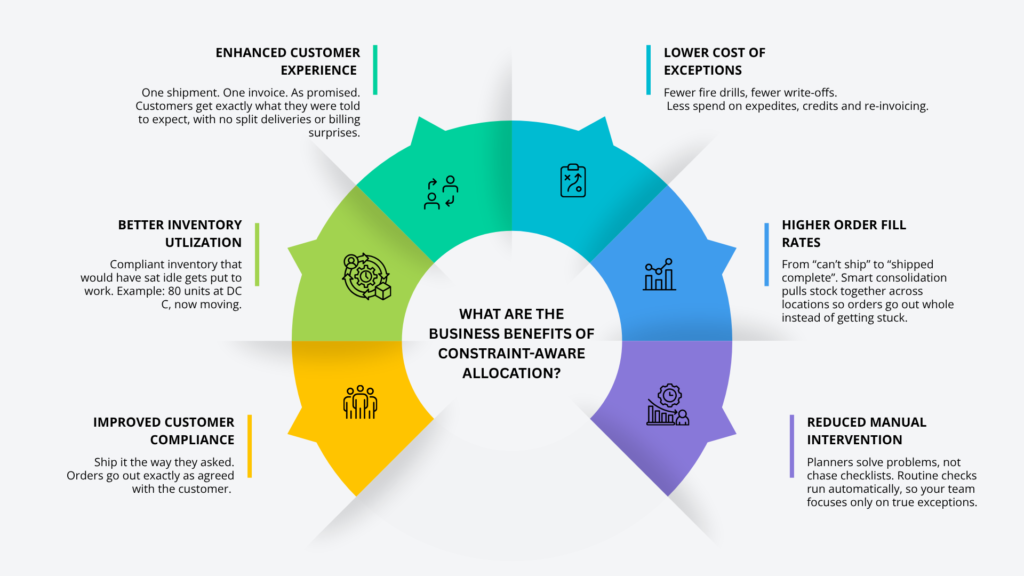
- Improved customer compliance: orders ship the way customers agreed, which matters when non-compliance can cost 3% of cost of goods
- Reduced manual intervention: planners handle true exceptions, not routine checks
- Better inventory utilization: compliant stock that would sit idle gets used, as with the 80 units from DC C
- Higher order fill rates: consolidation turns “can’t ship” into “shipped complete”
- Lower cost of exceptions: fewer expedites, credits and re-invoices
- Enhanced customer experience: one shipment, one invoice, as promised
The Role of a Modern OMS
What a modern OMS must do
A modern Order Management System (OMS) must do more than capture orders and route them for fulfillment. It should coordinate inventory, sourcing decisions, business constraints, and fulfillment operations across the supply chain.
- Rule-based order allocation: Allocate orders based on predefined business rules, customer priorities, inventory availability, and fulfillment requirements.
- Constraint management: Apply business and regulatory constraints, such as one purchase order (PO) per invoice, shelf-life requirements, and customer-specific fulfillment rules.
- Multi-node inventory visibility: Provide a unified view of inventory across warehouses, distribution centers, stores, and manufacturing facilities.
- Batch- and lot-level visibility: Track inventory by batch or lot, including expiry dates, remaining shelf life, and other product-specific attributes.
- Constraint violation detection: Identify allocation decisions that conflict with business rules, inventory conditions, or compliance requirements before they affect fulfillment.
- Interplant transfer orchestration: Coordinate inventory transfers between manufacturing plants and fulfillment locations when local stock cannot meet demand.
- Intelligent sourcing: Evaluate eligible fulfillment locations based on inventory availability, fulfillment costs, lead times, capacity, and business priorities.
- Real-time order promising: Provide reliable delivery commitments based on available-to-promise inventory, sourcing options, and fulfillment constraints.
- Exception management: Flag orders that cannot be fulfilled as planned and route exceptions to the appropriate teams for resolution.
- Cross-functional coordination: Align sales, finance, operations, and compliance teams around shared rules and consistent order allocation decisions.
- Scenario simulation and validation: Test allocation rules against historical order data and realistic business scenarios to identify potential conflicts before go-live.
- Auditability and traceability: Maintain visibility into allocation decisions, applied constraints, and exceptions to support operational reviews and compliance requirements.
- Performance monitoring: Track allocation outcomes, fulfillment performance, constraint violations, and exception rates to identify opportunities for continuous improvement.
Together, these capabilities help enterprises make more consistent allocation decisions, improve inventory utilization, and fulfill orders while respecting complex business requirements.
Where IBM SIP fits
SIP is a decisioning layer that sits alongside Sterling Order Management. Its modular Promising, Inventory and Optimization services bring real-time inventory visibility, rule-based safety stock, transfer rules, promising rules, capacity and cost-based optimization. IBM’s documentation also notes that tag-aware promising stays within matching tagged inventory and won’t fall back to untagged stock even when it’s cheaper, which is a hard-constraint behavior by design.
A practical note: batch- and invoice-level rules, plus the transfer order itself, are executed in Sterling OMS. SIP decides; OMS carries it out. We design the two together. See the pillar guide and our companion post on inventory-aware order allocation for how the layers fit.
| What a modern OMS needs | Sterling OMS | SIP adds |
|---|---|---|
|
Rule-based allocation |
Sourcing rules |
Promising rules, cost-based optimization |
|
Constraint management |
Order and customer rules |
Tag-aware sourcing, node eligibility |
|
Multi-node visibility |
Order-level |
Real-time global inventory view |
|
Violation detection |
Order validation |
Flags non-compliant options before commit |
|
Interplant transfers |
Transfer order execution |
Transfer rules inform sourcing |
|
Exception management |
Order exceptions |
Optimization explainer shows the “why” |
How IBM Sterling Intelligent Promising Addresses These Challenges
SIP is the decisioning layer. It evaluates constraints, sees eligible inventory across nodes and compares compliant options on cost and service, working alongside Sterling OMS for execution.
The same example, walked through
- SIP identifies 260 eligible units across Plant A, DC B and DC C, excluding the quality hold and the short-shelf-life batch.
- It flags the 120 + 80 split as non-compliant with one PO, one invoice.
- It compares the compliant options and picks consolidation at Plant A: 5 days against a 7-day requirement.
- Sterling OMS handles the hand-off: the transfer order, the single shipment and the single invoice.
Acuver Consulting is an IBM Business Partner (IBM Partner Plus Silver) with experience implementing and managing IBM Sterling Order Management for retailers. We also develop allocation and promising solutions that extend its capabilities.
Our approach brings sales, finance, operations, and compliance teams together to document business constraints in one place, classify them, and translate them into system configurations. Before go-live, we validate these configurations against historical order data to identify potential issues and ensure they align with real-world business requirements.
Since 2013, our IBM Sterling Order Management and order management consulting teams have supported enterprises across complex supply chains, including shelf-life-sensitive industries such as pharmaceuticals and manufacturing.
Ensuring Fulfillment with Constraint-Aware Order Allocation
Constraint-aware order allocation changes the question from “where can we ship this?” to “where can we ship this and keep every promise?” In our example, 330 units of nominal stock became 260 eligible units, a rejected order became a 5-day compliant delivery, and no one had to phone a planner.
If your orders carry promises your systems can’t see, we’d welcome a conversation. Get in touch with our team of experts, and let’s map your constraints together.