Introduction
Walk through almost any distribution center and you’ll see the same tension. If you ship each order the moment it’s ready, you pay for a lot of empty trailer space. If you hold orders back to fill the truck, one of them may miss its delivery window.
The waste is real. A Flock Freight and Drive Research study found that 58% of U.S. truckloads moved with empty trailer space in 2024, up from 43% in 2023. ACEEE estimates that 20–35% of U.S. truck miles are driven empty.
You don’t have to choose between cost and service if you make the consolidation decision early and with the right information. This blog covers how shipment consolidation works, where it gets hard, and how IBM Sterling Intelligent Promising (SIP) fits alongside Sterling OMS. To learn more about SIP, read our comprehensive blog, What Is IBM Sterling Intelligent Promising? A Guide to How It Works and Where It Fits.
What Is Shipment Consolidation in Order Fulfillment?
Shipment consolidation means combining several orders into one shipment or truckload so the truck is used better. Instead of three half-empty trucks going the same way, one fuller truck makes the trip.
Which orders are good candidates?
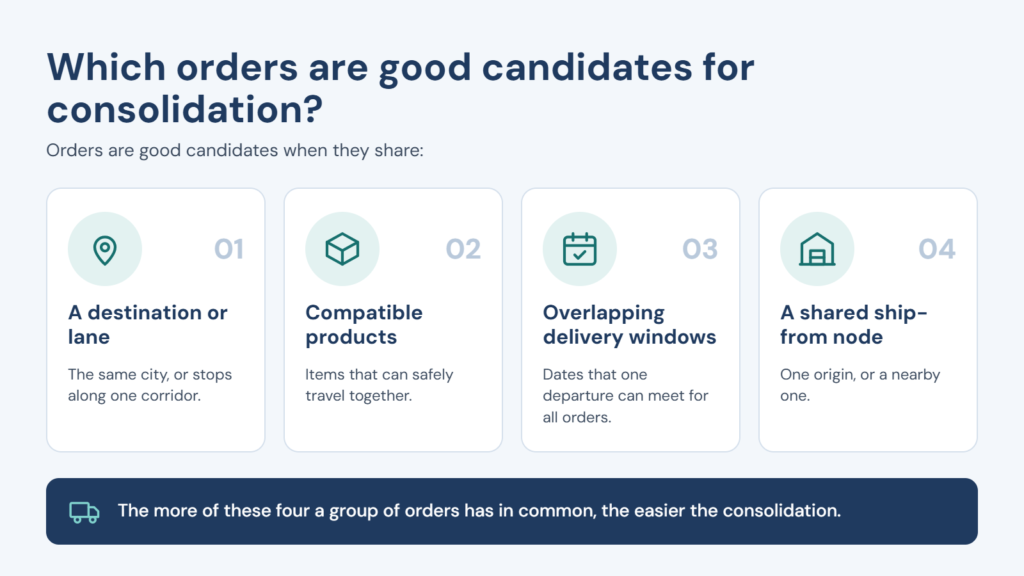
Orders are good candidates for consolidation when they share:
- A destination or lane: the same city, or stops along one corridor
- Compatible products: items that can safely travel together
- Overlapping delivery windows: dates that one departure can meet for all orders
- A shared ship-from node: one origin, or a nearby one
The more of these four a group of orders has in common, the easier the consolidation. Two orders that match on three of four are often still worth looking at. For example, a nearby second warehouse can sometimes feed the same truck with a short transfer.
Common ways to consolidate
- Same-lane consolidation: orders going to the same place leave together.
- Multi-stop routes: orders to different towns on one corridor share a truck that drops off at each stop. Our example below uses this.
- Time-phased consolidation: you hold orders for a short, fixed period so more can join the load. This is the approach that needs the most care, because waiting always has a cost.
Full truckload (FTL) vs. partial load
A full truckload (FTL) fills a trailer, so the cost is spread across the most units. A partial load, also called less-than-truckload (LTL), uses only part of the trailer. One U.S. analysis puts typical truck utilization at 60–80%, so even “full” trucks usually have room to spare. Finding that spare room is where consolidation pays off.
How it differs from conventional fulfillment
In conventional fulfillment, orders ship as they’re released and transportation is decided afterward. By then, the chance to combine orders has usually passed.
With consolidation, the possibility of sharing a shipment is considered at the fulfillment decision itself. Source, timing and load are chosen together, not one after the other.
Why it matters
Consolidation brings lower cost per unit, fewer shipments, better truck utilization and a smaller carbon footprint. It also helps customers, who get fewer delivery visits and fewer partial deliveries. McKinsey’s work on omnichannel fulfillment puts fulfillment at 10–20% of sales. It also notes that splitting shipments erodes margin, while consolidating into one box reduces cost. With costs that large, even small gains per shipment add up quickly.
Why Is Shipment Consolidation Hard to Fulfill?
If consolidation were easy, everyone would already do it well. Four things get in the way.
Delivery windows vs. truck fill
Waiting for more orders improves fill, but it risks lateness. Say the first order in the truck has a Wednesday–Thursday window. Every day you hold it to find a fourth order is a day off its margin for error. Fill rate and on-time delivery pull in opposite directions, so you need a clear rule for when to stop waiting.
Compatibility rules
Not everything can share a trailer. Temperature needs, hazardous materials, customer-specific restrictions and product-handling rules all decide which orders may travel together. An order that’s perfect on lane and timing can still be ineligible. For example, a chilled order can’t join an ambient load, and some products can’t ride next to others at all.
Moving order flow and uncertain demand timing
You don’t know when the next order will arrive or how big it will be. A consolidation plan built on Monday’s orders can look different by Tuesday, and the plan has to cope with that. Rules that only work when everything arrives on time won’t survive a normal week.
Hidden sub-constraints
Smaller limits shape what’s possible too: dock appointments, weight and volume limits, carrier rules and operating cut-offs. Two examples:
- A truck that fits by pallet count can still be over its weight limit.
- A load that’s ready can still miss its dock slot.
These are the limits that tend to break a plan that looked fine on paper. Check them early, not at the dock.
Exploring a Real-Life Business Case
It’s Monday. Several orders are heading along the same corridor from one distribution center, and together they can fill one truck. The truck takes 24 pallets. The figures below are illustrative.
| Order | Destination | Pallets | Delivery window | Ship-from | Notes |
|---|---|---|---|---|---|
|
O1 |
Pune |
8 |
Wed–Thu |
DC Mumbai |
Ambient |
|
O2 |
Satara |
6 |
Thu–Fri |
DC Mumbai |
Ambient |
|
O3 |
Pune |
4 |
Wed–Fri |
DC Mumbai |
Ambient |
|
O4 |
Kolhapur |
6 |
Fri–Sat |
DC Mumbai |
Ambient; released Tuesday noon |
|
O5 |
Pune |
3 |
Wed–Thu |
DC Mumbai |
Temperature-controlled |
The four ambient orders add up to exactly 24 pallets: 8 + 6 + 4 + 6. O5 is temperature-controlled, so it can’t share the trailer. Pune, Satara and Kolhapur sit on one corridor, so a single truck leaving Tuesday evening can reach Pune on Wednesday, Satara by Thursday and Kolhapur by Friday.
The Challenge: Finding the Right Consolidation Strategy
Option 1: Ship each order separately
That means four orders and four trucks. At an illustrative lane rate of $900 per truck, the total is $3,600 for 24 pallets, or $150 per pallet. Each trailer averages only 25% full. Delivery dates are safe, but you’re paying to move a lot of empty space.
Option 2: Hold orders until a truck fills
Here you wait until all 24 pallets are ready. That works if O4 is released Tuesday noon. If O4 slips to Thursday, the truck leaves too late and O1, which must reach Pune by Thursday, misses its window. Holding with no limit turns a cost saving into a service failure.
Option 3: Intelligent consolidation (preferred path)
Intelligent consolidation weighs fill rate, time windows and compatibility together. It also sets a hold-time limit so waiting never outruns the delivery promise. The truck leaves Tuesday evening with whatever is ready by the cutoff.
- If O4 arrives on time: the truck leaves full with 24 pallets on one multi-stop route. The illustrative cost is $1,100, or about $46 per pallet. That’s roughly 70% below the $3,600 for separate trucks.
- If O4 is late: the truck leaves with 18 pallets (75% full) and O4 follows on its own. The earlier windows stay protected.
The second case still beats Option 1 on cost and Option 2 on service, so the plan holds up even when things go wrong.
How Intelligent Consolidation Solves the Problem
Step 1: Identify consolidation candidates
Match orders by lane, timing and compatibility. Start with the hard rules (what can’t travel together), then look at the softer matches (which orders share a route). O1–O4 qualify. O5 is excluded because it needs temperature control.
Step 2: Check delivery windows and hold-time limits
Work out the latest departure that still meets every window, and treat it as a hard deadline. To do this, work backward from each order’s window using transit time, then take the earliest result. Here it’s Tuesday evening, because O1’s Wednesday window starts the clock.
Step 3: Evaluate truck capacity and fill
Check pallet count, weight and volume against the trailer, and confirm the dock slot. Here 24 of 24 pallets fit. Weight still needs checking, since pallet count alone doesn’t tell you whether the load is legal or safe.
Step 4: Compare consolidation vs. separate shipping on cost and service
Consolidation costs about $1,100 against $3,600, with every window met. If the consolidated plan would cost service, separate shipping wins. The point is to compare the options, not to assume consolidation is always better.
Step 5: Release the consolidated shipment; route exceptions
Release the load at the cutoff. Orders that don’t fit (O4 if late, O5 always) are routed to the next-best option, with the reason recorded. That record matters. Over time it shows you which orders keep missing the truck and why, so you can adjust your rules.
What are some of the decision factors?
- Delivery windows and customer commitments: the dates that bound everything else
- Truck capacity, weight and volume: what physically fits
- Product compatibility: ambient, chilled, hazardous or restricted items
- Transportation cost and lane rates: what each option really costs
- Operational cut-offs and dock constraints: the last time a load can be released and slotted
What are some of the business benefits?
- Lower transportation cost per unit: about $46 vs. $150 per pallet in our example
- Higher truck utilization: 100% (or 75% in the late-order case) instead of 25%
- Fewer shipments and touches: one departure instead of four, which also means less handling at the dock
- Maintained delivery commitments: hold-time limits protect every window
- Reduced emissions: fewer trucks for the same pallets. If you want to explore this theme, our post on green supply chains is a good companion
How to know it’s working
Track a few simple numbers before and after you start consolidating:
- Average trailer fill rate
- Transportation cost per pallet (or per unit) on each lane
- Shipments per order
- On-time delivery rate, so you can see that savings aren’t costing service
- How often held orders end up shipping separately anyway
If fill and cost improve while on-time delivery holds steady, your hold-time limits are set about right. If on-time delivery drops, they’re too long.
The Role of a Modern OMS
What it must do
A modern OMS needs consolidation-aware sourcing, multi-order visibility, delivery-window evaluation, shipment planning hand-off and exception management. Our blog on distributed order management explains how these pieces work together.
Where IBM SIP fits
SIP’s role is at the fulfillment decision. Its Promising service minimizes shipments while calculating delivery commitments. IBM’s documentation describes reducing split shipments during promise calculations to lower operational cost while maintaining delivery commitments. Its Optimization service weighs shipping cost, processing cost and transit time against the objectives you set.
To be clear about the boundary: SIP favors fewer shipments per order and respects delivery windows, node calendars and carrier cut-offs. Building multi-order truckloads, tendering to carriers and managing dock appointments sit with Sterling OMS and your transport systems. We design the hand-off between them.
| What it must do | Sterling OMS / transport systems | SIP adds |
|---|---|---|
|
Consolidation-aware sourcing |
Shipment grouping |
Sourcing that minimizes shipments |
|
Multi-order visibility |
Order and shipment view |
Network-wide inventory and capacity view |
|
Delivery-window evaluation |
Order due dates |
Cut-offs, node calendars, transit in promising |
|
Shipment planning hand-off |
Load building, carrier tendering |
Recommendations passed to OMS |
|
Exception management |
Shipment exceptions |
Optimization explainer shows why |
How IBM Sterling Intelligent Promising Addresses These Challenges
SIP is the decisioning layer. It evaluates fulfillment options, including those that favor fewer, fuller shipments, against delivery windows and cost. It then hands the decision to Sterling OMS and transport systems to execute.
Consolidation is one of several fulfillment challenges IBM SIP can help with. To understand what else it can help you with, read our blogs on how to enable constraint-aware order allocation and how to enable priority based order allocation.
The same example, walked through
- SIP evaluates the sourcing and delivery constraints for O1–O4. All four ship from DC Mumbai, and their windows are compatible with a Tuesday-evening departure.
- It favors the option with fewer shipments, which aligns with the consolidated route.
- Sterling OMS and your transport systems then build the 24-pallet load, tender it to the carrier and book the dock.
- If O4 is late, that order falls back to a separate shipment, and the other three still go out on time.
Making the rules fit your network
Consolidation logic has to reflect how your network really runs. Before you configure anything, settle a few questions:
- Which lanes are worth consolidating, and which don’t have enough volume?
- How long can you hold an order on each lane without hurting the promise?
- Which products can never share a trailer?
- What are your real weight, volume and dock limits at each node?
At Acuver, we help you define these rules, configure them in Sterling OMS, and connect them to your transport systems. Acuver is an IBM Sterling Order Management implementation partner and technology partner.
Ensuring Fulfillment with Shipment Consolidation
Consolidation works when the decision is made early, with delivery windows and hold-time limits built in. In our example, four trucks became one, cost per pallet dropped from about $150 to about $46, and every window was still met.
If you suspect your trucks carry more air than they should, we’d be glad to look at your lanes with you. Get in touch and let’s find where consolidation would pay off first.