Introduction
The same order can usually be fulfilled from several places. A store down the road, a regional DC, a warehouse two states away: each can ship it, and each answer has a different cost, a different delivery date and a different effect on everyone else’s stock.
Getting that choice wrong is expensive at scale. IHL Group estimates that inventory distortion will cost global retail around $1.7 trillion in 2026, or 6.2% of retail sales, and out-of-stocks account for almost two-thirds of it. Many of those stockouts happen even though the product is sitting somewhere in the network.
This blog talks about making that choice well. It’s about inventory-aware order allocation: how it works, where the usual shortcuts break, and how IBM Sterling Intelligent Promising supports it. To learn more about IBM Sterling Intelligent Promising, read our comprehensive guide titled, What Is IBM Sterling Intelligent Promising? A Guide to How It Works and Where It Fits.
What Is Inventory-Aware Order Allocation?
Inventory-aware order allocation means choosing the fulfillment source by weighing real-time inventory position, sourcing options and customer requirements together.
What it evaluates
The key word is eligible. On-hand quantity is only the starting point. A sound allocation looks at:
- Available vs. reserved vs. safety stock: units held for in-store pickup, held for quality, or deliberately withheld
- Inventory in transit: stock that will arrive in time versus stock that won’t
- Node capacity: can the location actually pick and ship today?
- Sourcing rules: which nodes may serve which customers or channels
- Cost to serve: shipping, handling and processing cost for each candidate
Network-level view vs. single-node view
A single-node view asks “can this location ship the order?” A network-level view asks “which location should, given everything else that location is committed to?” The second question is the one that protects your inventory health.
How it differs from conventional allocation
Conventional logic picks the nearest node or the node with the most stock. Inventory-aware allocation balances the needs of this order against the health of the whole network.
Why it matters
Without it you get familiar symptoms: stockouts at one node while another sits on excess, avoidable split shipments, and expedited freight to patch broken promises. Our guide to global inventory visibility covers the visibility foundation. This post covers the decision you make with it.
Why Is Inventory-Aware Order Allocation Hard to Fulfill?
Competing goals
Customers want speed. Finance wants low cost. Merchandising wants balanced inventory. A cheaper node may be slower, and the fastest node may be the one you can least afford to drain. McKinsey notes that in-store picking costs 1.5 to 2 times more per pick than picking in a distribution or fulfillment center, so even the “closest” option carries a price.
Time pressure
Sourcing decisions have to land in seconds, often before the shopper has finished checking out. There’s no time for a planner to weigh options, so the logic itself has to be right.
Data accuracy and latency
If node A’s count is an hour old and node B’s is a day old, the engine is comparing two different realities. Accuracy varies widely: one 2026 analysis cites inventory accuracy as low as 63% against 95% for top performers.
Hidden inventory constraints
Stock that looks available often isn’t: reserved for a pickup order, held for inspection, or restricted to a wholesale channel. These constraints rarely show up in a headline on-hand figure, but they decide whether an allocation succeeds.
Exploring a Real-Life Business Case
Here’s a scenario you’ll recognize. A customer orders 40 units of one SKU and has been promised delivery in two days. Four locations hold stock, and the figures below are illustrative.
| Location | Units available | Reserved / held / safety | Eligible units | Transit time | Cost to serve |
|---|---|---|---|---|---|
|
Store S1 (nearest) |
45 |
40 (BOPIS reserves, safety stock) |
5 |
1 day |
$5 |
|
Store S2 |
50 |
8 (safety stock) |
42 |
2 days |
$6 |
|
DC West |
60 |
10 (safety stock) |
50 |
2 days |
Ambient |
|
DC East |
300 |
125 (wholesale-restricted, safety) |
175 |
3 days |
$12 |
The four ambient orders add up to exactly 24 pallets: 8 + 6 + 4 + 6. O5 is temperature-controlled, so it can’t share the trailer. Pune, Satara and Kolhapur sit on one corridor, so a single truck leaving Tuesday evening can reach Pune on Wednesday, Satara by Thursday and Kolhapur by Friday.
The Challenge: Finding the Right Fulfillment Source
Option 1: Nearest node
S1 is closest, and its system shows 45 units. But only 5 are eligible. The logic either fails the allocation, leaving the order short and triggering a split or a cancellation, or it raids stock that was reserved for pickup customers. A promise made on raw on-hand quantity breaks later.
Option 2: Node with the highest stock
DC East has 300 units, so it looks safest. But it’s a 3-day transit, which misses the 2-day promise, and it costs $12, double S1’s. You’d be buying a worse outcome with the most inventory.
Option 3: Inventory-aware sourcing (preferred path)
Inventory-aware sourcing selects the source that balances availability, commitments and efficiency. Here that’s S2: 42 eligible units cover the full order in a single shipment, within the 2-day promise, at $6. It also moves aging stock, and it leaves DC West’s supply intact for western demand.
Notice that the “best” answer wasn’t the nearest, the fullest, or even the cheapest in every dimension. It was the one that fit the order and the network.
How Inventory-Aware Allocation Solves the Problem
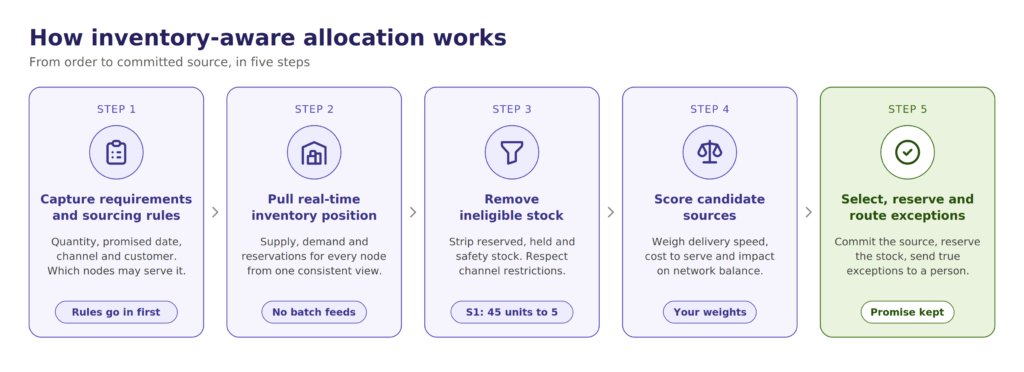
Step 1: Capture order requirements and sourcing rules
What’s the quantity, the promised date, the channel and the customer? Which nodes are allowed to serve it? The rules go in before the search starts.
Step 2: Pull real-time inventory position across nodes
Supply, demand and reservations for every candidate node, from one consistent view, not a patchwork of batch feeds.
Step 3: Remove ineligible stock
Strip out reserved, held and safety stock, and respect channel restrictions. This single step is what turns S1’s 45 units into 5.
Step 4: Score candidate sources on speed, cost and inventory impact
Each candidate is scored on delivery speed, cost to serve and its effect on network balance. The weights should reflect your business priorities, not a default.
Step 5: Select the source, reserve inventory and route exceptions
Commit the choice, reserve the stock so nobody else can take it, and send true exceptions (no compliant source) to a person, not into a black hole.
What are the Decision Factors
- Inventory position and reservations: what’s truly free to allocate
- Customer commitments and delivery dates: the promise you’ve already made
- Sourcing rules and node eligibility: who may serve whom
- Cost to serve: shipping, handling and processing
- Network balance and safety stock: the health of everything the order doesn’t touch
What are some of the Business Benefits
- Higher fill rates: orders ship complete from a source that really has the stock
- Better inventory utilization: aging and surplus stock gets used before it’s marked down
- Fewer split shipments: one source more often covers the whole order
- Lower fulfillment cost: cheaper sourcing without sacrificing the promise
- Reduced stockouts and overstock: allocation protects thin nodes and drains heavy ones
The numbers back this up. A major omni-channel retailer we worked with had store-first allocation logic that drove 8–12% order cancellations. Together we built a dynamic inventory allocation engine and rolled it out in 10 weeks. Order fulfillment accuracy rose 23%, cancellations fell 68%, inventory turnover rose 14%, and fulfillment cost per order dropped 9%. That engine was Acuver-built rather than SIP, but it proves what inventory-aware logic can do.
The Role of a Modern OMS
What it must do
A modern OMS needs real-time multi-node visibility, configurable sourcing rules, inventory reservation, sourcing scoring and exception management. If you’re weighing platform options, our guide to distributed order management is a good companion.
Where IBM SIP fits
SIP’s Inventory service provides real-time visibility and control, alongside the Promising and Optimization services. Per IBM’s documentation, you configure rules-based safety stock, segmentation allocation rules and transfer rules in the Inventory service, and cost-based optimization in the Optimization service. SIP is the decision layer, and Sterling OMS stays the system of record for the order.
| Capability a modern OMS needs | Sterling OMS | SIP adds |
|---|---|---|
|
Real-time multi-node visibility |
Order-level view |
Global inventory view, real-time |
|
Sourcing rules |
Rules-based sourcing |
Promising rules, tag-aware sourcing |
|
Reservation |
Order reservations |
Atomic inventory and capacity booking |
|
Scoring |
Rules-based |
Cost-based optimization, node balancing |
|
Exception management |
Order exceptions |
Optimization explainer: why this source? |
How IBM Sterling Intelligent Promising Addresses These Challenges
SIP works as the decisioning layer. It sees eligible stock across nodes, compares candidate sources on cost, speed and balance, and hands its recommendation to Sterling OMS to execute.
The same example, walked through
- S1 shows 45 units, but SIP’s inventory view nets out the reserved and safety stock, so only 5 count.
- DC East looks full, but wholesale-restricted units are excluded and transit misses the 2-day promise.
- DC West qualifies, but node-balancing values flag the drain on its regional supply.
- S2 emerges as the best fit: 42 eligible units, 2 days, $6, single shipment.
Sterling OMS then reserves the stock, creates the shipment and carries it through invoicing. Read our comprehensive blogs on constraint-aware order allocation, priority-based order allocation and shipment consolidation to understand how IBM SIP solves it.
At Acuver, we help you define these rules, configure them in Sterling OMS, and connect them to your transport systems. Acuver is an IBM Sterling Order Management implementation partner and technology partner.
Ensuring Fulfillment with Inventory-Aware Order Allocation
Inventory-aware order allocation is about replacing shortcuts with a decision: remove stock that isn’t really available, weigh speed against cost against network health, and commit the choice before the promise is made. In our 10-week omni-channel engagement, that discipline turned an 8–12% cancellation problem into a 68% reduction.
If the same order can ship from many places in your network, the logic that picks the place is worth examining. We’d be glad to look at yours with you. Reach out to our retail supply chain team or get in touch and let’s map where inventory-aware allocation would pay off first.