Introduction
Indian retail rarely runs through one channel or one fulfilment point. A customer may discover a product on a marketplace, buy it through a brand app and expect it to arrive from a nearby store or warehouse. Retailers must also manage returns, cash-on-delivery (COD), regional delivery coverage, tax processes and sharp increases in demand during major sale periods.
A cloud order management system (OMS) helps coordinate orders and inventory across channels and fulfilment locations. It applies business rules to decide how orders should move through the business and shares updates with the systems involved. Its value depends on how it is configured and integrated for the retailer’s operating model.
To learn more about what a cloud OMS is and how it can be beneficial for your business, read our comprehensive guide.
Why order management is harder in Indian retail
A multi-channel mix
Retailers may receive orders through physical stores, brand websites, mobile apps, marketplaces, social commerce and quick-commerce platforms. Each channel can have its own order format, service levels, cancellation rules and inventory expectations. Without a coordinated process, teams may need to check several systems before confirming stock or acting on an order.
A large network of SKUs, pincodes and fulfilment locations
The same product may be stocked across distribution centres, stores and dark stores while serving customers across a wide range of pincodes. Inventory changes as orders are placed, picked, transferred or returned. Retailers need to know not only how much stock exists, but where it is and whether it can be promised for a particular order.
Returns and cash-on-delivery exposure
Returns and exchanges add another journey to manage. COD orders bring additional steps such as confirmation, collection, settlement and reconciliation. If delivery fails or a customer refuses an order, the business must track the return-to-origin (RTO) journey and update inventory and financial records correctly.
If you are wondering whether you need an OMS or not, here is our guide to the 10 Questions to Ask Yourself to know if you need an OMS or not.
What cloud order management looks like in an Indian retail operation
Think of the OMS as a coordination layer between the place where an order is received and the location that fulfils it. It does not need to replace every system already in use. Instead, it works with those systems and applies agreed rules to move the order forward.
A typical order journey in India
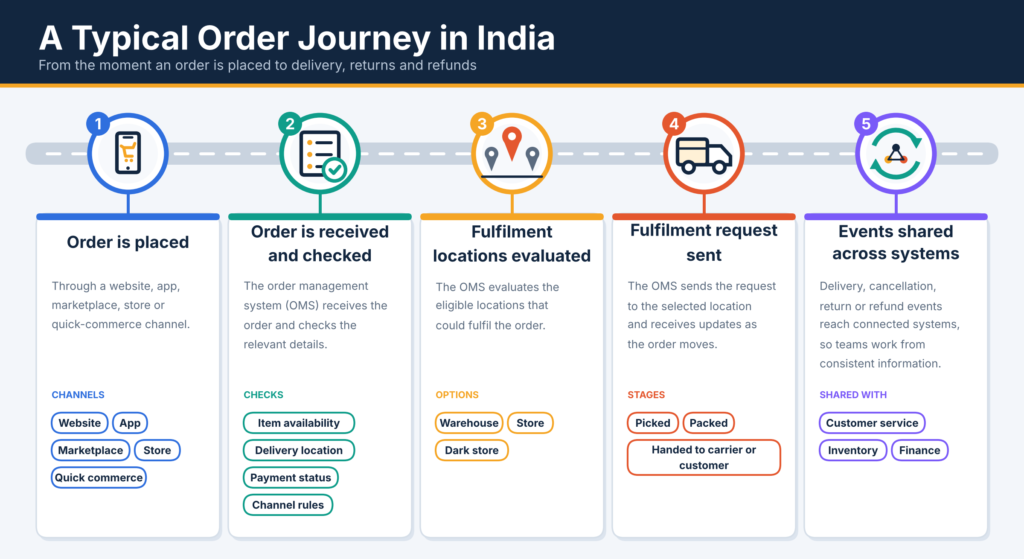
- An order is placed through a website, app, marketplace, store or quick-commerce channel.
- The OMS receives the order and checks relevant details, such as item availability, delivery location, payment status and channel rules.
- It evaluates eligible fulfilment locations, which may include a warehouse, store or dark store.
- The OMS sends the fulfilment request to the selected location and receives updates as the order is picked, packed and handed to a carrier or customer.
- Delivery, cancellation, return or refund events are shared with connected systems so customer service, inventory and finance teams can work from consistent information.
How the OMS connects stores, warehouses, dark stores and marketplaces
The OMS can connect different order sources to a network of fulfilment nodes. A node is a location that can hold inventory or fulfil an order, such as a warehouse, retail store or dark store. Rules determine which nodes can serve which orders, considering stock, distance, capacity, delivery commitments and business priorities.
For example, an online order from a customer in Bengaluru may be fulfilled by a nearby store if the item is available and the store is enabled for online fulfilment. Another order may be routed to a distribution centre if that is the better option. The rules should reflect the retailer’s actual service promises and operational constraints.
Where it sits alongside ERP, WMS and POS
An OMS generally works alongside, rather than automatically replacing, core enterprise systems. ERP may manage financial, purchasing and master-data processes; WMS manages warehouse execution; and POS records store transactions. The OMS coordinates order and fulfilment decisions across these systems. The division of responsibilities should be agreed during solution design to avoid duplicate or conflicting records.
India-specific capabilities a cloud OMS handles
There is no single checklist for every Indian retailer. Requirements vary by product category, channel mix, state footprint, payment methods and logistics network. Many local requirements are handled through the OMS working with ERP, tax, payment, marketplace and carrier systems—not necessarily through a standalone OMS feature.
GST and e-invoicing
The order journey may need to pass the right customer, product, tax and transaction details to the retailer’s ERP or invoicing solution. E-invoicing applicability and invoice rules depend on the business and current regulations. The OMS integration should preserve the information needed by the system responsible for tax calculation, invoice generation and reporting. Retailers should validate the design with their tax and finance teams.
COD confirmation, RTO and returns reconciliation
COD workflows can include order confirmation, carrier handover, delivery collection, settlement and reconciliation. The OMS should exchange relevant order and status events with payment and logistics partners. For failed deliveries and RTOs, the process should update order status, returned inventory and financial records in the appropriate systems.
Marketplace and quick-commerce integrations
Marketplaces and quick-commerce platforms may have different order formats, inventory update expectations, cancellation windows and service-level rules. You will need to design your integration to account for those differences, consistently map data, and monitor for failed or delayed messages.
Pincode serviceability and last-mile delivery of India’s carriers
Carrier selection and delivery promises are made based on serviceable pincodes, pickup coverage, delivery capacity, type of shipment and performance of the partner. These checks are typically enabled through carrier or shipping-platform integrations and transparent serviceability rules. Coverage should be tested with the retailer’s real logistics partners.
UPI, Wallets and Payment Channels
Retailers can accept prepayment through UPI, cards, wallets and payment gateways, and cash-on-delivery (COD) where applicable. The OMS has certain requirements around consistent payment status and exception handling, the payment provider or financial system. Payment processing and settlement is done by the payment provider or financial system. OMS requires consistent payment status and exception handling. We recommend that you test refund flows for all the payment methods that you support.
Data hosting and residency
When choosing a cloud deployment, you should look at the data classification, contracts, regulations and hosting options that are available in the platform you select. “It’s not automatic for all retailers to require an India-hosted deployment. Confirm where data is stored, processed, backed up and accessed and have the appropriate legal and security review done.
How it helps: key benefits for Indian retailers
More RTOs and cancelations
More accurate inventory information and clearer ordering rules can reduce the number of orders taken against unavailable stock. Improved coordination of order, payment and carrier events enables teams to catch confirmation or delivery issues sooner. The results are dependent on the quality of the data, on the performance of the partners, and on the processes of the customers.
Smarter sourcing means faster and less costly delivery.
An OMS can compare eligible fulfillment locations based on distance, stock, capacity, cost, and delivery promise. This can help prevent unnecessary long-distance shipping or defaulting all orders to one warehouse.
Accurate inventory in store and across channels
When inventory updates from ERP, WMS, POS and other sources are integrated and reconciled, teams can work with a more consistent view of stock. Accuracy still depends on timely transactions and disciplined store and warehouse processes.
The festive season and sale events make scaling easier.
Cloud architecture may be able to handle changing workloads depending on the platform and deployment design. Retailers should test the entire order path, covering integrations and downstream systems, with realistic sale-event volumes prior to peak periods.
Improved reconciliation and compliance
The integration of order, invoice, payment, delivery and return records can reduce the need for manual reconciliation. Each record should be clearly attributed to the OMS and should provide accurate information to the tax, payments and finance systems.
Retail use cases Clothing & Style
A customer buys a size on a brand’s website. The OMS checks stock in eligible stores and warehouses and routes the order to a location that can fulfilll the delivery promise. If the customer returns the item at a store, the return workflow can update the order and pass the stock status to the inventory system.
Grocery
Orders are placed with a quick delivery expectation. The order will be sent to a suitable node based on the service area and stock and capacity within dark stores. If the product is out of stock, the retailer can manage this according to the substitution/exception rules.
Electronics
An expensive product requiring a delivery time window or installation has been ordered. The OMS can integrate with the fulfilment and service systems to give visibility of product availability and order status. This helps the team understand and manage delivery commitments and exceptions.
Beauty and personal care
Orders are made via web, marketplaces and stores. The OMS can be used to centrally manage stock across these channels. Bundle, promotion and limited fulfillment rules can be applied as required. Catalogue and inventory information is managed by other systems.
FMCG
Orders are placed by retail partners and directly. Order management can be used to standardize order creation, allocation and visibility across multiple depots, distributors and customer accounts, dependent on the B2B processes within the business.
Challenges Indian retailers face during adoption
Multiple System and Integrations With Local Partner
The business may be using legacy systems such as ERP/POS/warehouse systems in addition to new commerce platforms. Integration requirements may vary between carrier, marketplaces and payment partners. A sensible approach should be taken to understand what systems exist, what data they hold, and what connections need to be created, improved or replaced.
Stock Accuracy at Store
Even with OMS in place, poor stock accuracy can occur. If stock is not updated in a timely manner, damage is not logged, product information is incorrect or processes differ between stores, this can impact order commitments. Data ownership, stock reconciliation, and processes in stores should be considered as part of this programme.
Change management across stores
Store teams may need to pick, pack, stage and hand over online orders in addition to existing responsibilities. Training, clear task ownership, realistic capacity rules and feedback from pilot locations can make adoption smoother.
How can an implementation partner help adjust to India’s retail requirements?
An implementation partner translates the retailer’s operating needs into a solution design, then connects and configures the systems required to support it. This includes understanding the order journey, defining fulfilment rules, mapping local partner integrations, planning data migration, testing exceptions and preparing teams for go-live.
Before selecting or implementing a cloud OMS, bring business and technology stakeholders together to document the current order journey and agree on the problems that matter most.
- Map channels, order types, fulfilment locations, returns and payment journeys.
- List systems involved—ERP, WMS, POS, e-commerce, marketplaces, payment providers and carriers—and identify their owners.
- Review item, location, customer and inventory data for accuracy and completeness.
- Define priority use cases and measures that will show whether they are working.
- Document service promises, sourcing priorities, exceptions, COD and returns processes.
- Confirm security, hosting, data-residency and regulatory requirements with the relevant teams.
- Plan pilot locations, user training, testing, cutover and post-go-live support.
If you are still deciding between implementation routes, read our blog titled, Cloud OMS Implementation: Which Implementation Approach Is Right for You? to compare the options and understand what each approach involves.
Order Management That Fits How India Actually Sells
A cloud OMS can help Indian retailers coordinate a complex mix of channels, locations, partners and customer expectations. Its value comes from connecting the order journey end to end: from accurate availability and fulfilment decisions to delivery updates, returns and reconciliation.
Use this short readiness checklist in internal discussions and vendor conversations:
- We know which channels and order types the OMS must support.
- We have mapped stores, warehouses, dark stores and their fulfilment roles.
- We understand where inventory, order, payment and tax data are mastered.
- We have identified local marketplace, carrier and payment integrations.
- We have documented COD, RTO, returns and refund workflows.
- We have reviewed hosting, security, data-residency and compliance needs.
- We have selected measurable priority use cases and a phased rollout plan.
At Acuver we help businesses design and implement order management solutions around their operating needs, with integration and engineering capabilities to connect the wider retail ecosystem. Contact the team to discuss your requirements.