Introduction
Choosing a cloud order management system is only one part of an OMS programme. The system must be shaped around how your business takes orders, manages inventory, fulfils demand and handles exceptions. It also needs to work with the applications your teams already rely on.
If you are in the earlier stages, read our blog to know what a cloud OMS is and how it can help you. If you ae not sure that your business needs a OMS, read our blog on the 10 questions to ask yourself to know if you need an OMS.
Acuver helps businesses plan, implement, integrate and improve order management solutions. The work can span early discovery and solution design through configuration, data migration, testing, go-live and post-launch support. The scope is shaped around the platform, business requirements and delivery model agreed with the client.
What does Acuver’s Cloud OMS implementation service comprise?
Acuver’s Order Management practice covers solution discovery. strategy and implementation, inventory and order management, returns management, modular OMS offerings and seamless integration.
To know about the different implementation approaches, and identify the right one for your business, read our blog titled, Cloud OMS Implementation: Which Implementation Approach Is Right for You?
For a cloud OMS programme, these capabilities can be brought together across five connected areas:
Consulting and discovery
Understand current order flows, customer journeys, fulfilment models, business priorities, pain points and platform requirements.
Solution design and implementation
Translate requirements into a target design, configure the selected OMS and define the order, inventory, sourcing and exception rules needed by the business.
Integration and migration
Connect the OMS with ERP, WMS, POS, e-commerce, marketplaces, payments, carriers and other applications. Plan data mapping, migration, validation and reconciliation.
Quality engineering and go-live
Test functional journeys, integrations, performance, exceptions and user acceptance before cutover. Prepare release, rollback and hypercare plans.
Optimization and ongoing support
Monitor the live solution, resolve issues and identify opportunities to improve workflows, rules, integrations and performance.
Acuver’s role is implementation and technology services around the OMS selected or shortlisted with the client. The engagement should make platform responsibilities, third-party responsibilities and client ownership clear from the beginning.
What we do
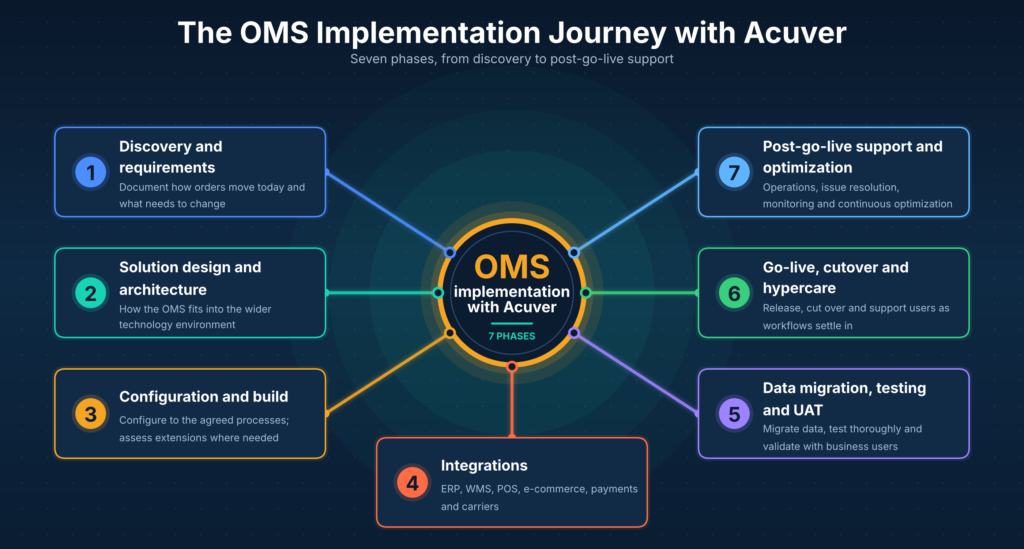
1. Discovery and requirements
Acuver works with business, operations and IT stakeholders to document how orders move through the organization today and what needs to change. Discovery can cover order journeys across channels, fulfilment locations, inventory ownership, returns, cancellations, integration dependencies, security requirements, reporting needs and measurable success criteria. The output is a shared view of scope, priorities, dependencies and requirements.
2. Solution design and architecture
The solution design defines how the OMS will fit into the wider technology environment. It covers the role of each application, the information exchanged between them and the rules that govern order processing. Depending on the programme, this can include deployment choices, application architecture, integration patterns, order and inventory flows, fulfilment-node design, security and non-functional requirements.
3. Configuration and build
The OMS is configured to reflect the business processes agreed during discovery and design. This may include organizations, items, inventory models, sourcing rules, order pipelines, fulfilment workflows, status management, returns and user roles. Where standard configuration does not meet a requirement, the team assesses whether an extension or custom development is appropriate.
4. Integrations
Order management depends on information moving reliably between systems. Acuver’s integration work can connect the OMS with ERP platforms for financial and master data; WMS platforms for warehouse execution; POS systems for store transactions; e-commerce platforms and marketplaces for order capture; payment providers for payment and refund events; and carriers for shipment and delivery updates. Integration scope includes data mapping, interface design, error handling, monitoring, security and reconciliation. Aekyam can be used where it fits the client’s integration and orchestration requirements; it complements the OMS rather than replacing its core order-management role.
5. Data migration, testing and UAT
Data migration may involve item, location, inventory, order or other records required by the target solution. The plan should identify source systems, data owners, transformation rules, validation checks and reconciliation steps. Quality engineering can include unit, functional, integration, regression, end-to-end, performance and load testing. UAT gives business users the opportunity to validate the solution against real operational scenarios.
6. Go-live, cutover and hypercare
Go-live preparation brings together release planning, data readiness, integration checks, user training, operational runbooks, support ownership and rollback considerations. During hypercare, the project team monitors the solution, triages issues and supports users as new workflows settle into day-to-day operations. The length and coverage of hypercare are agreed as part of the programme plan.
7. Post-go-live support and optimization
The work does not have to stop when the system goes live. Depending on the engagement, Acuver can support application operations, issue resolution, release and environment activities, integration monitoring and continuous optimization. Its Managed Services practice includes support for IBM Sterling Order Management environments. The support model should define service hours, service levels, escalation routes and responsibilities.
How we have impacted our clients
| Client challenge | Acuver’s work | Published outcome |
|---|---|---|
|
Large Indian fashion retailer needed stronger OMS performance and scale. |
OMS transformation and implementation for a high-volume retail operation. |
3x faster OMS and 99.99% uptime, as reported in Acuver’s case-study listing. |
|
Major omnichannel retailer needed better order accuracy. |
Order-management improvement programme. |
Order accuracy improved by 23% in 10 weeks, as reported in Acuver’s case-study listing. |
|
Major Indian retailer wanted faster customer deliveries. |
Omnichannel fulfilment transformation and order-flow improvements. |
30% faster deliveries, as reported in Acuver’s case-study listing. |
|
Global fashion footwear brand needed centralised multi-country order management and inventory visibility. |
OMS transformation with Aekyam integration to unify inventory and streamline fulfilment. |
70% reduction in order fulfilment turnaround time, 99% inventory accuracy and integration enabled across 45+ countries, as reported on the case-study page. |
What we did: a comparison at a glance
This summary connects the business problem to the type of implementation work and the reported impact. Follow the case-study links for full context.
| Business problem | How Acuver helped | Reported impact |
|---|---|---|
|
OMS performance and stability at scale |
OMS transformation for a large Indian fashion retailer. |
3x faster OMS; 99.99% uptime. |
|
Order accuracy across an omnichannel operation |
Order-management improvement programme for a major omnichannel retailer. |
23% improvement in order accuracy in 10 weeks. |
|
Delivery speed and fulfilment efficiency |
Omnichannel fulfilment transformation for a major Indian retailer. |
30% faster deliveries. |
|
Fragmented inventory and multi-country fulfilment |
Centralized OMS transformation and Aekyam-based integration for a global footwear brand. |
70% lower order fulfilment turnaround time; 99% inventory accuracy; integration enabled across 45+ countries. |
To learn more about how we have created an impact, read here.
The bottom line
Cloud OMS implementation is not simply a software installation. It is a business change programme that brings order processes, inventory, fulfilment locations and connected applications into a coordinated operating model.
Acuver’s approach brings together consulting, OMS implementation, integration, quality engineering and post-go-live services. The work is organized around the client’s requirements, with a focus on building a solution that can support current operations and adapt as the business grows.
The right implementation plan also makes ownership clear: what the OMS manages, what connected systems manage, what the implementation partner delivers and what the client team owns after launch. That clarity is essential to a stable go-live and continuous improvement.
Contact our team of experts to start your journey today.