Supply chain disruptions have become a defining challenge for businesses worldwide. In recent years, companies across industries have faced operational breakdowns that led to significant revenue losses, delayed deliveries, and frustrated customers, exposing just how fragile traditional supply chain models can be.
Supply chain control tower solutions now help companies manage their complex global supply networks better. These advanced command centers give companies up-to-the-minute data analysis and decision-making tools that work throughout their supply chain ecosystem. Companies that use control tower systems can spot problems early and take action quickly to keep operations running smoothly.
This blog explores how digital supply chain control tower systems revolutionize operations through advanced analytics, AI-powered decision support, and seamless integration. You’ll learn about the most important benefits of supply chain control towers, from better visibility to improved risk management. We’ll also give you a practical framework to implement these systems successfully. Whether you’re thinking about adopting supply chain control tower software or want to improve your current setup, this guide will help you achieve supply chain excellence.
Understanding Next-Generation Control Tower Architecture
Supply chain control tower architecture has grown from simple visibility tools into sophisticated command centers that reshape strategic decision-making across organizations.
Evolution from Traditional to Advanced Control Towers
Control tower architecture has seen remarkable progress in the last decade. Traditional control towers worked in silos with a linear approach giving limited insights into specific operations like transportation or warehousing. The global control tower market has grown significantly over this period and continues to expand rapidly, reflecting major changes in both capabilities and adoption across industries.
Modern control towers utilize cloud computing power to process and analyze large volumes of data. They blend artificial intelligence, machine learning, and IoT technologies to enable proactive supply chain management rather than reactive firefighting.
Key Components of Modern Control Tower Solutions
Today’s digital supply chain control tower has these essential components:
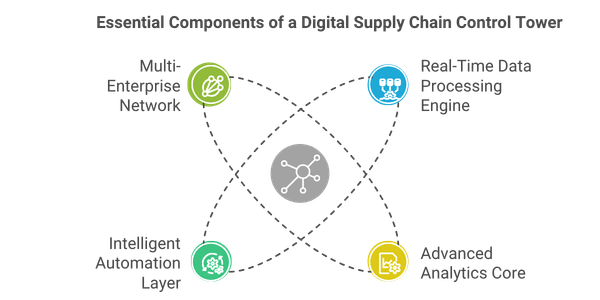
- Real-Time Data Processing Engine: Collects and integrates structured and unstructured data from supply chain automatically
- Advanced Analytics Core: Powers what-if analysis and scenario comparisons
- Intelligent Automation Layer: Manages exception flagging and automated responses
- Multi-Enterprise Network: Connects suppliers, manufacturers, and partners
Integration Capabilities and Technology Stack
Modern control towers run on decoupled system architectures that work independently from traditional ERP systems. This architecture enables:
| Feature | Capability |
|---|---|
|
Data Integration |
Automated collection from IoT, sensors, and external sources |
|
Process Orchestration |
End-to-end workflow management and optimization |
|
Decision Support |
AI-powered recommendations and automated responses |
|
Scalability |
Easy expansion to additional entities and use cases |
The technology stack typically leverages cloud-native, platform-agnostic microservices that integrate with leading technology providers. Organizations that deploy these solutions report meaningful gains in productivity, cost efficiency, and operational responsiveness benefits that compound over time as the system learns from operational data.
Implementation Framework and Best Practices
A successful supply chain control tower implementation needs careful planning and a well-structured approach. Organizations that follow a systematic implementation framework are significantly more likely to achieve their desired outcomes than those that treat it as a purely technical deployment.
Readiness Assessment and Planning
Each control tower implementation starts with a full readiness assessment. Experience shows that evaluating the current cloud environment’s security controls, processes, and governance risks is significant. This assessment creates a roadmap that lines up with well-architected best practices.
Key success factors for readiness assessment:
- Data quality and integration capabilities evaluation
- Stakeholder alignment and resource availability check
- Technical infrastructure readiness review
- Process maturity assessment
Phased Implementation Approach
A structured phased approach has proven successful in multiple implementations:
| Phase | Focus Area | Key Activities |
|---|---|---|
|
1 |
Foundation |
Identify business objectives and priorities |
|
2 |
Analysis |
Develop response strategies and detection mechanisms |
|
3 |
Technology |
Enable through design and deployment |
|
4 |
Optimization |
Implement continuous improvement processes |
Organizations using this phased approach typically achieve faster time-to-value in their control tower implementations compared to big-bang deployment approaches.
Change Management Strategies
Change management plays a vital role in control tower success. Organizations need clear communication channels and complete training programs. Early investment in super users and key influencers helps them support the new system.
Success in adoption depends on:
- Pre-implementation Planning: Define metrics for adoption and communicate value realization timelines
- Stakeholder Engagement: Regular playbacks and continuous communication with business teams
- Training and Support: Complete training at go-live and beyond, with available materials
- Continuous Improvement: Regular evaluation and refinement of processes
Organizations that invest in these change management strategies achieve markedly higher user adoption rates than those that treat change management as an afterthought.
Measuring Control Tower ROI and Performance
Measuring a supply chain control tower implementation’s success requires a detailed approach to tracking performance and assessing ROI across multiple dimensions simultaneously.
Key Performance Indicators (KPIs)
Digital supply chain control tower implementations need to focus on these essential performance indicators:
| KPI Category | Metrics to Track |
|---|---|
|
Operational Efficiency |
On-time delivery, perfect orders, capacity plan accuracy |
|
Financial Performance |
Cost per PO, spend management, cost savings |
|
Process Improvement |
Plan budget vs. actuals, headcount to spend ratio |
Financial Impact Assessment
Supply chain control tower implementations can generate significant financial advantages across multiple value levers. Revenue benefits come from reducing lost sales caused by stockouts and fulfillment failures. Inventory optimization reduces holding costs and working capital requirements. Capital efficiency improves as excess inventory is identified and eliminated. Across these dimensions, well-implemented control tower solutions have demonstrated strong ROI with relatively short payback periods making the business case compelling even in constrained budget environments.
Continuous Improvement Metrics
A successful continuous improvement strategy needs both leading and lagging indicators. Our control tower implementations monitor:
- Process Efficiency Metrics
- Time to schedule and close purchase orders
- Field failure rates for new product introductions
- Capacity plan accuracy measurements
- Performance Optimization Metrics
- Supply chain agility indicators
- Response time to disruptions
- Supplier performance trends
Organizations that build rigorous measurement frameworks consistently uncover inventory reduction and sourcing optimization opportunities that would otherwise remain invisible.
Risk Management and Resilience Building
Building resilient operations is one of the most compelling arguments for supply chain control tower investment, particularly in today’s unpredictable business environment. Advanced control towers help organizations reduce risk-related costs while building the organizational muscle to respond to disruptions faster and more effectively.
Proactive Risk Identification
Modern supply chain control tower software must make use of information from both internal and external sources to get a full picture of risks. Good control tower solutions integrate:
| Risk | Identification |
|---|---|
|
Risk Category |
Monitoring Parameters |
|
Internal Risks |
Capacity, Sales, Inventory |
|
External Risks |
Supplier Status, Weather, Geopolitical |
|
Operational Risks |
Transportation, Production, Quality |
Mitigation Strategies
Effective control tower supply chain management system uses multi-layered mitigation strategies:
- Automated Response Protocols: AI-powered scenario capabilities help understand disruption effects
- Real-time Collaboration: A single source of truth for stakeholder communication
- Intelligent Evaluation: Automated demand and supply shaping decisions
- Risk Scoring: Quantitative and qualitative methodologies for risk assessment
Business Continuity Planning
Cloud-based control tower solutions with embedded AI and machine learning provide intelligent, real-time analysis of developments across the supply network giving organizations the situational awareness they need to maintain continuity during disruptions. The most mature implementations support faster disruption detection, autonomous execution of pre-approved response protocols, and quicker recovery from supply chain events. The result is not just better crisis management but a fundamentally more resilient operation one that can absorb shocks that would cripple less prepared organizations.
Integration with Emerging Technologies
Emerging technologies are reshaping what supply chain control towers can do, creating smarter, more responsive supply networks that were simply not possible with previous generations of technology.
Blockchain Integration
Blockchain integration in control tower supply chain management systems can significantly boost transparency and trust across multi-party supply networks. Key capabilities include:
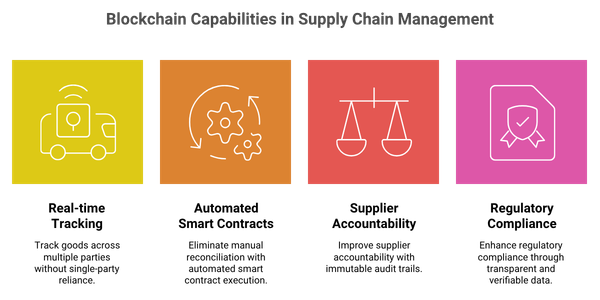
- Real-time tracking of goods across multiple parties without relying on any single party’s
- Records, automated smart contract execution that eliminates manual reconciliation
- Improved supplier accountability through immutable audit trails
- Enhanced regulatory compliance through transparent and verifiable data.
These capabilities are particularly valuable in industries where provenance and chain-of-custody documentation are critical, industries like pharmaceuticals, food and beverage, luxury goods, and electronics among them.
IoT and Sensor Networks
IoT sensors are creating smarter supply chain control tower dashboards by bridging the gap between physical operations and digital systems. A well-designed sensor network architecture has:
| Component | Function | Benefit |
|---|---|---|
|
Edge Devices |
Data Collection |
Real-time monitoring |
|
Local Networks |
Data Transmission |
Reduced latency |
|
Base Stations |
Data Processing |
Better accuracy |
|
Cloud Integration |
Data Analysis |
Better visibility |
IoT-enabled control towers reduce the workforce costs associated with manual monitoring while improving customer satisfaction through proactive service because problems are identified and addressed before they become customer-facing failures.
5G and Edge Computing Applications
5G technology revolutionizes digital supply chain control tower implementations. The integration of 5G enables:
- Better Data Processing
- Ultra-low latency for real-time decision making
- Support for massive device connectivity
- Better reliability in data transmission
- Advanced Analytics Capabilities
- Real-time inventory tracking
- Predictive maintenance alerts
- Automated quality control
5G-powered control towers can support a high number of simultaneous device connections per square kilometer. This provides complete visibility across complex supply networks. Edge computing integration helps organizations reduce response times and improve operational efficiency by processing data closer to its source. Together, 5G and edge computing support complete visibility across supply networks of a scale and complexity that previous connectivity infrastructure simply could not accommodate.
Industry-Specific Applications and Use Cases
Supply chain control tower solutions look different across industries because the problems they’re solving are different. Here’s how they’re being applied across major sectors.
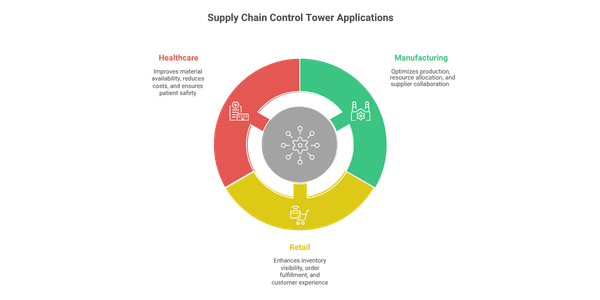
Manufacturing Sector Implementation
Manufacturing companies have been among the most active adopters of digital supply chain control tower solutions. In manufacturing environments, control towers help monitor real-time production status across multiple facilities, optimize resource allocation dynamically as conditions change, improve supplier collaboration through shared visibility, and enhance demand forecasting accuracy by connecting market signals to production planning. The result is streamlined operations, fewer manual interventions, and better utilization of labor and capital resources.
Retail and E-commerce Solutions
Supply chain control towers have become critical infrastructure for retailers managing the complexity of omnichannel operations. Real-time inventory visibility reduces stockouts and the lost sales that come with them. Improved order fulfillment capabilities drive better delivery times and customer satisfaction. Demand sensing improves forecasting accuracy and reduces the over-ordering that leads to markdowns. Omnichannel integration ensures a consistent customer experience regardless of which channel the customer uses. RFID-enabled control tower solutions give retailers granular inventory tracking from shipping container to final sale enabling proactive decisions about balancing capacity, available supply, and production demand.
Healthcare Supply Chain Optimization
Healthcare organizations face uniquely demanding supply chain requirements where stockouts have patient safety implications and compliance failures carry regulatory consequences. Control tower implementations in healthcare have delivered operational improvements including meaningful reductions in nurse time spent on supply management, better tracking of large volumes of stock movements annually, reductions in annual spending through improved procurement visibility, more effective management of large third-party product catalogs, and improved material availability at the point of care. Healthcare providers using control tower solutions can deliver better patient care at lower costs because the right supplies are available at the right time without the waste of over-ordering.
The Future of Control Tower Solutions
Supply chain control tower solutions will continue to evolve rapidly through the remainder of this decade. The trajectory is clear: from simple visibility tools toward autonomous decision-making centers that can sense, analyze, decide, and act with minimal human intervention.
Emerging Trends and Technologies
Several breakthrough developments are shaping the next generation of supply chain control towers. Generative AI is enhancing predictive capabilities and enabling automated response generation that goes beyond rule-based automation. Network-wide orchestration is enabling real-time collaboration across entire supply chain partner ecosystems rather than just within the four walls of a single organization. Autonomous operations self-learning systems that make and execute decisions are moving from concept to reality in leading-edge implementations. Sustainable operations capabilities, including carbon footprint tracking and optimization, are being integrated as environmental accountability becomes a business imperative. Edge computing continues to enhance real-time processing capabilities across distributed supply networks.
The Evolution of Control Tower Capabilities
Control tower capabilities can be understood across three generations. The first generation focused on simple visibility transport tracking and basic collaboration tools. The current generation delivers predictive analytics, multi-domain control, and decision support. The next generation will deliver autonomous control: end-to-end orchestration and self-execution of supply chain decisions. Organizations that begin building toward this third generation now by investing in the data infrastructure, integration capabilities, and AI foundations it requires will be positioned to capture its benefits earliest.
Preparing for Future Challenges
As control tower implementations grow more sophisticated, organizations face several challenges that require proactive attention. Data integration and quality demands strong data governance frameworks, standardized data models, and seamless system interfaces because autonomous decision-making is only as good as the data it relies on. Network collaboration requires multi-enterprise collaboration platforms, standardized communication protocols, and trust-building through transparent operations. Practical implementation benefits from a hybrid rollout approach that builds capabilities over time based on business use cases adding depth to visibility, alerts, and response mechanisms through agile sprints rather than attempting everything at once. The organizations that navigate these challenges most effectively will be those that treat the control tower not as a technology project but as a strategic capability that requires sustained investment and executive sponsorship.
How Acuver Helps You Get There
Understanding control tower architecture is one thing. Implementing it successfully in a real enterprise, with real complexity, on a timeline that delivers business value is another. This is where Acuver comes in.
Acuver is a specialist supply chain consulting and technology firm with over a decade of experience helping global enterprises optimize their supply chain operations. Trusted by Fortune 500 companies across retail, manufacturing, automotive, pharmaceutical, and logistics, Acuver brings deep domain expertise and a proven implementation track record to every engagement.
Successful control tower implementations don’t happen by accident. They require careful planning, strong change management, and a commitment to continuous improvement that extends well beyond the go-live date. Acuver brings this discipline in their implementation with experienced professionals who have navigated these challenges before, and consistently achieve faster results and higher adoption rates
If you’re ready to move from supply chain visibility to supply chain intelligence, the conversation starts with Acuver.