Why a Modular OMS Is Essential for Omnichannel Retail
A modular OMS lets retailers activate only the capabilities they need without committing to a full enterprise platform. For omnichannel retail specifically, it creates a single operational backbone that connects every sales channel. Orders, inventory, and fulfilment data flow through one system, so customers get accurate stock information, faster delivery, and consistent service whether they shop online, in-store, or on a marketplace.
In short: it gives smaller retailers enterprise-grade omnichannel capability without the enterprise-grade complexity.
Retail has changed. Customers shop across channels and expect a seamless experience at every step. They want to buy it online and return it in-store. They want real-time stock visibility. They want fast, accurate fulfillment. Meeting these expectations requires more than good products; it requires the right operational infrastructure.
For small and mid-sized retailers, traditional OMS platforms often feel too much. They are built for enterprise scale, priced accordingly, and loaded with features that go unused. Implementing them takes months. Maintaining them takes dedicated IT teams.
A modular OMS solves this. It lets smaller retailers access the same operational power as large enterprises, but in a way that fits their size, budget, and pace of growth. Instead of buying a full suite upfront, retailers activate only the modules they need, order routing, inventory sync, returns management, or fulfillment of orchestration and expand as they scale.
The result is a lean, agile operation that can respond to customer demands, seasonal spikes, and new sales channels without friction.
What is a Modular OMS?
A modular OMS is an order management system built as a collection of independent, plug-and-play components. Each module handles a specific function, such as order capture, inventory management, fulfillment, or returns and can be deployed separately or together.
Unlike a monolithic OMS where all functions are bundled into one system that must be implemented in full a modular OMS lets you build your tech stack piece by piece. Each module integrates with your existing tools via APIs, so you do not have to rip and replace what already works.
Why Choose a Modular OMS?
The modular approach was born out of a simple frustration: most retailers do not need everything an enterprise OMS offers, and they cannot afford to wait 12 months for a full implementation.
What makes Modular Architecture Different?
- Flexibility: Add or remove modules based on what your business needs right now.
- Speed: Deploy a single module in weeks, not months.
- Cost control: Pay for what you use, not for a full platform.
- Low disruption: Integrate with your current ERP, WMS, or ecommerce platform without a full system overhaul.
How Does a Modular OMS Benefit Retailers?
A modular OMS delivers practical, day-to-day value across the entire retail operation. Here are the key benefits:
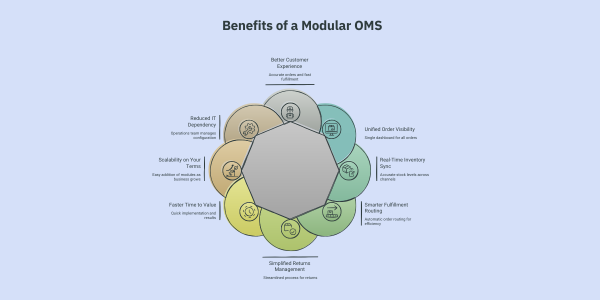
- Unified Order Visibility
Orders from every channel: online, in-store, marketplace, or social are visible in a single dashboard. Your team always knows where an order stands, reducing errors, and improving response times.
- Real-Time Inventory Sync
Stock levels update in real time across all your channels. You do not oversell, you do not disappoint customers with out-of-stock items, and you do not tie up capital in excess inventory.
- Smarter Fulfillment Routing
Orders are routed to the best fulfillment location automatically whether that is a warehouse, a store, or a third-party logistics partner. This cuts shipping time and cost.
- Simplified Returns Management
A dedicated returns module handles reverse logistics cleanly. Customers get a smooth experience, and your team gets clear workflows for restocking or refunding.
- Faster Time to Value
Because you deploy only what you need, implementation is faster. You start seeing results in weeks, not quarters.
- Scalability on Your Terms
As your business grows, you add modules. There is no need to migrate to a new platform every time your needs evolve.
- Reduced IT Dependency
Modern modular OMS solutions are API-first and designed for easy integration. Your operations team can manage much of the configuration without waiting on IT.
- Better Customer Experience
When orders are accurate, inventory is correct, and fulfillment is fast, customers notice. A modular OMS helps you deliver the consistent experience that builds loyalty.
How to Know When to Choose a Modular OMS?
You should consider a modular OMS when your current system can no longer keep up with how you sell. If you are managing orders manually across channels, dealing with constant stock discrepancies, or struggling to scale without adding headcount, it is time to look at a better solution.
Signs You Should Opt for a Modular OMS
- You sell across two or more channels but manage orders in separate systems.
- Inventory errors and overselling are regular occurrences.
- Your team spends too much time on manual order processing.
- Customer complaints about late or incorrect orders are increasing.
- You want to add a new sales channel but cannot do so without major disruption.
- You have outgrown your current OMS, but a full enterprise replacement feels too risky or expensive.
Key Questions to Ask Before Choosing a Modular OMS
- Which order management problems cost us the most time or money right now?
- How many channels do we currently sell on, and how many do we plan to add?
- What systems do we already have in place, and does this OMS integrate with them?
- What is our implementation timeline and budget?
- Do we have the internal capacity to manage the rollout, or do we need a partner?
What to Look for in a Modular OMS?
- API-first architecture that integrates with your existing ecommerce, ERP, and logistics tools.
- A clear module library so you can activate exactly what you need.
- Real-time inventory and order visibility across all channels.
- Scalability; the system should grow with you, not force you to migrate.
- Strong implementation support and documentation.
- Transparent, usage-based pricing.
How a Modular OMS Helps with Omnichannel Success
Omnichannel retail is not just about selling in multiple places. It is about making those places feel like one seamless experience for the customer. That requires your backend operations to be just as connected as your customer-facing channels.
A modular OMS creates that connection. Here is how:
Single Source of Truth for Orders and Inventory
Every order and every stock movement is captured in one place, regardless of where it originates. This eliminates the silos that cause errors and delays in multichannel operations.
Consistent Customer Experience Across Channels
When a customer buys online and returns in-store, your system handles it without friction. When they check stock availability on your website, the data is accurate. This consistency is what turns one-time buyers into repeat customers.
Faster Fulfillment at Lower Cost
Intelligent order routing sends each order to the most efficient fulfillment point. This reduces shipping distances, cuts delivery times, and lowers costs, all of which directly improves customer experience.
Easier Channel Expansion
Want to start selling a new marketplace or launch a mobile app? With a modular OMS, adding a new channel is a configuration change, not a systems overhaul. Your operations scale with your ambitions.
Data-Driven Decision Making
A unified OMS gives you a clear view of performance across every channel. You can see which channels drive the most orders, where fulfillment bottlenecks occur, and where returns are highest and act on that information in real time.
Building Omnichannel Resilience with a Modular OMS
The retail landscape will keep evolving. New channels will emerge. Customer expectations will rise. Supply chains will face fresh disruptions. The retailers who thrive will be the ones with operations flexible enough to adapt quickly.
A modular OMS gives you flexibility. It is not a one-time fix it is a foundation you can build on. Start with the modules that solve your biggest challenges today. Add more as your business grows. Swap out what no longer fits as your needs change.
For small and mid-sized retailers, this is a decisive advantage. You get enterprise-grade capability without enterprise-grade complexity or cost. You stay lean, responsive, and customer-focused, which is exactly where you need to be to compete and win in omnichannel retail.
If your current order management setup is holding you back, a modular OMS may be the most impactful operational investment you make this year.
Acuver Consulting is a supply chain technology firm specializing in Order Management, Warehouse Management, and Software Engineering. With deep domain expertise, we deliver solutions tailored to your stack including modular, plug-and-play components that let you adopt only what you need, without overhauling your entire system. Connect with our team of experts to implement modular solutions that fit your business.