Introduction
A cloud order management system (OMS) can help retailers connect orders, inventory and fulfilment across channels. But the platform alone does not create a better customer experience. The real value comes from how it is designed, integrated and configured around the way a business operates.
What a well-implemented cloud OMS makes possible
For a retailer, a cloud OMS should do more than record orders. It should help teams decide where an order should be fulfilled from, check whether stock is genuinely available, coordinate delivery, and keep customers informed as the order moves through the business.
That requires the OMS to work with the systems already running the business, including ERP, warehouse management, point-of-sale, e-commerce, payment and carrier platforms. The implementation must also reflect real business rules: store capacity, delivery promises, inventory buffers, service levels, returns policies and peak-period demand.
Acuver works with businesses on order management strategy, implementation, integration and optimization. The focus is on making the chosen OMS work within the wider retail ecosystem. Acuver also brings integration capabilities through Aekyam, its proprietary integration and orchestration platform.; Aekyam is not positioned as a replacement for the OMS itself.
To know what a cloud OMS is, and how it can help you, read our blog, What Is A Cloud Order Management Solution? The Complete Guide to Platforms, Benefits and Implementation
The use cases below show what a well-planned implementation can make possible, and the work involved in getting each one running reliably.
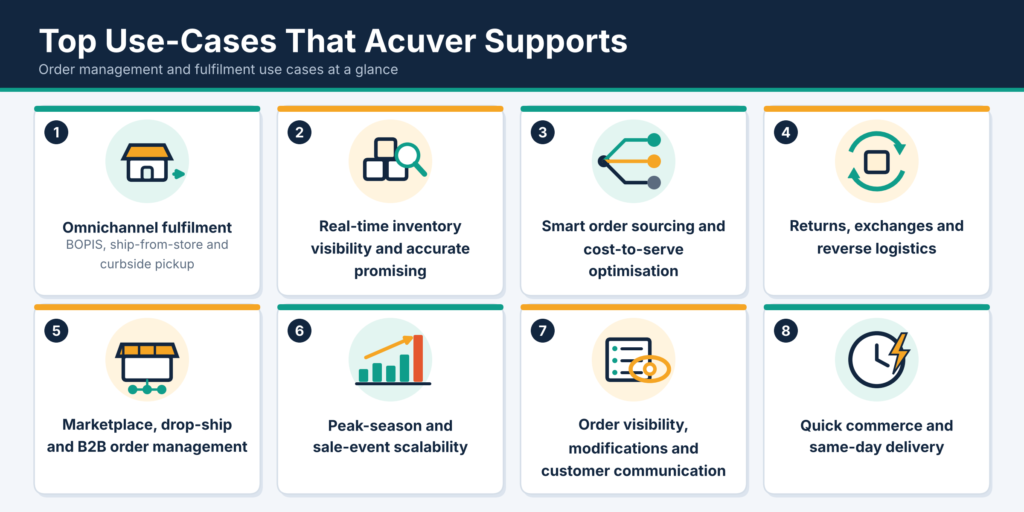
- Omnichannel fulfilment: BOPIS, ship-from-store and curbside pickup
- Real-time inventory visibility and accurate promising
- Smart order sourcing and cost-to-serve optimisation
- Returns, exchanges and reverse logistics
- Marketplace, drop-ship and B2B order management
- Peak-season and sale-event scalability
- Order visibility, modifications and customer communication
- Quick commerce and same-day delivery
Use case
1.Omnichannel fulfilment (BOPIS, ship-from-store and curbside)
The problem
When stores and online channels operate with separate inventory and order processes, customers may see stock that cannot actually be fulfilled. Store teams may also lack the information needed to prepare online orders. The result can be missed pickup windows, avoidable cancellations and extra delivery costs.
What the OMS enables
A well-configured OMS can coordinate orders across stores, warehouses and online channels. Depending on the retailer’s operating model, customers may be able to buy online and pick up in store (BOPIS), have an online order shipped from a store, or collect an order through a curbside process.
How Acuver implements it
Acuver’s implementation work can include connecting store, e-commerce, inventory and fulfilment systems; defining which locations can accept and fulfil each order type; configuring sourcing and pickup rules; and testing the full journey with store teams. The design should account for store capacity, operating hours, stock accuracy and handover steps.
What this makes possible
The intended outcome is a more consistent omnichannel experience, better use of store inventory, and fulfilment choices that balance customer convenience with delivery cost and speed.
2. Inventory visibility and promising
Inventory can sometimes be incorrectly reported due to variations in the timing of store, warehouse and digital inventory feeds. Products can erroneously show as being available for purchase online, despite having been sold, reserved or become faulty. This can cause over-selling and both out-of-stocks and subsequent order cancellations.
OMS functionality
An OMS can consolidate inventory feeds and then use defined business rules to establish what can be promised. Available to promise calculations can factor in stock, reservations, safety stock and suitability of locations alongside other rules to enable an order to be approved.
How Acuver delivers this
Acuver can assist in identifying inventory and data ownership. It can also bring together feeds relating to ERP, WMS and POS. Inventory level and safety stock rules can be set and the system can be tested for how it behaves in situations where feeds are late or contradictory. Good data and rules are key to successful delivery.
Benefits
More accurate promises can be made. Avoidable order cancellations can be minimised and there is enhanced multi-channel inventory visibility.
3. Intelligent order routing and cost to serve optimisation
Whilst the most geographically suitable location may be ideal for fulfilling an order, there may be insufficient stock, high workloads and/or a higher delivery cost there. It can also be less likely to meet delivery date commitments. Fulfilling all orders from a single default location can additionally result in more split deliveries and higher logistics costs.
OMS functionality
Business rules can be used within an OMS to decide where to fulfil orders. These can take into consideration aspects such as stock levels, distance, delivery date commitment, fulfilment capacity, delivery cost and location priority. They can be tailored to match both a retailer’s service offering and business goals.
How Acuver delivers this
Acuver can collaborate with both business and technology functions to establish order fulfilment priorities. Relevant business rules can then be set. Integration can be made between location and carrier data. Common order situations can also be tested pre-go live. Testing should cover situations including low stock, unavailability of locations and differing delivery date commitments.
Benefits
This aims to ensure that order fulfilment is both standardised and commercially appropriate. It contributes to the optimisation of delivery speed, cost and capacity.
4. Returns, exchanges and reverse logistics
Many different business functions and systems can be involved in a returns or exchange process including customer services, stores, warehouses, carriers, payment and finance. Where these functions/systems operate according to differing processes, customers can experience extended wait times for refunds. Staff can also find it difficult to monitor and manage returned stock and to carry out payment reconciliations.
OMS functionality
Goodly integrated OMS functionality can enable a standardised returns and exchanges service to be provided across all channels. It can support receipt of return queries; establish suitable return locations; manage reverse logistics; and share order status. Information can then be conveyed to relevant systems for refund and inventory purposes.
How Acuver delivers this
Acuver can assist in establishing returns policies and processes. It can also integrate carrier and payment functionality. Return location options can be configured and links can be made to warehouse and inventory systems. Consideration should be given to processes for examination of goods, managing faulty stock, exchanges and both payment and inventory reconciliation.
Benefits
Improved interlinking can lead to better returns insight. Manual processes can be reduced and stock that meets quality criteria can be re-sold more swiftly.
5. Managing orders for marketplaces, drop-shipping and B2B
Alongside orders generated via a retailer’s digital offering, orders can also originate from marketplaces and both wholesale clients and suppliers who directly fulfil orders. Disconnected order management can result in duplicate entry of data. Staff may then also have to manually reconcile status information and manage stock discrepancies.
OMS functionality
An OMS allows a unified method for managing order information and fulfilment rules for various channels. It can therefore manage order capture, validation, allocation and status together with consideration for channel specific needs, supplier fulfilment and B2B order rules.
How Acuver delivers this
Acuver can facilitate links between marketplaces, commerce, ERP, suppliers and fulfilment functions. Activities may encompass analysing order and inventory data; establishing channel specific business rules; and managing order acknowledgments and cancellations. Appropriate mechanisms should also be put in place for monitoring communications which have not been received or have been received late.
Benefits
This ideally leads to standardised order management. Manual processes can be reduced and improved insight is provided regarding in-house, marketplace, wholesale and supplier fulfilled orders.
6. Scaling for busy trading periods and promotions
Retailers can experience spikes in order volume around festive seasons, promotional events and new product launches. Even if a system operates well in non-busy periods, staff may find that it becomes less responsive when there are concurrent increases in order capture, inventory feed, payment verification and fulfilment activity.
OMS functionality
Cloud hosted OMS functionality can be structured to allow for scalable provision. However, the system’s scalability will depend upon its architecture, configuration, interlinked systems and infrastructure. Appropriate processes must also be in place to allow staff to effectively manage situations when downstream services become less responsive or unavailable.
How Acuver delivers this
Acuver can advise on how to prepare for busy periods by undertaking analysis of workloads, together with performance and load testing. Integration, exception and process testing can also be undertaken. Operational run books can be established. Staff should test not just discrete transactions but also realistic order volumes and end-to-end processes. Providing ‘hyper-care’ for key promotional periods can further enable quick issue identification and resolution.
Benefits
Having prepared effectively, retailers can better manage risks to service provision and are more confident in responding to order volume fluctuations.
7. Order status, amendment and customer messaging
Consumers typically want to be informed about an order’s status (for example, confirmation, packing and despatch) and may wish to amend delivery details, cancel items and/or seek clarification about delivery issues. Poorly integrated systems can prevent customer services staff from seeing a full picture of an order.
OMS functionality
An OMS can offer a unified order status overview and distribute pertinent status information to front-facing systems. Provided that business rules permit, it can also facilitate order amendments and cancellations at particular points in an order’s life cycle.
How Acuver delivers this
Acuver can aid the development of order status information. Links can also be established between the OMS and customer services and messaging systems. Further, Acuver can establish what alterations can be made to orders at different points in the order cycle. It is important that order status is consistently and correctly maintained within the OMS, as well as on a retailer’s digital commerce offering, customerservices tools and fulfilment partners.
Benefits
Better order status information can help to limit unwarranted customer services queries regarding order status. It can also enable staff to engage with consumers using greater contextual awareness.
8. Fast commerce and next day delivery
Fast commerce and next day delivery require both swift order fulfilment and local stock. Retailers may need to manage dark and local stock, delivery partners and defined service regions. Conventional order fulfilment rules may not suit the requirements of fast commerce and next day delivery orders.
OMS functionality
An OMS can facilitate local order fulfilment by analysing the availability, service capability, capacity and delivery date commitment of fulfilment nodes. It can subsequently allocate orders to suitable dark or local stock locations and ensure status information is shared appropriately along an order’s life cycle.
How Acuver delivers this
Acuver can assist with establishing fulfilment nodes, service capability and order fulfilment rules. Last-mile delivery partners can also be integrated. Order situations can be tested for a variety of pincodes and timeframes. The system should be structured around real-world delivery capacity, inventory accuracy and partner service areas – recognising that not all locations will necessarily be able to fulfil all orders.
Benefits
This can allow for better control of fast delivery. Fulfilment choices can be more clearly made and the number of orders that cannot be fulfilled by a retailer’s network can be decreased.
Utilising use cases in Acuver’s solution delivery
For a use case to be effective it should function efficiently within the systems, functions and exception processes which are engaged in actual order management. Consequently, solution delivery should initially be driven by business use case requirements rather than purely by platform features.
- Use case discovery: Acuver collaborates with stakeholders to analyse existing order processes, challenges, business goals, channels and fulfilment limitations. This assists in the prioritisation of use cases for development.
- Solution design and architecture: An envisaged solution illustrates how an OMS will interface with other systems including ERP, WMS, POS, commerce, payment and carriers. It also establishes data ownership, integration approaches, business rules and exception processes.
- Phased configuration and integration: Where practical, implementation can be delivered in manageable phases. Priority workflows are configured and connected first, while dependencies and later use cases are planned in a structured way.
- Testing against real order scenarios: Testing should cover normal orders as well as exceptions: split fulfilment, short inventory, failed payments, cancelled orders, delayed carrier updates, returns and peak traffic. Business users should validate the journeys through UAT.
- Go-live, hypercare and optimisation: A controlled cutover, clear support ownership and post-go-live monitoring help teams stabilise the solution. Once the core workflows are running, the implementation can be reviewed and refined using operational feedback and performance measures.
Acuver’s role is to help design, implement and integrate the OMS around the retailer’s requirements. The OMS platform is selected or confirmed with the client; Acuver’s AI Orchestration platform, Aekyam, may be used where it fits. This keeps the implementation focused on business outcomes rather than treating one product as the answer to every requirement.
Start your Cloud OMS journey with Acuver
The right starting point is not necessarily a full-scale transformation. Many retailers begin with a clearly defined challenge, such as improving inventory visibility, enabling ship-from-store or simplifying marketplace order flows. A focused first phase can help validate the approach, surface integration dependencies and create a foundation for the next set of improvements.
Acuver brings order management, quality engineering and implementation experience to help businesses move from a target design to working order flows. Explore Acuver’s Order Management solutions or speak with the team about the use cases that matter most to your business.