Introduction
You didn’t choose IBM Sterling Order Management because it was simple. You chose it because your fulfilment reality is complicated, multiple channels, multiple warehouses, a store network that has to behave like a distribution centre on the busiest week of the year, and a promise to the customer that has to hold every single time.
Here’s the uncomfortable part. The software almost never fails on its own. Research from McKinsey and the University of Oxford across more than 5,400 IT projects found that large IT projects run 45% over budget, 7% over schedule, and deliver 56% less value than planned, and that 17% go so badly they threaten the company’s existence. Sterling is a proven platform. What varies is who implements it, how they sequence the work, and whether they’re still around when peak season arrives.
This blog covers what IBM Sterling OMS implementation partner services actually include, how partner-led delivery compares with in-house and IBM-led routes, and what to look for in 2026 now that agentic AI has landed inside the platform itself.
What Are IBM Sterling OMS Implementation Partner Services?
IBM Sterling OMS implementation partner services are the consulting, engineering, and support activities an IBM Business Partner delivers to design, build, integrate, migrate, and run IBM Sterling Order Management System on a client’s behalf. They typically cover solution architecture, configuration and extension, systems integration, data migration, quality engineering, cutover, and post-go-live application managed services.
That’s the short answer. The longer one matters more, because these services are not a single package, they are six distinct layers, and the mix you need depends entirely on where you are in your journey.
The Six Service Layers
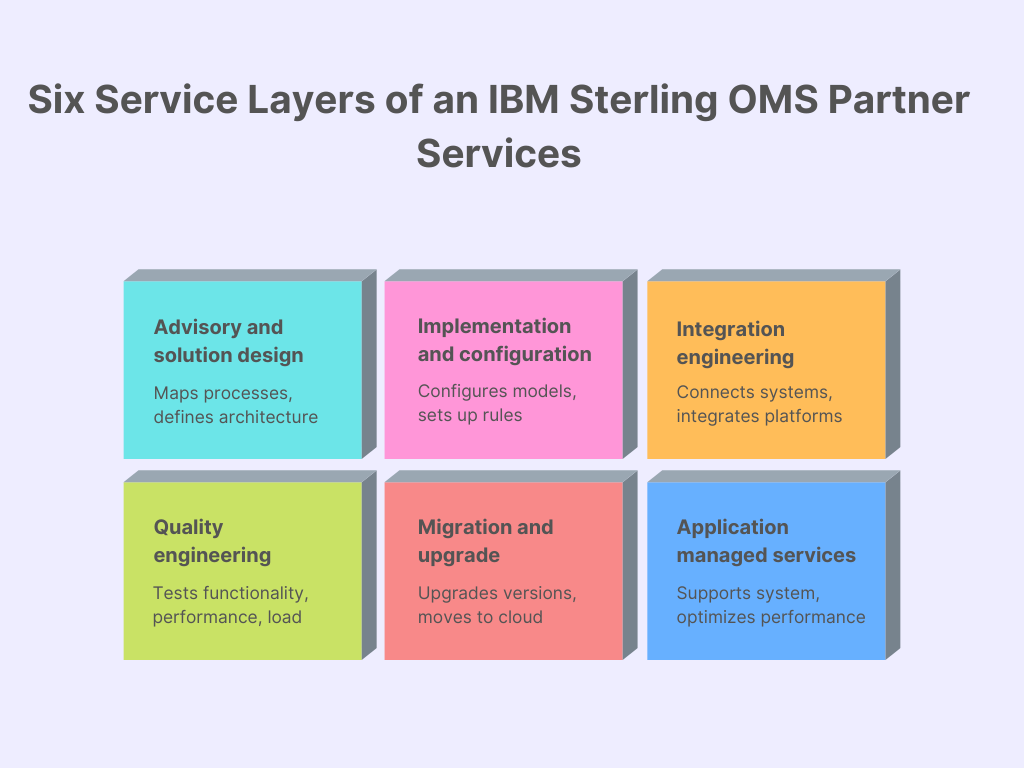
Advisory and solution design. Business process mapping, fulfilment strategy, target architecture, and the deployment decision, on-premises, on-cloud, or hybrid. This layer is where most of the value is either created or quietly lost.
Implementation and configuration. Setting up organisations, item and inventory models, sourcing and scheduling rules, order pipelines, and the Order Hub experience your teams will live in every day.
Integration engineering. Connecting Sterling to commerce platforms, ERP, WMS, marketplaces, payment systems, and carrier networks. This is usually the largest surface area in the programme and the most frequently underestimated.
Quality engineering. Functional, integration, performance, and peak-load testing. On a system that touches revenue directly, test automation and performance engineering aren’t a phase at the end, they run alongside the build.
Migration and upgrade. Version-to-version upgrades, on-premises to SaaS moves, and data migration with retention and reconciliation planning.
Application managed services. Ongoing support, release management, environment operations, and continuous optimisation once the programme becomes a running system.
What a Partner Does That IBM Support Doesn't
This distinction confuses a lot of teams, so it’s worth being precise. IBM Support handles the product defects, patches, platform incidents, and the maintenance lifecycle. IBM’s own documentation on Sterling OMS service roles sets this out clearly: IBM provides an onboarding specialist and a client success manager, while implementation, operation, customisation, and support services are delivered by contracted providers, IBM, third-party Business Partners, or your own team.
In other words, partner-led delivery is not a workaround. It is how IBM designed the operating model. A partner owns your business logic, your integrations, your data, and your release cadence. IBM owns the product beneath all of it.
Why Do Enterprises Use an Implementation Partner Instead of Building In-House?
Because Sterling expertise is deep, narrow, and hard to hire and because the cost of learning on a live order pipeline is measured in cancelled orders.
The In-House Attempt Pattern
This sequence has repeated itself more often than not. A capable internal team takes on a Sterling upgrade, gets most of the way, hits an environment or data-model problem nobody anticipated, and stalls. Release cycles freeze. The next attempt starts from a worse position than the first.
Where Sterling Programmes Actually Break
Three places, consistently.
Requirements consensus. McKinsey’s research on supply chain IT modernization found that 45% of executives named a lack of agreement on technical and process requirements as the biggest barrier to launching a project, and that when planning implementations fail, 60% of the time it’s because they miss the schedule, miss the budget, or miss the expected outcome.
The integration surface. Every connected system is a contract. The count is usually higher than the original estimate, and the ones nobody mapped are the ones that break at 2 a.m.
Cutover timing. Go-live windows collide with peak season more often than they should. A partner who has run cutovers before builds the calendar backwards from your busiest week, not forwards from the kickoff date.
For the wider, platform-agnostic view of what makes any OMS rollout succeed, our guide to best practices for implementing an order management system covers the fundamentals that apply regardless of which platform you’ve chosen.
Partner, IBM Expert Labs, or In-House — How Do You Decide?
There’s no universally right answer, and anyone who tells you otherwise is selling. There is a right answer for your situation, and it usually falls out of five variables.
| Consideration | Implementation Partner | IBM Expert Labs | In-House Team |
|---|---|---|---|
|
Product depth |
Deep, and combined with cross-industry delivery patterns |
Deepest — direct access to the engineering roadmap |
Varies; strongest on your own business logic |
|
Business context |
Built during discovery, retained across the engagement |
Focused on the product-side of the problem |
Already there — the genuine in-house advantage |
|
Speed to mobilise |
Days to weeks with an existing bench |
Scoped as defined offerings and packages |
Slow if hiring is required |
|
Cost predictability |
Moderate to high, depending on engagement model |
High — packaged, fixed scope |
Low; overruns land internally and stay hidden |
|
Post-go-live continuity |
Strong when the same team moves into managed services |
Handover back to client or partner |
Strong, if the team stays |
|
Best when |
You need build and run, with sustained capability |
You need a targeted product intervention or health check |
You have a mature Sterling practice already |
The honest framing: these aren’t mutually exclusive. Plenty of successful Sterling programmes blend all three, IBM for a defined product assessment, a partner for delivery and integration, and your team owning process design and adoption. What matters is that ownership of each layer is explicit before the first sprint, not negotiated during the first escalation.
What Should IBM Sterling OMS Implementation Partner Services Include in 2026?
The market is moving faster than most statements of work account for. Fortune Business Insights projects the multichannel order management market to grow from $4.52 billion in 2026 to $11.34 billion by 2034, a 12.2% CAGR, with cloud already holding roughly 72% of the market in 2026. Three capabilities separate current partner services from ones written for 2021.
SaaS and OMoC Readiness, Not Just On-Premises Skill
If a partner’s Sterling experience is entirely on-premises, they are skilled at an architecture the market is leaving. Cloud-native deployment changes environment management, release cadence, data retention, and how you plan a migration. It also changes what “good” looks like operationally, a partner should be able to describe their target state for deployment frequency and downtime, in numbers.
Agentic AI Readiness
This is new enough that many partner capability decks haven’t caught up. IBM made agentic AI capabilities generally available inside Sterling OMS on 6 March 2026 through the Sterling OMS Agentic Toolkit Add-On, with agents covering order information, coupon enforcement, cancellations, inventory segmentation, and contract risk. IBM’s documentation also confirms that you can extend OMS with your own externally built agents through a Model Context Protocol server.
The practical question for a partner is not whether they’ve heard of it. It’s whether they can tell you which agents are worth activating for your order profile and which aren’t.
Continuity From Build Into Run
A programme that ends at go-live hands you a system nobody who built it still supports. The partners worth having offer application managed services with the same people, or a deliberate, documented handover and they will tell you which one you’re getting before you sign.
How Is an IBM Sterling OMS Implementation Partner Engagement Structured?
Most engagements move through six stages, and each one has its own failure mode. Rather than compress them here, we’ve given each the depth it deserves:
- Partner selection and evaluation — the questions that separate a capable partner from a convincing one. Explore our blog, How to Choose an IBM Sterling OMS Implementation Partner: 14 Questions to Ask, for the key questions that separate capable partners from convincing ones.
- Commercial structuring — what drives cost, and which engagement model fits which risk profile. Read our blog, What Drives IBM Sterling OMS Implementation Cost? Engagement Models Explained, to understand what drives implementation costs for IBM Sterling OMS.
- Delivery — discovery, design, build, conference room pilots, cutover, and hyper care. We cover the implementation roadmap and the different phases of IBM Sterling OMS, in our blog titled, The IBM Sterling OMS Implementation Roadmap, Phase by Phase.
- Migration and upgrade — for estates already on Sterling. Explore our blog on migrating from on-premises to cloud IBM Sterling OMS without breaking peak season.
- Run and optimize — managed services, release management, and agentic AI activation.
- Continuous improvement — the stage most programmes skip, and the one where compounding returns actually live.
Where AI orchestration across systems is the genuine constraint rather than order management itself, our platform Aekyam handles the integration layer.
Choosing IBM Sterling OMS Implementation Partner Services That Deliver
Three things are worth carrying out of this guide. First, IBM Sterling OMS implementation partner services are six layers, knowing which layers you need is half the decision. Second, the delivery route matters more than the platform choice, because the platform is proven and the delivery is where 45% budget overruns come from. Third, the definition of partner readiness changed in March 2026, and a partner who can’t discuss agentic AI activation is describing a 2021 engagement.
Acuver Consulting is a supply chain firm, specializing in order management, warehouse management and software engineering solutions. Acuver has been crucial as an IBM Business Partner, implementing, extending, and managing IBM Sterling Order Management for retailers, manufacturers, and logistics enterprises across India, the UK, the US, and APAC. We offer enterprise implementation services that cover the full journey, advisory through managed services with the same team on both sides of go-live.
If you are weighing up your options for the year ahead, connect with our team to get an expert idea of what Sterling OMS will do for you.