Introduction
You have probably seen this happen. A shopper sees “in stock” and a delivery date at checkout. They place the order. Two days later, your team is writing an apology. The stock was reserved for someone else. Or the store or warehouse had no capacity. Or the “two-day” promise assumed a cut-off time that nobody checked.
This mistake is expensive. IHL Group estimates that overstocks and out-of-stocks will cost global retail about $1.7 trillion in 2026. That is 6.2% of worldwide retail sales. A broken delivery promise is the most visible sign of this problem.
IBM Sterling Intelligent Promising was built to fix this. This blog explains what it is and how it works across the order lifecycle. It also covers the KPIs it improves, the five use cases that matter most, and how to get started.
What Is IBM Sterling Intelligent Promising?
IBM Sterling Intelligent Promising (SIP) is a cloud-based platform for order promising. It tells your customer when an order will arrive. It also helps you choose the best store or warehouse to ship it from. SIP does this by checking real-time stock, capacity and shipping cost. This way, the date you show at checkout is one you can keep.
IBM’s documentation says SIP has three separate services on one shared platform. Promising gives delivery dates. Inventory tracks stock across your network. Optimization picks the best way to fulfill each order. There is also an interface called Order Hub, where you manage your rules and nodes. A node is any place that holds stock, such as a store or a warehouse.
SIP comes in three packages: Essentials, Standard and Premium. You can use it as SaaS. In the Standard package, you can also run it as on-premises containers.
What does it do?
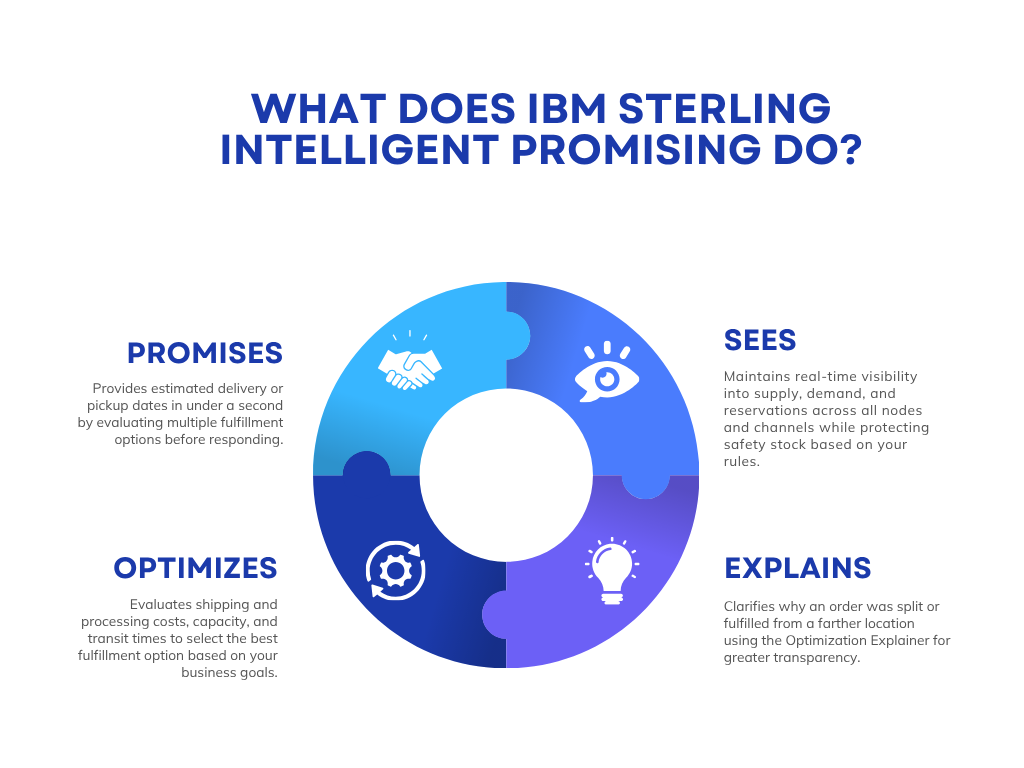
Think of SIP as an air-traffic controller for your inventory. It makes sure every order goes to the right place at the right time. It does four jobs:
- Promises: gives estimated delivery or pickup dates in under a second. It checks many ways to fulfill the order before it answers.
- Sees: keeps a live view of supply, demand and reservations across all nodes and channels. It also holds back safety stock based on your rules.
- Optimizes: compares shipping cost, processing cost, capacity and transit time. It then picks the option that best fits the goals you set.
- Explains: shows why an order was split or shipped from a farther node. The Optimization explainer does this.
How does IBM Sterling Intelligent Promising bring value to retail?
SIP brings value to retail by fixing problems before an order is committed. Here is how it helps:
- Lower fulfillment cost: Fulfillment is where a lot of margin is lost. McKinsey’s analysis says omnichannel order fulfillment costs 10–20% of sales. SIP weighs shipping and processing cost before the order is committed. This is much cheaper than fixing the problem later.
- Fewer split shipments: McKinsey also says that splitting shipments eats into margin. SIP looks at the whole network and tries to ship each order in as few shipments as possible.
- Promises you can keep: SIP books inventory and capacity together. Its delivery dates account for cut-off times and transit time. So the date a shopper sees is one you can meet.
- Better use of stock: SIP sees stock across all nodes and channels in real time. In the Premium package, it also adds the cost of stockouts and markdowns to its sourcing decisions.
Why Traditional Order Promising Falls Short
Order promising means telling a customer what they can buy and when it will arrive. Most promising logic was built for a simpler time. Back then, retailers sold through fewer channels and shipped from fewer locations. Stock changed slowly, so an update in batches was good enough.
Today, shoppers buy on the web, in stores and on marketplaces. Stock sits in many places and changes by the minute. Shoppers also expect an accurate delivery date at checkout. Old promising logic cannot keep up with this. Three problems show up again and again.
Static ATP. Available-to-promise (ATP) is the stock you can promise to customers. It is calculated in batches, so it is out of date as soon as demand changes. Shoppers see stock that is already gone.
Siloed inventory. Stores, distribution centers and marketplaces each keep their own numbers. The stock exists somewhere in the network, but the promise engine cannot see it. So it either refuses the sale or sells stock it does not have.
Stockouts after checkout. The shopper has paid. The node has the units, but not the staff to pick them today. The promise was based on inventory alone. Nobody looked at capacity.
The table below compares traditional promising with SIP.
| Traditional promising | With SIP | |
|---|---|---|
|
Availability |
Batched, per system |
Real-time, network-wide |
|
Capacity |
Ignored |
Optional capacity service removes nodes that are out of capacity |
|
Delivery date |
Lead-time tables |
Calculated from stock, cut-off times and transit time |
|
Cost |
Added after the fact |
Built into sourcing |
|
After checkout |
Reroute and apologize |
Inventory and capacity booked together |
Where SIP actually improves things
SIP improves two things the most.
- First, IBM’s Promising service books inventory and capacity together. This means the same unit cannot be promised twice.
- Second, it looks at the state of the whole network. This is how it reduces split shipments instead of just accepting them.
How IBM Sterling Intelligent Promising Actually Works
Architecture and integrations
SIP connects to the systems you already use. Here is how the pieces fit together.
Your storefront calls the Promising APIs on the product list page, product detail page, cart and checkout. Supply and demand data flow into the Inventory service from your ERP, WMS and POS. IBM also publishes Kafka topics for Inventory, Promising and Optimization events. After the purchase, the Optimization service receives real-time orders from your order management system. It sends back sourcing recommendations, and Sterling OMS applies them.
Nodes, distribution groups and rules are set up once. All three services share them. This shared setup is also where many implementations go wrong. We cover this later in the blog.
The order lifecycle
SIP supports every step of an order. Here is what happens at each step:
- Browse: the storefront asks for delivery dates, and Promising returns options in under a second.
- Promise: the customer picks an option. Promising confirms it and books inventory and capacity in one step.
- Allocate: the order reaches Sterling OMS. Optimization recommends the best sourcing within your rules.
- Consolidate: the engine tries to use fewer shipments. It weighs cost goals against speed.
- Ship: Sterling OMS handles shipment, invoicing and returns. The benefits report tracks the results.
SIP vs. Sterling OMS: how they fit together
Sterling OMS and SIP do different jobs. OMS handles order capture, orchestration and execution. SIP adds the visibility, promising and fulfillment-optimization layer in front of and alongside it. Our blog on order orchestration vs. order management explains this split in more detail. The table below shows who does what.
| Capability | Sterling OMS | SIP |
|---|---|---|
|
Order capture and lifecycle |
Core |
Not its job |
|
Shipment, invoicing, returns |
Core |
Not its job |
|
Real-time global inventory view |
Supports |
Core (Inventory service) |
|
Delivery-date promising |
Supports |
Core (Inventory service) |
|
Cost-based sourcing |
Rules-based |
Core (Optimization service) |
What Are the Business Benefits and KPIs of IBM Sterling Intelligent Promising?
IBM publishes expected benefit ranges for each package on its pricing page. These are IBM estimates, not guarantees. Your results will depend on your network. Use them as a starting point, then test them.
Conversion and cart abandonment
Accurate delivery dates on listing pages, product pages and checkout remove the guesswork for the shopper. IBM cites a 1–3% increase in online sales from showing estimated delivery dates. The opportunity is real. Baymard finds that 21% of shoppers who abandon their carts cite slow delivery.
Cost-to-serve and split-shipment rate
SIP weighs shipping and processing cost for every order before it chooses where to ship from. IBM estimates this cuts online fulfillment shipping cost by 6–12%, thanks to better sourcing and fewer split shipments. For a real example, a major omni-channel retailer we worked with cut fulfillment cost per order by 9%. This happened within a 10-week phased rollout.
On-time delivery and customer satisfaction
SIP promises account for capacity, cut-offs and transit time, so they are promises you can keep. In the same rollout, order cancellations fell by 68% and fulfillment accuracy rose by 23%. These results came from an allocation engine Acuver built, not from SIP itself. But they show what dynamic, inventory-aware allocation can deliver.
Markdown reduction and inventory productivity
Premium’s predictive optimization includes the cost of stockouts and markdowns when it chooses sourcing. IBM estimates this reduces overall inventory cost by 3–7%. In the same omni-channel engagement, inventory turnover rose by 14%.
The table below shows what each package adds and the benefit range IBM states for it.
| Package | What it adds | IBM-stated benefit range |
|---|---|---|
|
Essentials |
Promising service |
1–3% online sales increase |
|
Standard |
+ Inventory and deterministic Optimization |
6–12% lower shipping cost |
|
Premium |
+ Predictive (AI/ML) optimization |
3–7% lower inventory cost |
What Are Some Key Use Cases You Can Achieve with IBM Sterling Intelligent Promising?
SIP can solve many order-fulfillment problems. These five use cases matter most. Each one shows the problem a retailer faces and how SIP fixes it.
5.1 Inventory-aware order allocation
Problem: Many retailers pick the shipping location with a simple rule. The rule is usually “nearest node” or “most stock.” These rules ignore the bigger picture. They can drain a shelf that another channel needs. They can also ship from a location that is slow to pack and send the order. The result is stock gone from the wrong places and slow deliveries.
How SIP solves it: SIP first works out which stock is truly available to use. It does this with real-time supply and your safety stock rules. Stock you want to hold back is left out. Then the Optimization service scores each option on speed, cost and node balance. Node balance means not emptying one location while others hold plenty. The order goes to the best option.
Read more: inventory-aware order allocation.
5.2 Constraint-aware order allocation
Problem: Some orders come with rules. A customer may need all items in a single shipment. They may need a single invoice. Some products must have a minimum shelf life left when they arrive. Logic that only looks at stock availability breaks these rules. This leads to unhappy customers and compliance problems.
How SIP solves it: SIP uses promising rules and tag-aware sourcing, which checks stock details. These keep each decision within stock that follows your rules. SIP also uses transfer rules to open compliant routes. This helps when one node cannot fill the whole order. Sterling OMS then carries out the transfer and the invoice.
Read more: constraint-aware order allocation.
5.3 Priority-based order allocation
Problem: Sometimes demand is higher than stock. A first-come, first-served approach gives stock to whoever orders first. Your best customers or most important channels can end up with nothing. That hurts the relationships that matter most to your business.
How SIP solves it: SIP uses segmentation allocation rules. You rank your customer or channel segments. For each segment, you set an allocation percentage and a minimum quantity. SIP then protects stock for your priority segments. This keeps your best customers and channels served when stock runs short.
Dive deeper: priority-based order allocation.
5.4 Shipment consolidation
Problem: Many small shipments cost more to send. But waiting to build fuller shipments can make deliveries late. It is hard to balance these two risks.
How SIP solves it: SIP tries to use the fewest shipments for each order while still meeting your delivery commitments. It weighs cost goals against speed. Planning at the load level happens outside SIP. Sterling OMS and your transport systems handle that part.
Learn more: shipment consolidation.
5.5 Dynamic order promising and delivery optimization
Problem: Many retailers show delivery dates from fixed tables. To be safe, they add extra days. Padded dates push shoppers away, so you lose sales. Dates that are too tight get missed, and that breaks your promise.
How SIP solves it: SIP calculates each date live. It uses stock levels, capacity, node cut-off times and transit time. The date reflects what is true at that moment. So the date you show is both competitive and reliable.
Read more: dynamic order promising.
How to Get Started with IBM Sterling Intelligent Promising
Acuver Consulting is an IBM Business Partner (IBM Partner Plus Silver), and we have been helping retailers implement and run IBM Sterling Order Management. We also build allocation and promising solutions on top of it. For integration, we offer a modular approach that pairs IBM with Aekyam’s iPaaS. After go-live, our managed services team supports you.
We have taken a major omni-channel retailer to production in 10 weeks using a phased rollout. Below is how we would guide you through the same journey.
Data readiness
Promising is only as good as your inventory data. One 2026 analysis cites inventory accuracy as low as 63% against 95% for top performers. Check your inventory accuracy first. Then define your nodes, distribution groups, carriers, cut-offs and calendars. Every SIP service depends on them.
Integration effort across OMS, ERP, WMS, POS and storefront
IBM advises you to plan with an implementation partner. It also advises testing in an environment that matches production. Integration often takes the most time. Where that is the case, our modular offering pairs IBM with Aekyam’s iPaaS. It comes with more than 1,000 pre-built adaptors.
Configuring rules and promising logic
Start with a small, clear set of rules. Include safety stock, shipping groups, promising rules and optimization weights. Then use the Optimization explainer. It shows what each weight actually did.
Phased rollout
Our omni-channel retail rollout reached production in 10 weeks by using phases. Start with Promising on one channel. Then add Inventory. Then add Optimization.
Typical pitfalls
These are the mistakes we see most often:
- Treating inventory accuracy as someone else’s problem
- Configuring capacity before you can measure it. Capacity is optional, and nodes with no capacity set are treated as having unlimited capacity
- Setting every optimization weight to 100% and calling it balanced
- Skipping the benefits report, so nobody can prove the value
Hybrid deployment considerations
You can run SIP in two ways. SaaS is fully managed by IBM. On-premises containers are available in the Standard package. Premium AI is available as a hybrid add-on for those containers. Core functions run in your containers, and AI workloads run on IBM Cloud. Decide early which data can leave your environment.
After go-live, our managed services team keeps your rules and performance tuned.
Is IBM Sterling Intelligent Promising Right for Your Retail Business?
SIP is a strong fit if you sell across channels from several nodes. It is also a good fit if split shipments and cancellations are eating into your margin, or if your delivery promises do not hold after checkout. It is a weaker fit if you ship from a single warehouse and rarely oversell.
Implementation is not just a software install. It is a journey of data, rules and change management. We have walked it with retailers for over a decade. Explore our IBM Sterling Order Management services and order management consulting. Or talk to our team about where SIP would move your KPIs first.