Introduction
A delivery date is the most expensive sentence on your website. The moment a shopper reads “Arrives Thursday,” it stops being an estimate and becomes a commitment, one they’ll plan a birthday, a move or a launch around.
That’s why the date has to be both fast to give and reliable to keep. Fast, because it appears on a product page before the shopper commits. Reliable, because every miss costs you a customer’s trust. Baymard’s research finds that 21% of shoppers who abandon a checkout cite delivery that was too slow, so the date you show can win or lose the sale.
Our earlier post on intelligent promising and customer delight covers the shopper journey. This one looks at the engine underneath: how dynamic order promising calculates a date you can stand behind, and how IBM Sterling Intelligent Promising (SIP) does it. To know what IBM SIP is and how it is making a change in the present retail landscape, read our blog titled, What Is IBM Sterling Intelligent Promising? A Guide to How It Works and Where It Fits.
What Is Dynamic Order Promising?
Dynamic order promising is the real-time calculation of feasible delivery commitments from current inventory, sourcing options, customer requirements and constraints.
What it evaluates
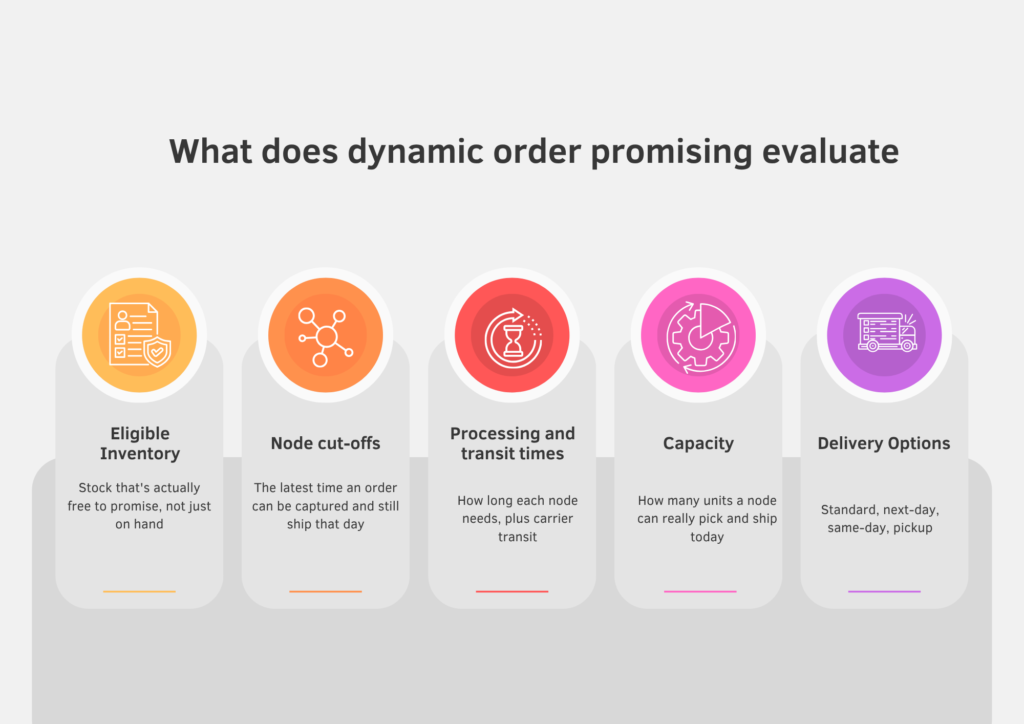
- Eligible inventory: stock that’s actually free to promise, not just on hand
- Node cut-offs: the latest time an order can be captured and still ship that day
- Processing and transit times: how long each node needs, plus carrier transit
- Capacity: how many units a node can really pick and ship today
- Delivery options: standard, next-day, same-day, pickup
Static vs. dynamic promising
Static promising reads from a fixed table: “Node A, region 3, two days.” It’s cheap and fast, and it’s wrong whenever conditions differ from the table. Dynamic promising computes the answer for this order, at this moment.
How it differs from conventional promising
Conventional promising shows padded or generic dates to stay safe. Dynamic promising shows dates based on actual conditions, so they can be both aggressive and dependable.
Why it matters
Missed promises lose repeat customers, and slow or vague dates lose conversions. In B2B channels the penalties are explicit: Walmart, for example, fines suppliers 3% of cost of goods on non-compliant orders under its on-time-in-full program. Either way, an inaccurate date has a price.
Why Is Dynamic Order Promising Hard to Fulfill?
Speed vs. accuracy
A promise must come back in well under a second, yet it reflects stock, capacity, cut-offs and carrier logic. Doing complex math in the time a page takes to load is an engineering problem before it’s a business one.
Constantly changing conditions
Inventory moves, capacity gets used up and carriers change schedules. A date that was right at 9 a.m. can be wrong at 3 p.m. IBM’s capacity documentation makes the point plainly: a fulfillment center may hold ten thousand units, but if it can only pick one hundred today, a date that ignores that is unreliable.
Many fulfillment permutations
One order can be sourced from several nodes, in one or several shipments, by different carrier services. The number of combinations grows fast, and the best answer depends on what you’re optimizing for.
Hidden constraints
Carrier cut-offs, node calendars, customer rules and node restrictions all shape the answer, and many live in people’s heads or in separate systems rather than in the promising logic.
Exploring a Real-Life Business Case
A customer asks for 30 units and needs them by Thursday. It’s Tuesday at 3:30 p.m. Four locations could serve it (illustrative figures):
| Location | Eligible units | Order eligibility | Cut-off, processing, transit | Earliest delivery | Cost |
|---|---|---|---|---|---|
|
Store A |
12 |
Partial only (12 of 30) |
5 p.m. cut-off, same-day, 1 day |
Can’t cover full order |
$6 |
|
DC South |
45 |
Full |
6 p.m. cut-off; today’s remaining capacity is 10 units, so ships Wed; 1 day transit |
Thursday |
$11 |
|
DC North |
80 |
Full |
2 p.m. cut-off already passed; ships Wed; 2 days |
Friday |
$8 |
|
DC East |
120 |
Full |
4 p.m. cut-off; ships Tue; 3 days |
Friday |
$7 |
Notice what makes this hard. DC South looks fastest on paper (cut-off not yet passed, one day of transit), but its capacity for today is mostly spent.
The Challenge: Finding the Right Delivery Commitment
Option 1: Static lead-time promise
The table says DC South is one day of processing plus one day of transit, so it promises Wednesday. But today’s capacity is gone, the order ships Wednesday, and it arrives Thursday. You’ve promised a date you can’t keep.
Option 2: Padded, conservative dates
To stay safe, you add two buffer days and promise Saturday. It’s reliable, but the customer needs it by Thursday, so you’ve lost the sale to a competitor who knew the real answer.
Option 3: Dynamic promising on real-time conditions (preferred path)
Dynamic promising calculates the commitment from live conditions. It finds that DC South can deliver on Thursday, offers that date, and books the inventory and capacity so nobody else takes them.
It’s neither the cheapest option (DC East at $7) nor the earliest-looking one. It’s the fastest feasible one that matches what the customer needs.
How Dynamic Promising Solves the Problem
Step 1: Capture the request and customer requirements
Quantity, destination, requested date, delivery option and any customer rules, all taken at the moment of the request.
Step 2: Evaluate eligible inventory across nodes
Which nodes hold enough eligible stock, after reservations and safety stock? Store A drops out here because it can only cover 12 of 30.
Step 3: Calculate feasible fulfillment and delivery options
For each eligible node, apply cut-off, processing time, capacity and transit to find the earliest feasible date. DC South gets Thursday, and DC North and DC East get Friday.
Step 4: Select the commitment that balances date reliability, cost and constraints
Not just the earliest, and not just the cheapest. Here, Thursday from DC South meets the customer’s need at $11, while the $7 option misses the deadline.
Step 5: Return the promise, then re-evaluate as conditions change
Return the date, book the stock and capacity, and keep watching. If capacity is consumed or a carrier schedule shifts, the next request sees the new reality, and true exceptions route to a person.
What are some of the decision factors
- Customer delivery expectations: the date they need, and what they’ll pay for it
- Inventory and sourcing options: which nodes can serve this order, and how many shipments it takes
- Processing, cut-off and transit times: the clock each node and carrier runs on
- Capacity constraints: what each node can actually handle today
- Cost to serve and promise reliability: how much margin you’ll trade for certainty
What are some of the business benefits
- More accurate delivery dates: promises based on how your network is really performing
- Higher conversion and customer confidence: IBM cites a 1–3% online sales increase from estimated delivery dates on listing and product pages, an estimate you should validate against your own data
- Fewer broken promises and penalties: capacity-aware dates stop warehouses drowning in commitments they can’t meet
- Better use of network capacity: demand flows to nodes with room, instead of piling up at the obvious one
- Less manual date negotiation: teams stop calling customers to renegotiate dates
We’ve seen this in practice. A global home-furnishings retailer, operating in 60+ markets with 450+ stores, worked with us on an integrated OMS with real-time inventory accuracy, optimized multi-mode fulfillment and precise order promising. The result was accurate delivery slotting across geographies. If you’re running same-day or next-day programs, our blog on same-day delivery strategies is a useful companion.
The Role of a Modern OMS
What it must do
Real-time promising, multi-node inventory visibility, constraint evaluation, continuous re-evaluation and exception management.
Where IBM SIP fits
The Promising service provides estimated delivery dates with sub-second response times, using business-defined sourcing decisions and fulfillment constraints. IBM’s documentation describes it as consuming both inventory visibility and capacity data, so a node with plenty of stock but no capacity left today is pruned from consideration. It also uses atomic booking mechanics to lock inventory and capacity together.
| What a modern OMS needs | Sterling OMS | SIP adds |
|---|---|---|
|
Real-time promising |
Basic availability |
Sub-second EDD from the Promising service |
|
Multi-node inventory visibility |
Order-level view |
Global real-time inventory view |
|
Constraint evaluation |
Sourcing rules |
Cut-offs, node calendars, transit schedules, capacity |
|
Continuous re-evaluation |
Order-level |
Capacity depletion reroutes new requests |
|
Exception management |
Order exceptions |
Explainability of sourcing decisions |
How IBM Sterling Intelligent Promising Addresses These Challenges
SIP is the decisioning layer. It evaluates inventory, capacity, cut-offs and transit together, and returns a commitment that Sterling OMS can carry into fulfillment.
The same example, walked through
- Store A can’t cover 30 units, so it’s out.
- DC South’s cut-off hasn’t passed, but its remaining capacity today is 10 units. The calculation moves the ship date to Wednesday and delivery to Thursday.
- DC North’s cut-off has passed, and DC East’s transit pushes both to Friday.
- SIP offers Thursday, books the inventory and capacity, and Sterling OMS takes the order from there.
You can also tune what the date optimizes for. IBM’s delivery objectives include minimizing the number of shipments, finding the earliest delivery, or finding the least-cost date. IBM SIP tackles other challenges such as, constraint-aware order allocation, priority-based allocation, inventory-aware allocation and smart shipment allocation.
Promising rules are only as good as the operational facts behind them: real cut-off times, honest node calendars, realistic capacity, transit data that matches your carriers. At Acuver, we help you define these rules, configure them in Sterling OMS, and connect them to your transport systems. Acuver is an IBM Sterling Order Management implementation partner and technology partner.
Ensuring Fulfillment with Dynamic Order Promising
A promise is only as good as the conditions it was built on. Dynamic order promising replaces static tables and padded buffers with a live calculation, so you can show shoppers a date that’s competitive and still keep it. In our example, the static table would have promised Wednesday and missed it, the padded one would have promised Saturday and lost the sale, and the dynamic calculation found Thursday.
If your delivery dates drift from your delivery reality, we’d love to look at where. Explore our order management consulting or talk to our team about where dynamic promising would earn its keep first.