Decoupling frontend and backend architectures has captured widespread developer attention as the definitive solution for scalability and team independence. Yet this separation brings complexities that contradict the seamless development many teams expect.
The architectural pattern creates at least two independent applications that can theoretically work autonomously. However, real-world implementation reveals substantial obstacles that surface only during development. The API Contract Paradox establishes rigid dependencies between supposedly independent layers. Logic Drift and Duplication spreads redundant code across your architecture. The Latency Tax compounds performance penalties with each service interaction. Developer Blocking creates coordination overhead that slows feature delivery.
Modern development teams are responding with re-coupling approaches that balance separation benefits against practical integration needs. These hybrid solutions acknowledge that complete decoupling isn’t always the optimal choice for every organization.
This blog explores the common misconceptions, hidden implementation challenges, and emerging hybrid approaches that will help you determine whether decoupling makes sense for your specific development context.
Common Myths About Decoupling Frontend and Backend
Misconceptions about frontend and backend separation create unrealistic expectations that lead development teams toward architectural decisions based on assumptions rather than practical requirements.
Myth: Frontend and backend can work completely independently
Can separated development layers truly operate in isolation? The appeal of autonomous development ignores fundamental coordination requirements. Backend and frontend development cannot be seen as separate areas that can be developed in isolation. Microservices are loosely coupled, not completely decoupled. They still need to communicate via APIs or messaging systems, and managing these dependencies is a key challenge.
Parallel development between frontend and backend reveals integration issues early. Without this alignment, extended features built on top of initial functionality require extensive refactoring. The coordination overhead remains substantial, contradicting the autonomous development many teams envision.
Myth: Decoupling automatically improves performance
Performance improvements through separation alone don’t materialize automatically. Resource embedding can cut response time by 75% compared to multiple round-trip requests. Teams have improved initial load times by 80% by splitting frontends strategically. However, latency between the consumer and server degrades total response time significantly, even when resource embedding techniques are used.
Myth: Decoupling is only for large organizations
Do small teams lack the resources for decoupled architecture? The decision depends on specific requirements rather than team scale. Organization size doesn’t determine architectural suitability. Matching architectural complexity to actual needs presents the real challenge. Small teams benefit from decoupling when multiple frontend channels exist, but the overhead must justify the separation costs.
Myth: One API fits all frontend needs
Single APIs serving diverse frontend consumers introduce friction rather than eliminating it. An API built in a backend silo will almost always create friction for the frontend team that has to consume it. Each frontend needs to know about the others, but too much coupling defeats the purpose of separation.
The Reality: Hidden Challenges of Decoupling
Teams adopting decoupled architectures encounter obstacles that emerge during implementation rather than design. These challenges expose gaps between theoretical benefits and practical development realities.
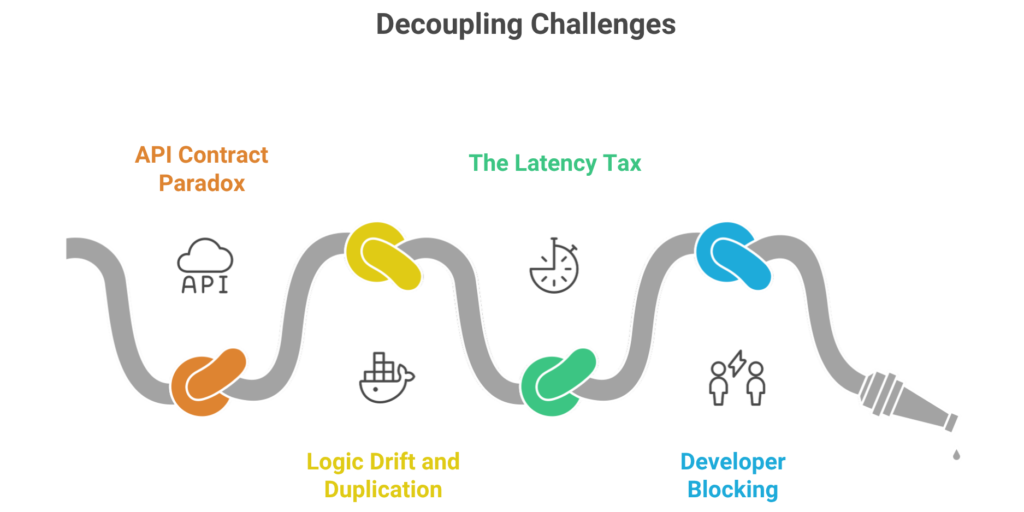
· The API Contract Paradox
An API establishes a contract between provider and consumer, and maintaining this contract’s stability proves fundamental. Breaking changes occur when API updates disrupt existing consumers, often going unnoticed until they cause failures in dependent applications. Even small, unvalidated API changes can cause major failures across dependent applications.
Without contract validation, these changes result in application crashes, integration failures, and customer impact. Your API is a contract with its consumers, and any change has the potential to break their applications.
The paradox emerges when teams realize that maintaining independence requires rigid adherence to contracts, creating the very dependencies they sought to eliminate.
· Logic Drift and Duplication
Business logic ends up duplicated across frontend and backend layers. When frontend teams want specific endpoints that return filtered data based on business rules, they face a choice: duplicate validation logic client-side or make additional API calls. Logic should not be repeated, as this tends to make systems unmaintainable.
Metric drift compounds this issue. When marketing defines metrics differently than finance, organizational trust evaporates. Without a unified semantic foundation, inconsistencies multiply across layers.
Teams discover that avoiding duplication requires coordination mechanisms that negate the independence benefits decoupling promised to deliver.
· The Latency Tax
Geographic distance between services creates compounding performance penalties. For pages making five API calls during server-side rendering, latency accumulates: same region totals 5-25ms, different EU regions reach 100-200ms, cross-Atlantic jumps to 400-600ms, and EU to Asia spans 1,000-1,500ms. API communication can introduce performance bottlenecks if not optimized.
Each additional service call multiplies the latency penalty.
· Developer Blocking and Coordination Overhead
Frontend development stops when backend APIs are slow, under development, unstable, or blocked. Waiting on the backend delays features, slows testing, and reduces productivity. Meanwhile, coordination requirements between teams building decoupled software demand active dependency management.
The blocking effect creates bottlenecks that eliminate the parallel development advantages, teams expected from architectural separation.
When Decoupling Actually Makes Sense
Specific architectural and organizational conditions justify the complexity of separating frontend and backend systems. Understanding these scenarios helps you avoid premature separation while recognizing genuine problem-solving opportunities.
Multiple frontend channels requiring same data
Content APIs enable omnichannel support when established brands need their content published into many different channels and media. Your website, iOS app, Android app, and even billboards might source content from the same central content API. A headless CMS keeps the backend independent from frontend delivery channels, making services available via APIs that all use the same underlying data.
Multi-channel e-commerce demonstrates this principle clearly. If you have a product available on both Amazon and Google Shopping, your headless API can route pricing data from a common source like a PIM, ensuring price, product descriptions, and images remain identical on both channels. Managing content with a tool that provides a content API allows you to consume that API by sites, apps, stores, and services living in various channels.
High traffic demands and scalability needs
Separate code division enables targeted performance optimization. You can increase resources for frontend and backend at different speeds since the backend needs to be ramped up at a relatively faster pace as you grow. Each component scales independently based on specific traffic and resource demands.
Independent team velocity requirements
Frontend teams can manage their own Backend-for-Frontend service independently, giving them control over language selection, release cadence, workload prioritization, and feature integration. This autonomy enables efficient operation without depending on a centralized backend development team.
Future-proofing design changes
Tool flexibility prevents vendor lock-in. You can replace the frontend without upsetting content authors, or replace the CMS without throwing the rest of your stack into the trash. Release management for code works best when decoupled from content and editorial copy release.
The Re-coupling Trend: Finding the Middle Ground
Modern development teams are stepping back from complete separation, choosing hybrid approaches that balance architectural benefits against implementation complexity.
What is progressive decoupling?
Progressive decoupling allows you to continue using your CMS rendering system while simultaneously using a JavaScript framework to power client-side interactivity. Content editors and site assemblers maintain contextualized interfaces, content workflow, and site preview features. Frontend developers dedicate portions of pages to JavaScript frameworks, pursuing their own velocity while keeping site assemblers unblocked.
The approach targets specific high-impact sections like product pages while keeping other areas intact. This selective separation addresses performance bottlenecks without introducing full architectural complexity across your entire application.
Server components and hybrid approaches
Hybrid rendering: Combines server and client rendering strengths. Partial hydration only makes specific interactive components client-side, minimizing JavaScript payload. React Server Components render entirely on the server without sending their JavaScript to client, dramatically reducing bundle sizes.
Streaming SSR: Sends HTML in chunks as it generates, so users see content immediately rather than waiting for complete page rendering. This approach reduces perceived load times while maintaining server-side benefits.
Micro-frontends as partial decoupling
Micro-frontends decompose frontend monoliths into independently deliverable applications that compose into a cohesive product. The architecture delivers several advantages:
- Smaller codebases become more maintainable
- Teams gain autonomy over their specific domains
- You can upgrade parts incrementally without affecting the entire system
Evaluating your actual needs vs trends
Match architectural complexity to genuine requirements. Progressive approaches avoid the distributed monolith trap while delivering targeted improvements where they matter most. Consider your team size, traffic patterns, and development velocity before choosing separation strategies.
The key question isn’t whether to decouple, but where and how much decoupling serves your specific context.
Choosing the Right Level of Decoupling
Decoupling frontend and backend architectures appeals to development teams seeking scalability and independence, yet the separation creates substantial challenges that often outweigh the theoretical advantages. The implementation realities—rigid API contracts, duplicated logic, performance penalties, and coordination overhead—contradict the seamless development experience many teams expect.
The decision to decouple should stem from genuine architectural requirements rather than industry trends. Multiple frontend channels consuming shared data, significant traffic demands requiring independent scaling, or team velocity constraints that justify the coordination complexity represent valid use cases. Otherwise, the overhead rarely justifies the separation.
At Acuver, our progressive decoupling and hybrid approaches offer practical alternatives that capture specific benefits without full architectural commitment. These solutions acknowledge that complete separation isn’t always optimal, allowing teams to address targeted problems while maintaining development efficiency.
We believe that your architectural choices should solve actual problems rather than follow popular patterns. Our approaches include evaluating your specific context, traffic requirements, team structure, and technical constraints before committing to decoupled architectures. We ensure that implementations match complexity to genuine needs, avoiding both premature optimization and unnecessary coordination burdens.
Contact our team of experts today for more information.