Users expect quick responses, intuitive interfaces, and reliable data processing across every touchpoint. This expectation makes Unified UI essential in modern application development. Frontend and backend systems operating independently create significant obstacles to delivering this unified experience. Integration between these elements becomes critical for consistent user experience, yet fragmented architectures produce inconsistent interfaces, performance bottlenecks, and maintenance challenges.
The Backend for Frontend (BFF) pattern addresses these architectural challenges directly. BFF creates dedicated backend services for each frontend interface, enabling channel consistency, performance optimization, and centralized governance. Unified UI and BFF function as strategic partners rather than separate components—together they deliver the cohesive, high-performing experiences users’ demand.
The Foundation: What makes Unified UI and BFF Strategic Partners
Unified UI explained
Unified UI creates a cohesive framework that standardizes user interface components across applications. This framework establishes design principles, reusable components, consistent interaction patterns, and shared development practices that govern interface creation throughout an application ecosystem. Responsive web design principles ensure optimal viewing and interaction experiences across screen sizes, devices, and orientations. Users receive similar experiences whether they access applications through browsers, tablets, or phones. Without this architecture, UI fragmentation occurs—different application parts look and behave differently, creating user confusion and development team maintenance challenges.
Backend for Frontend pattern overview
The Backend for Frontend (BFF) pattern establishes one backend per user experience rather than relying on a single general-purpose API backend. Sam Newman introduced this architectural approach where applications maintain dedicated backends for each user experience.
The BFF couples tightly to specific user experiences and typically gets maintained by the same team managing the user interface. This arrangement simplifies API definition and adaptation based on UI requirements while streamlining client and server component release coordination.
The Natural Synergy Between Unified UI and BFF
Strategic partnership between Unified UI and BFF stems from complementary objectives. Unified UI standardizes presentation layers across channels while BFF provides architectural foundations for delivering tailored data to each interface without compromising consistency. The BFF pattern customizes client experiences for specific interfaces without affecting other interfaces, optimizing performance to meet frontend environment needs. Frontend teams manage their own BFF services independently, controlling language selection, release cadence, workload prioritization, and feature integration. This autonomy enables efficient operations without depending on centralized backend development teams. The BFF translates generic data models from backend services into formats optimized specifically for frontends.
How BFF Enables True Unified UI
BFF creates purpose-built pathways for each client type, addressing the challenge of serving diverse frontend needs without compromising unified experiences. This architectural approach transforms how data reaches different interfaces.
· Tailored data delivery for each interface
Frontend requirements vary dramatically in data structures and payload sizes. Mobile applications need compact API responses with just product name, price, and image, whereas web applications demand detailed product views including reviews, specifications, and seller information. Admin dashboards require additional APIs for stock levels, margins, and supplier details.
The BFF layer customizes API responses to suit the data and format requirements of the specific frontend it serves.
Streaming platforms illustrate this clearly: TV apps need high-quality video URLs, mobile apps require adaptive video streams with subtitles, and web apps display trailers, recommendations, and cast information.
· Eliminating frontend data processing overhead
BFF aggregates multiple microservice calls into one response, eliminating the need for frontends to call separate endpoints and merge data.
The BFF produces render-ready JSON objects, moving the complexity of building a consumer into a central service that can be reused by all consumers. Frontend applications become “dumb clients” that simply process incoming requests, determine which screen to grab from the BFF, and render components without handling complex data aggregation.
· Supporting persona shaping through customized backends
Different user personas require isolated data access patterns. Banking applications demonstrate this principle: customer apps show account balance and transactions, whereas employee dashboards display risk scores, customer details, and compliance flags. The BFF ensures customers never accidentally see employee-only fields, creating security boundaries tailored to each persona type.
· Maintaining consistency through centralized backend logic
Centralizing client-specific logic eliminates inconsistencies between different frontends, reducing bugs, and lowering development costs. Business rules, validation policies, and error handling work identically everywhere when requests flow through the same governed entry point.
Strategic Benefits that make them Inseparable
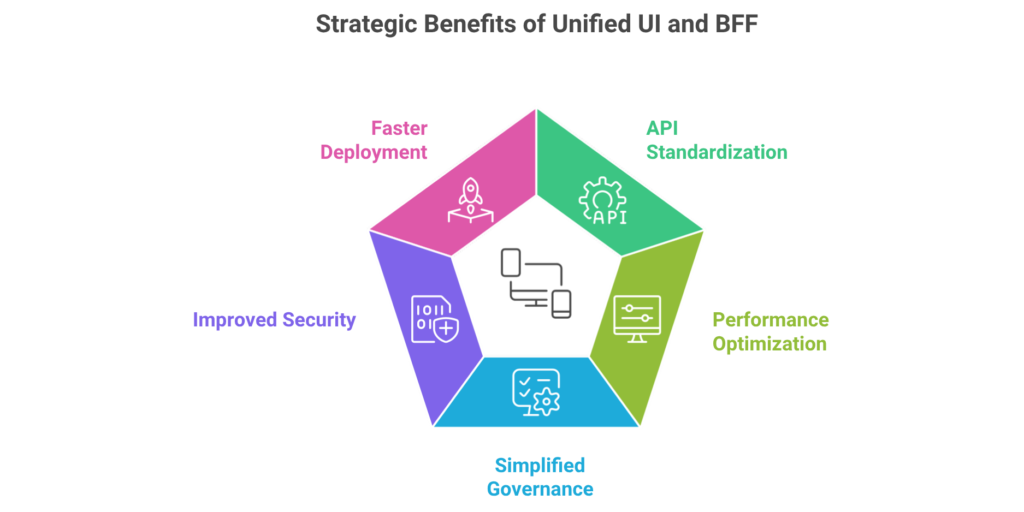
Unified UI and BFF create strategic value when they function as a combined system. The partnership delivers measurable advantages that neither pattern achieves independently.
· API standardization across all channels
BFF creates a single, tailored API surface that accelerates frontend development. The pattern establishes unified response formats across diverse backend services, eliminating inconsistencies that affect applications consuming multiple microservices directly. Frontend teams work with one standardized contract per channel rather than managing dozens of varying API schemas.
· Performance optimization for different devices
The BFF layer reduces client-side network usage through single network calls between client and server, building payloads that match specific client needs and limiting over-fetch overheads. Multiple device types access the backend simultaneously. Browsers make requests to the browser BFF while mobile devices access their optimized endpoints, obtaining faster responses from services.
· Simplified governance and maintenance
Separation of concerns: Frontend requirements stay distinct from backend concerns, simplifying maintenance. Centralized error handling at the BFF level reduces client-facing issues. Server errors that mean nothing to frontend users get mapped to appropriate user-facing messages, improving experience. Different application parts can be handled by separate teams efficiently.
· Improved security through abstraction
Sensitive information stays hidden, and unnecessary data gets omitted when sending responses to frontends. API keys, tokens, and sensitive logic remain in the BFF layer, never exposed to clients. This abstraction makes applications harder for attackers to target.
· Faster development cycles
Frontend teams gain ownership of both their client application and underlying resource consumption layer, creating high development velocities. Teams can work on separate BFFs for each frontend, accelerating development and reducing conflicts.
Real-world Scenarios where Separation Fails
Architectural decisions show their true impact through failure patterns. Serving multiple frontends without the BFF pattern creates predictable, recurring problems that damage both performance and user experience.
· When single API gateway falls short
General-purpose API backends cannot address the specific requirements of diverse client ecosystems. The one-size-fits-all approach forces mobile apps on limited networks to download unnecessary payloads through over-fetching, while constructing complete views requires multiple endpoint calls, increasing network latency through under-fetching.
· The cost of inconsistent user experiences
Frontend and backend deployments rarely align perfectly. Backend systems go live first, frontend implementations lag behind, and users encounter 404 errors or mismatched payloads.
For example, the interface might expect a piece of information in one format, but the backend changes how that information is provided. When this happens, certain parts of the interface may appear blank or stop working properly. The issue can become worse when older versions of the interface are still cached, while the backend has already updated its responses.
· Latency issues without BFF layer
Each additional layer without BFF introduces potential latency that degrades application performance. Resource consumption grows as running extra services demands computational resources.
· Challenges of managing multiple frontends independently
Managing ten frontends requires maintaining ten separate codebases. Code duplication becomes unavoidable when multiple systems support different frontend clients. Synchronization problems arise as keeping data models aligned across multiple layers becomes increasingly difficult.
Building Scalable Systems with Unified UI and BFF
Unified UI and BFF represent strategic necessities that operate as one system rather than optional complements. Implementation of both patterns delivers consistent user experiences, optimized performance across devices, and simplified governance that neither achieves independently. Separating them creates fragmented interfaces, bloated frontends, and maintenance challenges—the exact problems they solve together.
Organizations should treat them as inseparable partners from project inception rather than retrofitting BFF when performance bottlenecks emerge. This approach prevents architectural debt and ensures scalable, maintainable systems that meet user expectations across all touchpoints.
Enabling this transformation is Acuver’s Aekyam, an AI Orchestration Platform, meant to unify systems, apps and platforms creating a centralized operational layer that powers a Unified UI. By orchestrating workflows and enabling seamless communication between services, Aekyam ensures that the BFF layer can access reliable, real-time information across the enterprise.
Beyond integration, Aekyam adds intelligence to the architecture. Its orchestration capabilities help automate workflows, surface insights across systems, and enable smarter decision-making through a single operational view. This allows organizations to move from siloed applications to a connected environment where teams can monitor, manage, and optimize operations from one unified interface.
Together, Unified UI, BFF, and Aekyam create a scalable architecture that simplifies complexity behind the scenes while delivering seamless digital experiences to users. This unified approach enables organizations to build systems that are not only efficient today, but also resilient and adaptable for the future.