Why Do Most Businesses Not Decide to Get an OMS Until They Hit a Breaking Point?
Most businesses do not decide to get an OMS on their own. They wait until daily problems force the decision for them. This happens for a simple reason. Getting an OMS is a big investment, and it is easy to keep putting it off while the old process still, barely, works.
To know what an OMS is and how it can benefit your business read our blog titled, What Is an Order Management System? The Complete Guide for Modern Businesses.
An OMS costs real money, and it also costs real time. A business has to pick the right platform. It has to connect that platform to every existing tool. It has to move years of order and customer data into the new system. None of this happens overnight.
For a closer look at what an OMS actually involves day to day, read our blog titled, How Does an Order Management System Work?
Employees also need to be trained properly once the system is in place. A powerful OMS does very little good if staff still fall back on old habits. Many keep tracking orders in a spreadsheet on the side out of pure habit. Training takes time away from daily work. Because of this, many businesses delay the whole project until the pain of not having an OMS becomes too large to ignore.
Types of OMS Based on Business What Do the Signs Look Like?
The signs that a business needs an OMS usually show up in four areas: daily operations, growth, customer experience, and financial reporting. Each area sends its own warning signals, and they tend to get louder over time rather than fading on their own.
Operational Signs
- Manual order entry errors keep increasing
- Overselling or stockouts happen across channels
- Staff spend hours reconciling orders across spreadsheets and platforms
- Fulfillment delays keep creeping up
Growth Related Signs
- Adding new sales channels, such as a marketplace, retail store, or wholesale account, and struggling to keep up
- Expanding into new warehouses, regions, or third party logistics partners
- Order volume that is outpacing what current tools can handle
Customer Experience Signs
- Rising complaints about order status, wrong shipments, or delayed delivery
- An inconsistent experience across channels, such as online orders working smoothly while in store pickup does not
Financial and Reporting Signs
- Inventory carrying costs creeping up due to poor visibility into what is actually in stock
- No way to get a unified view of sales and inventory data for decision making. However, AI powered OMS platforms are increasingly built to solve exactly this problem. Read our blog titled, How Is AI Changing the OMS Scene? to see what’s possible.
A Self Assessment Checklist
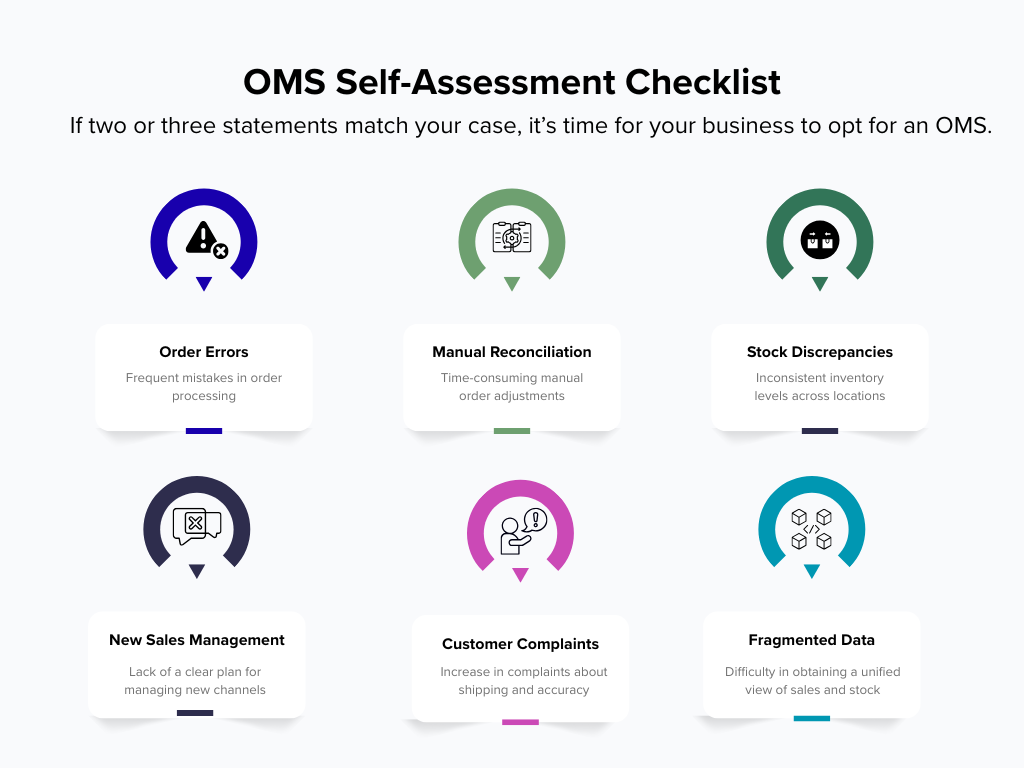
A simple checklist can help a business gauge how urgent the problem has become. Read through the list below and count how many statements sound familiar.
- Order errors happen at least a few times a week
- Staff spend more than a few hours a week reconciling orders by hand
- The business has stock discrepancies across more than one location
- A new sales channel was added in the past year without a clear plan for managing its orders
- Customer complaints about shipping or order accuracy have gone up recently
- No one on the team can pull a single, accurate view of sales and stock without checking several systems first
A business that matches two or three of these statements should start planning for an OMS soon. A business that matches four or more is likely already losing time and money to the problem every single day. Choosing the right kind of OMS as per your business needs is also a crucial part of the planning process. For a detailed insight into the types of OMS, read our blog titled, What are the different types of Order Management Systems?
What Happens If These Signs Are Ignored?
Ignoring these signs leads to real, measurable costs, not just daily frustration. The longer a business waits, the more these costs tend to compound.
Lost sales are often the first cost to show up. Overselling and stockouts send customers straight to a competitor. Many of them do not come back to check again. Customer churn follows close behind. Shoppers who deal with wrong shipments or late deliveries tend to quietly stop ordering rather than complain. Staff burnout builds quietly in the background too. Employees who spend their days reconciling spreadsheets and chasing down order errors have less time and energy for work that actually helps the business grow.
The Cost of Waiting Is Often Higher Than the Cost of Change
It is natural to see an OMS as an expense to delay. Still, the cost of staying with the current process is usually higher. Every week without an OMS adds more manual work, more errors, and more frustrated customers to the pile. A business that switches early avoids months, sometimes years, of these hidden costs stacking up. The investment in an OMS often pays for itself simply by removing the daily waste that manual processes create.
Waiting for a breaking point is not a strategy. It is simply what happens when a business puts off a decision for too long. The businesses that come out ahead are the ones that act on these signs early, before lost sales and burned out staff become the norm rather than the exception. Once you have confirmed the signs apply to you, the next step is getting the rollout right. Read our blog on the best practices to implement an OMS, to avoid the most common early mistakes.
Acuver Consulting helps businesses spot these signs early and move on them with confidence. Its team reviews how a business currently handles orders, points out exactly where the cracks are forming, and recommends an OMS setup built around that business rather than a generic template. From the first assessment through full implementation, Acuver stays involved so a business never has to guess whether it made the right call.
Connect with Acuver’s team of experts to know if your business needs an OMS.