In What Way Is AI Driving a Shift in Order Management, From Rules-Based Automation to Intelligent Decision-Making?
AI is driving this shift by giving an OMS the ability to make judgment calls. Older systems could only follow fixed rules. If a rule did not cover a situation, the system got it wrong or passed the problem to a person.
For a complete breakdown of what an OMS actually is, read our blog titled What is an OMS? The Comprehensive Guide for Modern Businesses.
AI changes this by letting the system learn from patterns in real data. It can weigh several factors at once. It can adjust to new conditions. It can improve its own decisions over time. This shows up in a few clear ways.
- It predicts demand instead of just reacting to orders as they arrive
- It chooses the smartest fulfillment path instead of following one fixed routing rule
- It spots unusual patterns on its own, instead of waiting for a person to notice them
- It answers questions in plain language, instead of requiring someone to build a report
AI-Powered Demand Forecasting
AI improves demand forecasting by looking at far more data than a person or a simple spreadsheet ever could. Traditional forecasting often relies on last year’s sales, adjusted a little by gut feeling. AI based forecasting looks at seasonal trends, local events, marketing campaigns, and weather, all at the same time.
This has a direct impact on inventory planning. A business that forecasts demand more accurately can order the right amount of stock instead of guessing. This cuts down on stockouts, where popular items run out at the worst moment. It also cuts down on overstock, where cash sits tied up in items that stay on a shelf for months. These are some of the classic warning signs that a business has outgrown manual processes, for a full breakdown, read our blog on the signs to know your business needs an OMS.
Intelligent Order Routing and Warehouse Allocation
AI improves order routing by weighing several factors at the same time. Older systems often follow one fixed rule, like always shipping from the nearest warehouse.
To understand how an OMS handles these processes step by step, read our blog titled How Does an Order Management System Work?
A smart routing engine looks at shipping cost, delivery speed, and current inventory position together. It then picks the option that best fits that specific order.
This has a real, measurable impact. Businesses that use dynamic routing often see lower shipping costs, since orders are not always sent from the closest location if a farther one is cheaper or better stocked. Delivery times also tend to improve. The system can react to a warehouse running low on stock in real time, rather than a person catching the problem after an order has already failed.
Anomaly Detection
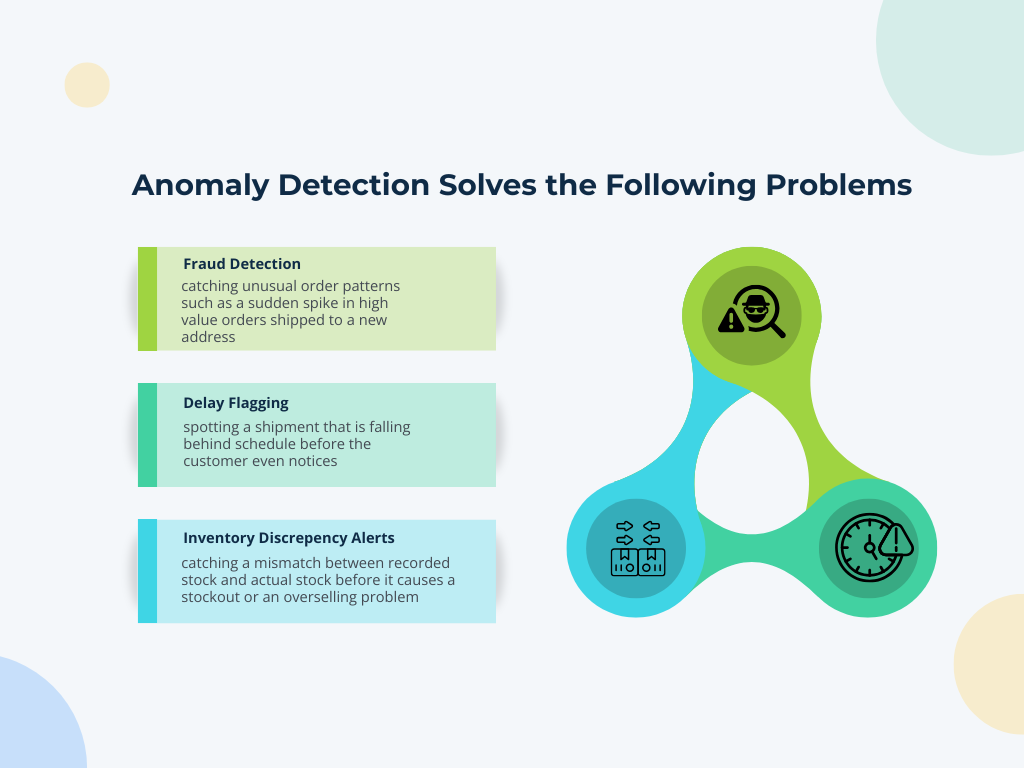
AI supports anomaly detection by scanning order patterns constantly and flagging anything that looks out of the ordinary. This covers a few different kinds of problems.
- Fraud detection, catching unusual order patterns such as a sudden spike in high value orders shipped to a new address
- Delay flagging, spotting a shipment that is falling behind schedule before the customer even notices
- Inventory discrepancy alerts, catching a mismatch between recorded stock and actual stock before it causes a stockout or an overselling problem
The value here is speed. A human team checking reports once a day might catch a problem after it has already affected several orders. An AI system watching in real time can flag the same problem within minutes.
Predictive Returns Management
AI supports predictive returns management by estimating how likely an order is to be returned, right at the point of sale. It looks at product category, size and fit history, and a customer’s past return behavior to build this prediction.
This prediction opens the door to proactive strategies. A business can adjust sizing guidance for items with a high return risk. It can flag certain products for better photos or clearer descriptions. It can also route high risk orders through a lighter, faster return process. Over time, this steadily brings the overall return rate down, instead of just processing returns after they happen.
Natural Language Interfaces for Order Queries
AI supports order queries by letting people ask questions in plain language instead of building a report or clicking through a dashboard. A customer service agent can simply ask where an order is. The system responds right away with a clear answer.
This reduces a business’s dependency on dashboards and manual reporting. Internal teams no longer need to wait for someone to pull a spreadsheet together. Customer service teams can answer questions faster, since they are not switching between several screens to find one piece of information.
The Road Ahead: Agentic OMS and Autonomous Fulfillment
The road ahead points toward agentic OMS platforms. Here, the system does more than suggest an action. It takes the action on its own and adjusts course as conditions change, much like a skilled employee would.
In this context, agentic means the system can set a goal, choose a path to reach it, and adapt that path without waiting for approval at every step. This differs from today’s automation, which mostly follows steps a person already defined in advance.
It helps to separate the realistic timeline from the hype. Fully autonomous fulfillment, where a system runs an entire operation without any human oversight, is still some way off for most businesses. What is available now, and improving quickly, are systems that handle specific decisions on their own, such as routing or fraud checks, while a person still oversees the bigger picture.
Businesses that want to prepare should start now. Clean, well-organized data is the foundation every AI feature depends on. Clear, documented processes make it easier to hand a task over to AI later. Staff who already work alongside automation will adapt faster once that automation becomes more independent.
For a step-by-step approach to getting your systems and teams ready, read our blog on What Are the Best Practices to Implement an OMS.
What Are the Risks and Considerations of AI in Order Management?
The biggest risk with AI in order management is poor data quality. AI accuracy depends entirely on the data it learns from. A system trained on messy or outdated data will make confident predictions that are simply wrong. Clean data is not optional. It is a prerequisite for AI to work at all.
Over-automation is the second major risk. Handing every decision to AI without human oversight can let small errors turn into large ones before anyone notices. The businesses that get the best results keep a person reviewing key decisions, while trusting AI to handle the repetitive work that does not need a judgment call.
The Future of Order Management Is Intelligent, Not Just Automated
Automation alone was always about doing the same task faster. Intelligence is about doing the right task in the first place. As AI becomes a bigger part of order management, the businesses that benefit most will be the ones that use it to make better decisions, not just faster ones.
Adding AI to an OMS is not simply a matter of turning on a feature. It requires clean data, a clear view of which decisions are worth automating, and a rollout plan that keeps people in control where it matters most.
Acuver Consulting helps businesses bring AI into their order management operations in a practical, grounded way. Its team assesses data readiness, identifies where AI can have the biggest impact first, such as routing or demand forecasting, and helps implement these capabilities without disrupting daily operations.
Connect with Acuver’s team of experts to start revolutionizing your order management operations using AI.