What Is Omnichannel Order Management?
Omnichannel order management means tracking and fulfilling orders across every sales channel, using one connected system.
A customer might order on your website. They might pick up in-store. They might return an item through an app. Omnichannel order management makes sure all of this runs smoothly. It links your stock, your systems, and your fulfilment process into one clear view.
Without this link, teams check many screens. They guess at stock levels. They fix mistakes by hand.
If you’re new to the concept, our comprehensive guide on what an order management system is breaks it down from the ground up.
Why Is Order Management Hard for Omnichannel Teams?
Order management is hard because teams juggle many systems that don’t talk to each other.
A typical retailer might use a website platform, a point-of-sale system, a warehouse tool, and a marketplace like Amazon. Each system holds its own version of stock and order data. When these systems don’t sync in real time, problems follow fast:
- Customers order items that are actually out of stock
- Warehouses send the wrong item or the wrong amount
- Returns take days to process, since no one has full visibility
- Staff spend hours re-typing data between systems by hand
These issues don’t just slow teams down. They cost real money. They hurt customer trust too. If these problems sound familiar, your business may already be ready for a dedicated system. Check our blog on the signs your business needs an OMS to see how many apply to you.
How Does AI Improve Order Management?
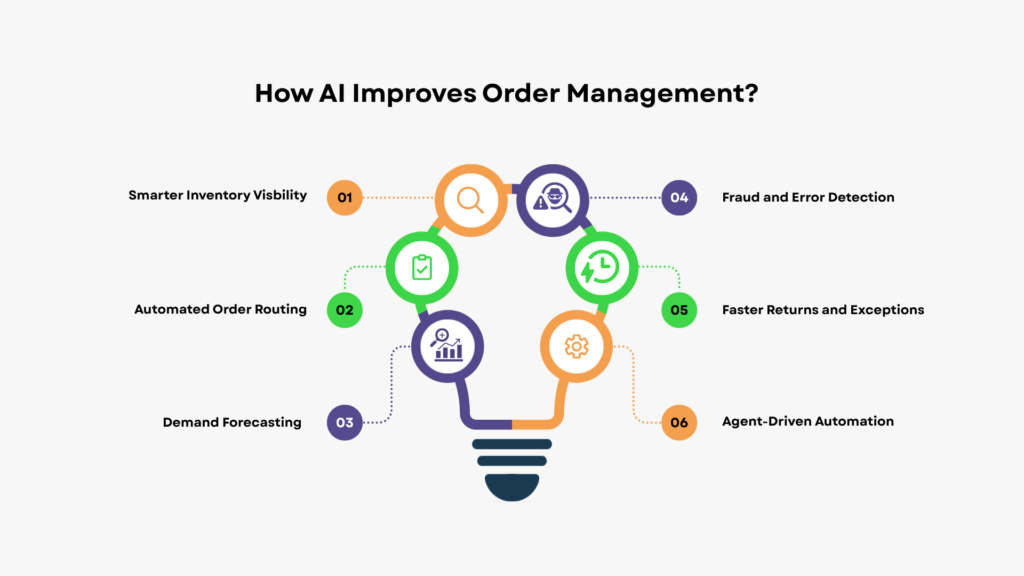
AI improves order management by spotting problems early, automating routine decisions, and keeping every channel in sync in real time.
Staff no longer need to check stock by hand or route orders one by one. AI handles this work on its own, using live data. For a closer look at that foundation, see our blog on how an order management system works. Here’s how that plays out:
- Smarter Inventory Visibility
AI pulls real-time data from every channel and warehouse. This gives teams one true view of stock. No more outdated numbers spread across separate systems.
- Automated Order Routing
AI picks the fastest, cheapest way to fill each order. It might choose the nearest store. It might pick the fullest warehouse. It might pick the cheapest shipping route. All of this happens without human input.
- Demand Forecasting
AI studies past sales patterns. It uses this to predict future demand. This helps teams stock the right amount, in the right place, before a rush hits.
- Fraud and Error Detection
AI flags odd orders. A sudden bulk purchase. A mismatched shipping address. It catches these before they turn into costly mistakes.
- Faster Returns and Exceptions
AI can approve simple returns on its own. It flags tricky cases for a person to review. It updates stock the moment a return gets scanned.
- Agent-Driven Automation
Modern platforms go further with AI agents. These agents can run full order tasks on their own. They check stock. They update customers. They stay in sync through orchestration, so nothing slips through the cracks.
What Are the Business Benefits of AI in Order Management?
The biggest benefits are fewer errors, faster fulfilment, lower costs, and happier customers.
Here’s what that looks like in practice:
- Fewer stockouts and overselling. Real-time stock data means customers rarely order something you don’t have.
- Faster order-to-delivery times. Automated routing sends orders to the fastest fulfillment point.
- Lower labor costs. Staff spend less time on manual entry and error fixes.
- Better customer experience. Accurate stock, fast delivery, and easy returns build trust and repeat business.
- Better decisions. Leaders get live dashboards instead of old weekly reports.
How Can Retailers Start Using AI for Order Management?
Retailers should start small. They should connect core systems first, then grow AI use case by case.
A simple path looks like this:
- Map your current systems. Find every platform that touches order data. This means your website, your POS, your warehouse tool, and any marketplaces.
- Connect them into one data layer. AI needs clean, live data to work well. Integration comes before automation. Still weighing your options? Our guide on the different types of order management systems can help you find the right fit.
- Start with one high-impact use case. Stock visibility or order routing are common starting points.
- Add AI agents step by step. Once the basics work, move into demand forecasting, fraud checks, and automated returns.
- Keep people in the loop. Let AI handle routine choices. Let staff review exceptions and high-value orders.
For a deeper, step-by-step rollout plan, read our guide on best practices to implement an order management system.
AI Turns Order Management Into a Competitive Advantage
Order management used to sit in the background. Now it’s a competitive edge. AI helps omnichannel teams see their stock clearly. It helps them fill orders faster. It helps them catch problems before customers ever notice.
Teams that adopt AI early will ship orders faster. They will spend less on manual fixes. They will build stronger customer loyalty. Teams that wait will keep fighting the same stock and shipping problems, year after year.
Acuver Consulting is a supply chain consulting firm, built around order management, warehouse management and software engineering. Acuver helps by combining deep order management expertise with the technology to make AI-driven fulfillment work in the real world.
For omnichannel teams ready to move from manual order management to a connected, AI-driven process, Acuver offers both the strategy and the hands-on delivery to make that shift practical. To explore your options, connect with our team of experts.